Ricciuti Biagio, Naqash Abdul Rafeh, Naidoo Jarushka, Sehgal Kartik, Miller Adam, Kehl Kenneth, Venkatraman Deepti, Sands Jacob, Lamberti Giuseppe, Recondo Gonzalo, Zhang Jiajia, Macherla Shravanti, Baig Sameer, Walker Paul, Rangachari Deepa, Gainor Justin F, Costa Daniel B, Rizvi Naiyer, Sholl Lynette M, Nishino Mizuki, Henick Brian, Farago Anna F, Awad Mark M
Lowe Center for Thoracic Oncology, Dana-Farber Cancer Institute, Harvard Medical School, Boston, Massachusetts.
Division of Hematology/Oncology, East Carolina University, Greenville, East Carolina.
JTO Clin Res Rep. 2020 Jul 15;1(4):100074. doi: 10.1016/j.jtocrr.2020.100074. eCollection 2020 Nov.
The development of immune-related adverse events (irAEs) has been associated with improved efficacy of immune checkpoint inhibitors in patients with urothelial cancer, melanoma, and NSCLC. Whether this association exists in patients with SCLC is currently unknown.
We conducted a multicenter retrospective study to evaluate the relationship between irAEs and immunotherapy efficacy in SCLC. To account for the lead-time bias resulting from the time-dependent nature of irAEs, the development of irAEs was considered as a time-varying covariate in univariate and multivariate Cox proportional hazard models.
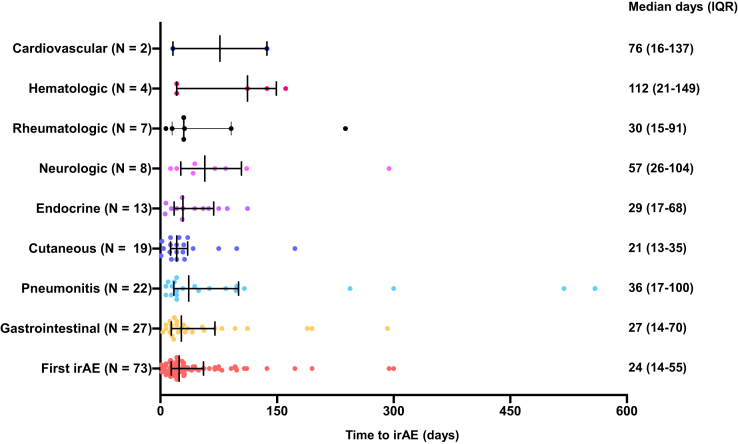
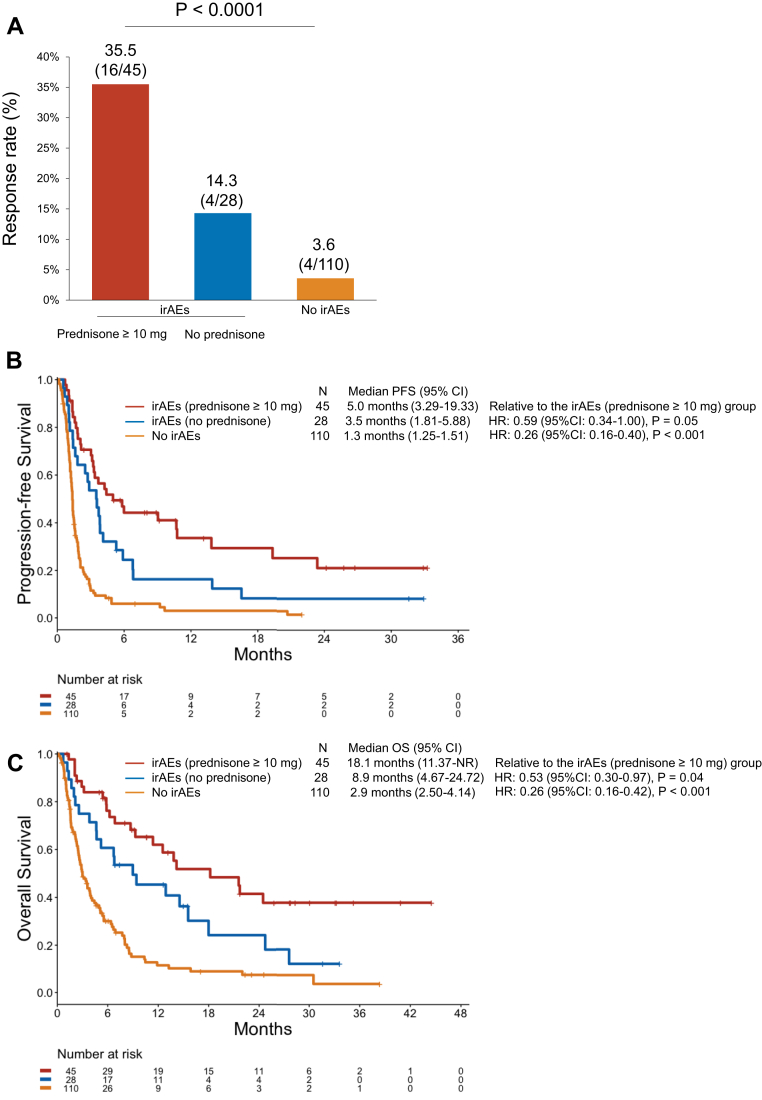
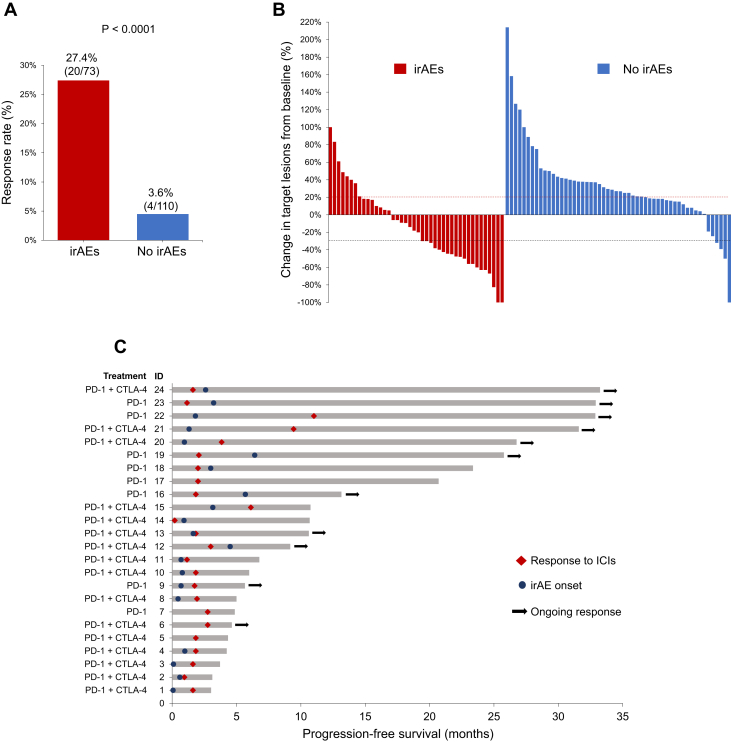
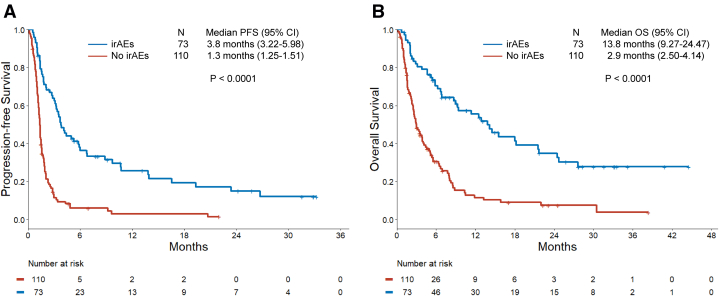
Of the 183 patients treated with immunotherapy, 73 (39.9%) experienced at least one irAE. A total of 42 patients (22.9%) had grade 1 to 2 irAEs, whereas 31 patients (16.9%) had grade 3 to 4 irAEs. The median time of onset to the first irAE was 24 days (interquartile range: 14-55). The baseline clinicopathologic features were well-balanced between patients with and without irAEs. At a median follow-up of 24 months (95% confidence interval [CI]: 17.0-31.6), the median progression-free survival was significantly longer in the irAE group than the non-irAE group (3.8 versus 1.3 mo, < 0.0001). The median overall survival was also significantly longer among patients with irAEs than patients without irAEs (13.8 versus 2.9 mo, < 0.0001). When analyzed as a time-varying covariate, the development of irAEs was associated with a significant improvement in progression-free survival (hazard ratio: 0.44 [95% CI: 0.29-0.66], < 0.001) and overall survival (hazard ratio: 0.47 [95% CI: 0.32-0.71], < 0.001) in multivariate models.
The development of irAEs is associated with improved clinical outcomes for immunotherapy in patients with advanced SCLC.
免疫相关不良事件(irAEs)的发生与免疫检查点抑制剂在尿路上皮癌、黑色素瘤和非小细胞肺癌(NSCLC)患者中的疗效改善有关。目前尚不清楚这种关联在小细胞肺癌(SCLC)患者中是否存在。
我们进行了一项多中心回顾性研究,以评估SCLC患者中irAEs与免疫治疗疗效之间的关系。为了考虑由irAEs的时间依赖性导致的领先时间偏倚,在单变量和多变量Cox比例风险模型中,将irAEs的发生视为一个随时间变化的协变量。
在183例接受免疫治疗的患者中,73例(39.9%)经历了至少一种irAE。共有42例患者(22.9%)发生1至2级irAEs,而31例患者(16.9%)发生3至4级irAEs。首次出现irAE的中位时间为24天(四分位间距:14 - 55天)。有和没有irAEs的患者之间基线临床病理特征均衡。在中位随访24个月(95%置信区间[CI]:17.0 - 31.6)时,irAE组的中位无进展生存期显著长于非irAE组(3.8个月对1.3个月,<0.0001)。有irAEs的患者的中位总生存期也显著长于没有irAEs的患者(13.8个月对2.9个月,<0.0001)。当作为随时间变化的协变量进行分析时,在多变量模型中,irAEs的发生与无进展生存期(风险比:0.44[95%CI:0.29 - 0.66],<0.001)和总生存期(风险比:0.47[95%CI:0.32 - 0.71],<0.001)的显著改善相关。
irAEs的发生与晚期SCLC患者免疫治疗的临床结局改善相关。