Perelman School of Medicine at the University of Pennsylvania, Philadelphia, PA, USA.
HVH Precision Analytics LLC, Wayne, PA, USA.
Arthritis Res Ther. 2021 Oct 1;23(1):252. doi: 10.1186/s13075-021-02628-2.
The occurrence of health events preceding a psoriatic arthritis (PsA) diagnosis may serve as predictors of diagnosis. We sought to assess patients' real-world experiences in obtaining a PsA diagnosis.
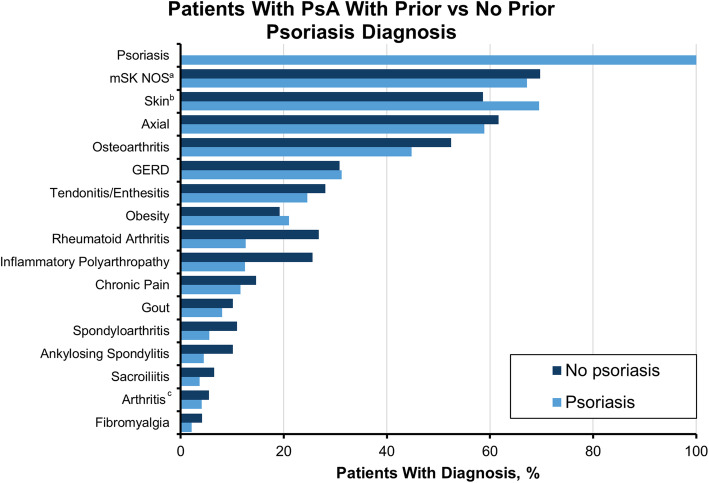
This retrospective cohort study analyzed MarketScan claims data from January 2006 to April 2019. Included were adult patients with ≥ 2 PsA diagnoses (ICD-9-CM/ICD-10-CM) ≥ 30 days apart with ≥ 6 years of continuous enrolment before PsA diagnosis. Controls were matched 2:1 to patients with PsA. Health events (diagnoses and provider types) were analyzed before PsA diagnosis and additionally stratified by presence of psoriasis.
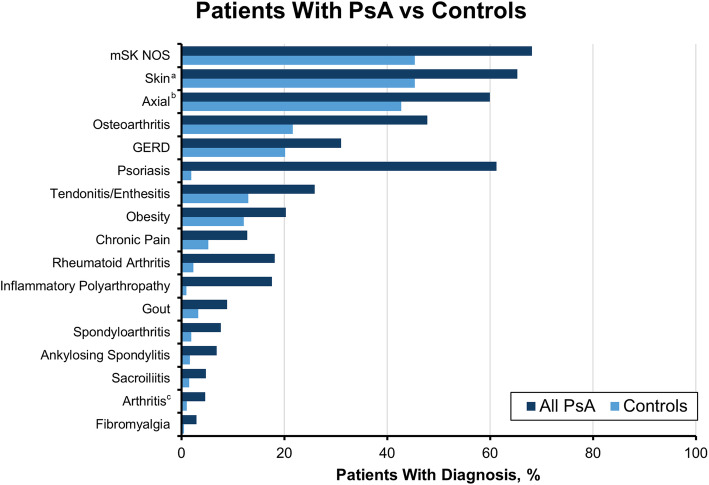
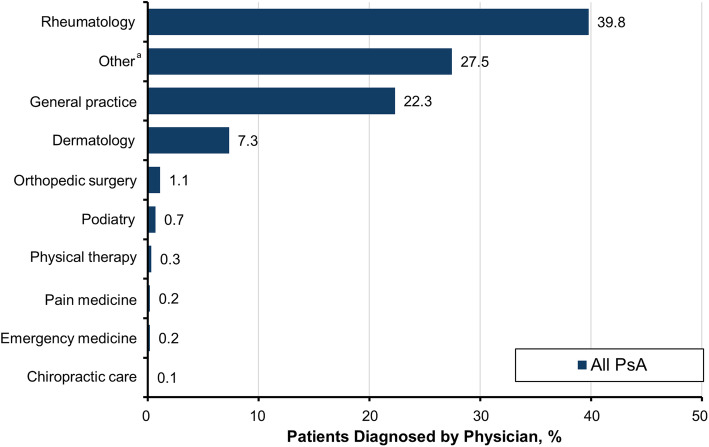
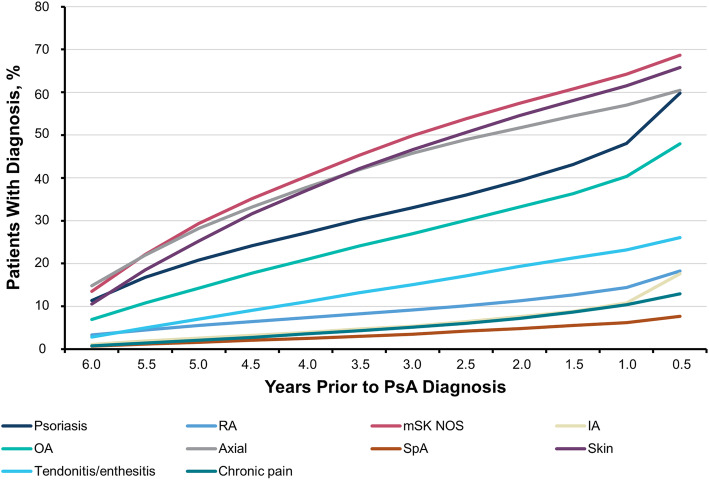
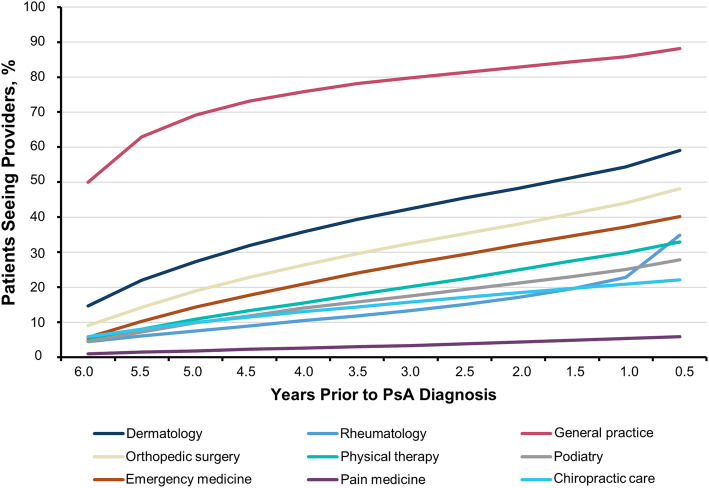
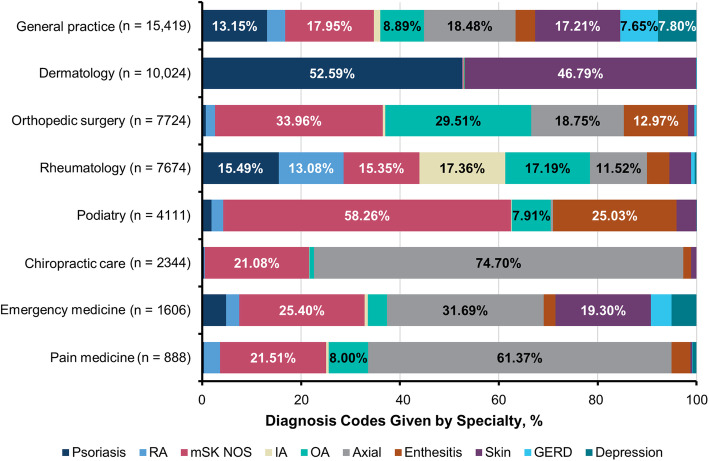
Of 13,661 patients, those with PsA had an increased history of coding for arthritis and dermatologic issues (osteoarthritis [48% vs 22%], rheumatoid arthritis [18% vs 2%], and psoriasis [61% vs 2%]) vs those without PsA. Diagnoses of arthritis, axial symptoms, and tendonitis/enthesitis increased over time preceding PsA diagnosis; notably, a sharp rise in psoriasis diagnoses was observed 6 months before PsA diagnosis. Rheumatology consults were more common immediately preceding a PsA diagnosis. Dermatologists were unlikely to code for arthritis and musculoskeletal issues, while rheumatologists were unlikely to code for psoriasis; general practitioners focused on axial and musculoskeletal symptoms. PsA was most commonly diagnosed by rheumatologists (40%), general practitioners (22%), and dermatologists (7%).
Rheumatologists, general practitioners, and dermatologists diagnosed two thirds of patients with PsA. Musculoskeletal symptoms were common preceding a PsA diagnosis. Greater awareness of patterns of health events may alert healthcare providers to suspect a diagnosis of PsA.
在银屑病关节炎 (PsA) 诊断之前发生的健康事件可能是诊断的预测因素。我们旨在评估患者在获得 PsA 诊断方面的真实体验。
这是一项回顾性队列研究,分析了 2006 年 1 月至 2019 年 4 月期间 MarketScan 索赔数据。纳入标准为至少间隔 30 天且在 PsA 诊断前连续入组至少 6 年的≥2 次间隔≥30 天的 ICD-9-CM/ICD-10-CM 确诊 PsA 患者。对照病例与 PsA 患者按 2:1 匹配。在 PsA 诊断之前分析健康事件(诊断和提供医疗服务的类型),并按是否存在银屑病进行分层。
在 13661 名患者中,患有 PsA 的患者既往有更高的关节炎和皮肤科疾病编码史(骨关节炎 [48% vs 22%]、类风湿关节炎 [18% vs 2%] 和银屑病 [61% vs 2%])。在 PsA 诊断之前,关节炎、轴向症状和肌腱炎/附着点炎的诊断随时间推移而增加;值得注意的是,在 PsA 诊断前 6 个月观察到银屑病诊断急剧上升。在 PsA 诊断前,风湿科咨询更为常见。皮肤科医生不太可能编码关节炎和肌肉骨骼问题,而风湿病医生不太可能编码银屑病;全科医生关注轴向和肌肉骨骼症状。PsA 最常由风湿病医生(40%)、全科医生(22%)和皮肤科医生(7%)诊断。
三分之二的 PsA 患者由风湿病医生、全科医生和皮肤科医生诊断。在 PsA 诊断之前常见肌肉骨骼症状。对健康事件模式的更多了解可能会促使医疗保健提供者怀疑 PsA 诊断。