Translational Medicine, Clovis Oncology, Inc., Boulder, Colorado.
Section of Hematology/Oncology, Department of Medicine, The University of Chicago, Chicago, Illinois.
Clin Cancer Res. 2021 Dec 15;27(24):6677-6686. doi: 10.1158/1078-0432.CCR-21-2199. Epub 2021 Oct 1.
The PARP inhibitor rucaparib is approved in the United States for patients with metastatic castration-resistant prostate cancer (mCRPC) and a deleterious germline and/or somatic or (BRCA) alteration. While sequencing of tumor tissue is considered the standard for identifying patients with BRCA alterations (BRCA), plasma profiling may provide a minimally invasive option to select patients for rucaparib treatment. Here, we report clinical efficacy in patients with BRCA mCRPC identified through central plasma, central tissue, or local genomic testing and enrolled in TRITON2.
Patients had progressed after next-generation androgen receptor-directed and taxane-based therapies for mCRPC and had BRCA alterations identified by central sequencing of plasma and/or tissue samples or local genomic testing. Concordance of plasma/tissue BRCA status and objective response rate and prostate-specific antigen (PSA) response rates were summarized.
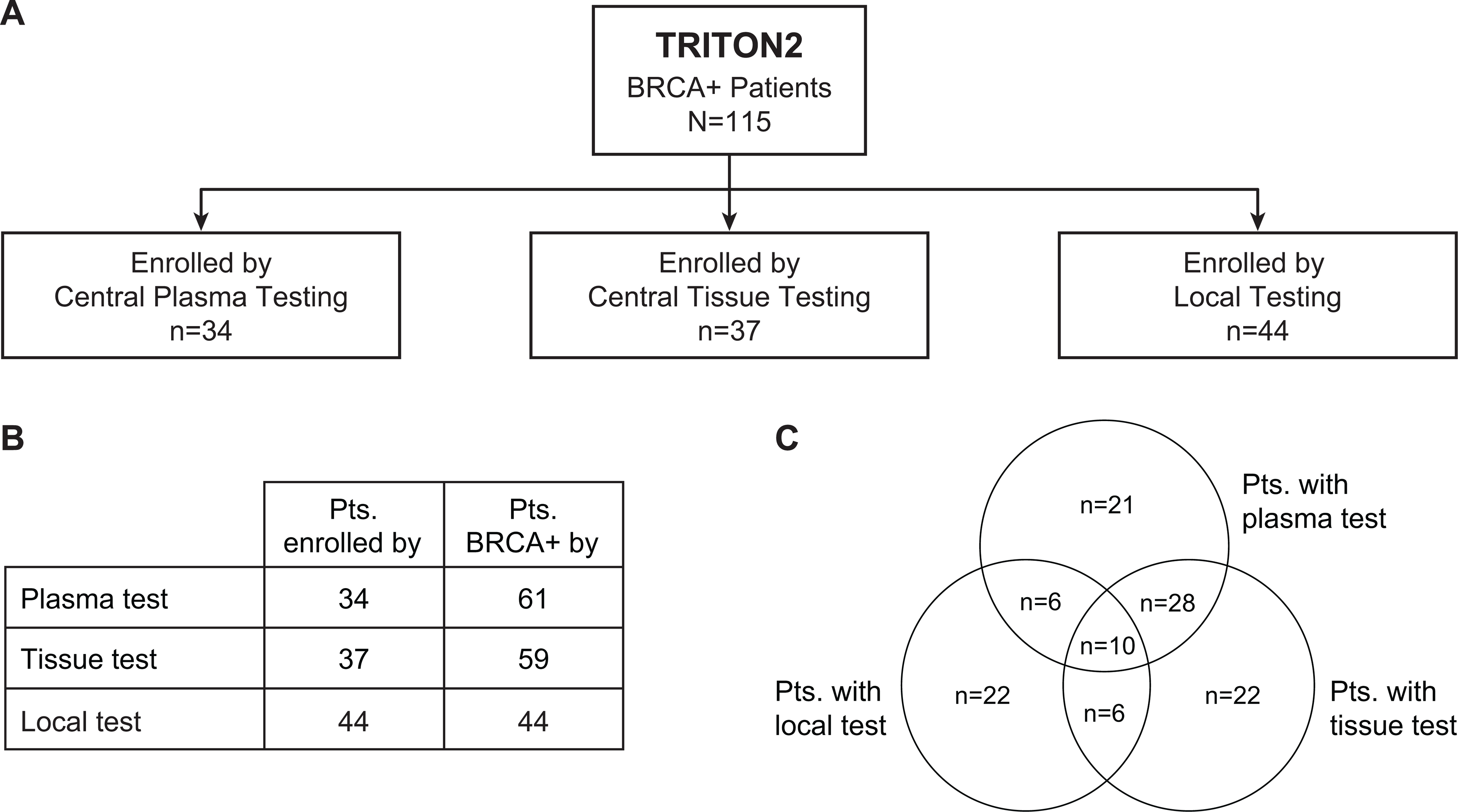
TRITON2 enrolled 115 patients with BRCA identified by central plasma ( = 34), central tissue ( = 37), or local ( = 44) testing. Plasma/tissue concordance was determined in 38 patients with paired samples and was 47% in 19 patients with a somatic BRCA alteration. No statistically significant differences were observed between objective and PSA response rates to rucaparib across the 3 assay groups. Patients unable to provide tissue samples and tested solely by plasma assay responded at rates no different from patients identified as BRCA by tissue testing.
Plasma, tissue, and local testing of mCRPC patients can be used to identify men with BRCA mCRPC who can benefit from treatment with the PARP inhibitor rucaparib.
聚腺苷二磷酸核糖聚合酶(PARP)抑制剂芦卡帕利在美国被批准用于治疗转移性去势抵抗性前列腺癌(mCRPC)且存在有害种系和/或体细胞 BRCA 改变的患者。虽然肿瘤组织测序被认为是识别存在 BRCA 改变(BRCA)患者的标准方法,但血浆分析可能为选择接受芦卡帕利治疗的患者提供一种微创选择。在此,我们报告了通过中心血浆、中心组织或局部基因组检测识别为 BRCA mCRPC 且入组 TRITON2 研究的患者的临床疗效。
患者在接受下一代雄激素受体靶向和紫杉烷类药物治疗 mCRPC 后进展,且通过中心血浆和/或组织样本测序或局部基因组检测确定存在 BRCA 改变。总结了血浆/组织 BRCA 状态与客观缓解率和前列腺特异性抗原(PSA)缓解率的一致性。
TRITON2 共入组了 115 例通过中心血浆(n=34)、中心组织(n=37)或局部(n=44)检测确定为 BRCA 的患者。对 38 例具有配对样本的患者进行了血浆/组织一致性评估,在 19 例存在体细胞 BRCA 改变的患者中,一致性为 47%。在 3 个检测组中,芦卡帕利的客观缓解率和 PSA 缓解率之间未观察到统计学显著差异。无法提供组织样本且仅通过血浆检测的患者的缓解率与通过组织检测确定为 BRCA 的患者无显著差异。
可以使用 mCRPC 患者的血浆、组织和局部检测来识别能够从 PARP 抑制剂芦卡帕利治疗中获益的存在 BRCA mCRPC 的男性。