Reichl Stephan, Mädl Eric, Riedlberger Felix, Piesch Martin, Balázs Gábor, Seidl Michael, Scheer Manfred
Institute of Inorganic Chemistry, University of Regensburg, Universitätsstraße 31, 93053, Regensburg, Germany.
Nat Commun. 2021 Oct 1;12(1):5774. doi: 10.1038/s41467-021-26002-7.
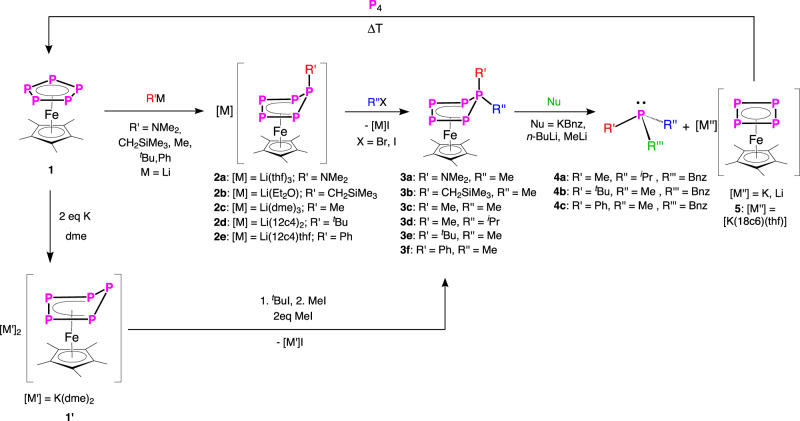
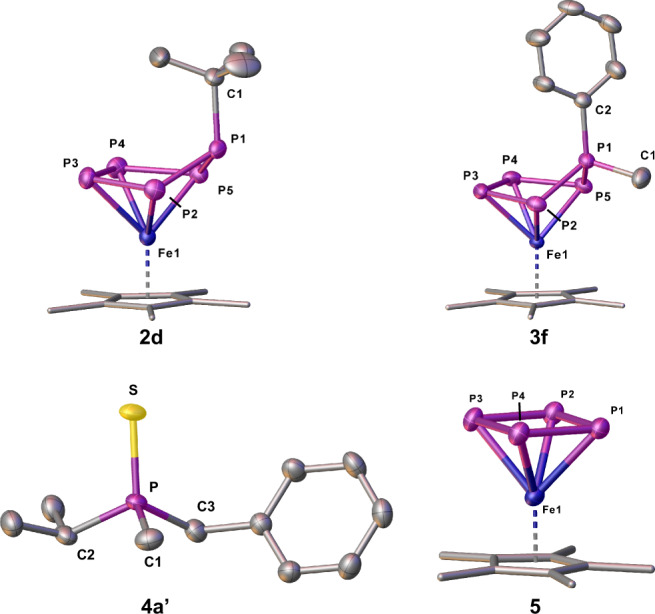
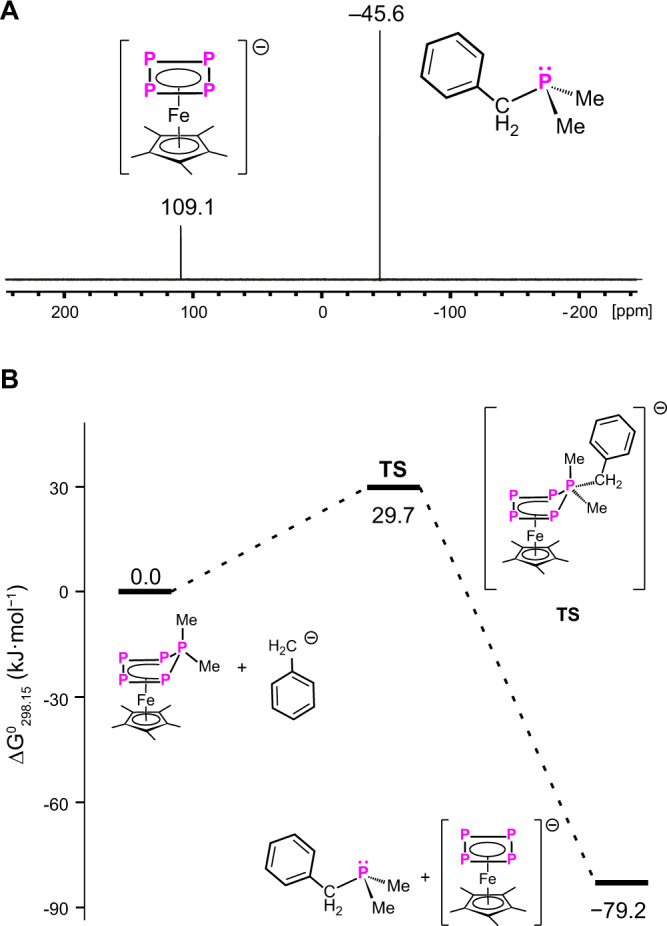
The synthesis of phosphines is based on white phosphorus, which is usually converted to PCl, to be afterwards substituted step by step in a non-atomic efficient manner. Herein, we describe an alternative efficient transition metal-mediated process to form asymmetrically substituted phosphines directly from white phosphorus (P). Thereby, P is converted to [CpFe(η-P)] (1) (Cp = η-C(CH)) in which one of the phosphorus atoms is selectively functionalized to the 1,1-diorgano-substituted complex [Cp*Fe(η-PR'R″)] (3). In a subsequent step, the phosphine PR'R″R‴ (R' ≠ R″ ≠ R‴ = alky, aryl) (4) is released by reacting it with a nucleophile R‴M (M = alkali metal) as racemates. The starting material 1 can be regenerated with P and can be reused in multiple reaction cycles without isolation of the intermediates, and only the phosphine is distilled off.
膦的合成基于白磷,白磷通常先转化为PCl,随后以非原子高效的方式逐步进行取代。在此,我们描述了一种替代的高效过渡金属介导的过程,可直接由白磷(P)形成不对称取代的膦。由此,P被转化为[CpFe(η-P)](1)(Cp = η-C(CH)),其中一个磷原子被选择性官能化为1,1-二有机取代的配合物[Cp*Fe(η-PR'R″)](3)。在后续步骤中,通过使其与亲核试剂R‴M(M = 碱金属)反应,以外消旋体形式释放出膦PR'R″R‴(R'≠R″≠R‴ = 烷基、芳基)(4)。起始原料1可以与P再生,并且无需分离中间体即可在多个反应循环中重复使用,仅蒸馏出膦。