Shilpasree Alagilawada S, Patil Vidya S, Revanasiddappa Manjunath, Patil Vijayetha P, Ireshnavar Deepti
Department of Biochemistry, SDM College of Medical Sciences and Hospital, Shri Dharmasthala Manjunatheshwara University, Sattur, Dharwad, Karnataka, India.
Department of Nephrology, SDM College of Medical Sciences and Hospital, Shri Dharmasthala Manjunatheshwara University, Sattur, Dharwad, Karnataka, India.
J Lab Physicians. 2021 Sep;13(3):257-262. doi: 10.1055/s-0041-1731107. Epub 2021 Jul 9.
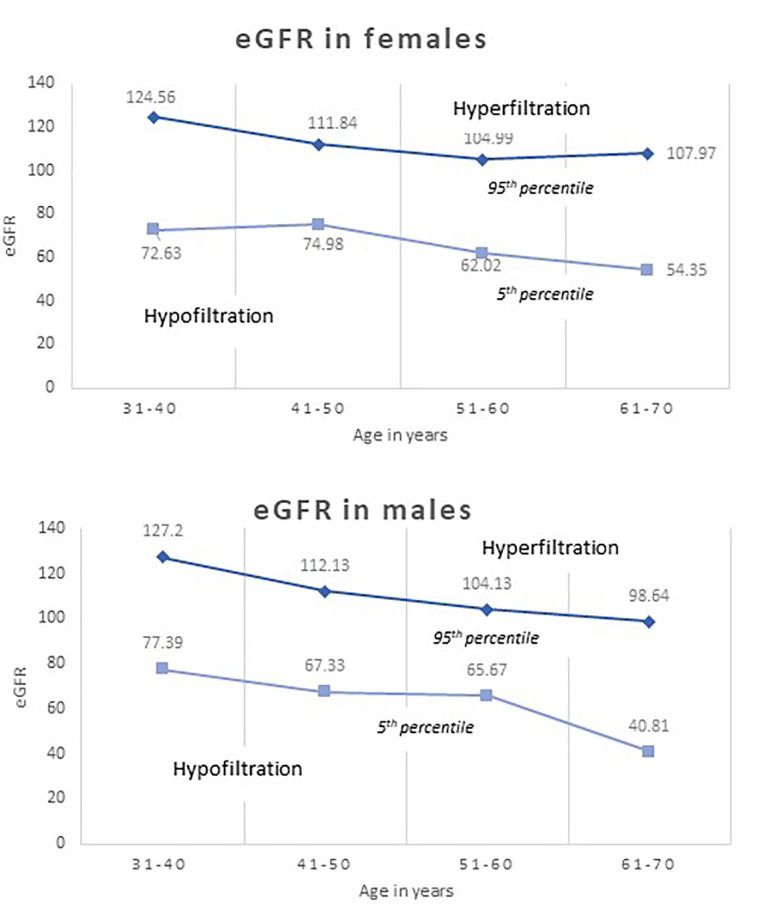
Prediabetes is defined as an intermediate state of hyperglycemia with glucose levels above normal but below the diagnostic cutoff of diabetes mellitus. Prediabetes is considered as an important risk factor for the development of diabetes and complications associated with diabetes. Since glomerular hyperfiltration (elevated GFR) and albuminuria represent early and reversible stages of kidney damage seen in patients with type 2 diabetes, we aim to assess the impact of hyperglycemia in prediabetic range on renal functions measured by estimated GFR and urine albumin excretion (UAE). The study included 1,031 patients aged 30 to 70 years, attending regular health checkup. Patients were grouped as normal, prediabetes, and diabetes according to the American Diabetic Association (ADA) criteria based on fasting blood sugar and hemoglobin A1c (HbA1c). Further, the patients were grouped into multiple subgroups based on age and gender. UAE was measured by using immunoturbidimetric method, and GFR was estimated by chronic kidney disease epidemiology collaboration (CKD EPI) equation. Prevalence of hyperfiltration (estimated glomerular filtration rate above the age and gender specific 95th percentile), and albuminuria in prediabetes and diabetes was compared with normal controls. Odds ratio and 95% confidence interval were calculated by using logistic regression analysis to predict the occurrence of hyperfiltration in prediabetes and diabetes. Analysis of variance followed by post hoc comparison was done to assess the significance of difference, and -value < 0.05 was considered statistically significant. Prevalence of hyperfiltration was more in prediabetes and diabetes compared with normal controls, and it increased with surging HbA1c level that was shown as higher odds ratio for hyperfiltration in both the groups. UAE was more in the prediabetes and diabetes group when compared with normal controls, but the difference was significant only in diabetes. Since glomerular hyperfiltration represents an early and reversible stage of renal damage manifesting before the appearance of albuminuria, elevated GFR can be used to identify asymptomatic patients with intermediate hyperglycemia having high risk of developing nephropathy in the future. Prediabetes represents a window of opportunity to initiate preventive strategies at an early stage before the occurrence of significant renal damage.
糖尿病前期被定义为血糖水平高于正常但低于糖尿病诊断临界值的高血糖中间状态。糖尿病前期被视为发生糖尿病及与糖尿病相关并发症的重要危险因素。由于肾小球高滤过(肾小球滤过率升高)和蛋白尿代表2型糖尿病患者肾脏损害的早期且可逆阶段,我们旨在评估糖尿病前期范围内的高血糖对通过估算肾小球滤过率和尿白蛋白排泄量(UAE)所测得的肾功能的影响。该研究纳入了1031名年龄在30至70岁之间、参加定期健康检查的患者。根据美国糖尿病协会(ADA)基于空腹血糖和糖化血红蛋白(HbA1c)的标准,将患者分为正常、糖尿病前期和糖尿病组。此外,根据年龄和性别将患者进一步分为多个亚组。采用免疫比浊法测量UAE,并通过慢性肾脏病流行病学协作组(CKD EPI)方程估算肾小球滤过率。将糖尿病前期和糖尿病患者中高滤过(估算肾小球滤过率高于年龄和性别特异性第95百分位数)和蛋白尿的患病率与正常对照组进行比较。使用逻辑回归分析计算比值比和95%置信区间,以预测糖尿病前期和糖尿病患者中高滤过的发生情况。进行方差分析及事后比较以评估差异的显著性,P值<0.05被认为具有统计学显著性。与正常对照组相比,糖尿病前期和糖尿病患者中高滤过的患病率更高,且随着HbA1c水平升高而增加,这在两组中均表现为高滤过的比值比更高。与正常对照组相比,糖尿病前期和糖尿病组的UAE更高,但差异仅在糖尿病组中具有显著性。由于肾小球高滤过代表在蛋白尿出现之前就已表现出的肾脏损害的早期且可逆阶段,升高的肾小球滤过率可用于识别未来发生肾病风险高的无症状中间高血糖患者。糖尿病前期代表了在发生显著肾脏损害之前早期启动预防策略的机会窗口。