
基于双传感生物报告系统的双色荧光法检测生物可利用镉
Detection of Bioavailable Cadmium by Double-Color Fluorescence Based on a Dual-Sensing Bioreporter System.
作者信息
Hui Chang-Ye, Guo Yan, Wu Jian, Liu Lisa, Yang Xue-Qin, Guo Xiang, Xie Ying, Yi Juan
机构信息
Department of Pathology & Toxicology, Shenzhen Prevention and Treatment Center for Occupational Diseases, Shenzhen, China.
National Key Clinical Specialty of Occupational Diseases, Shenzhen Prevention and Treatment Center for Occupational Diseases, Shenzhen, China.
出版信息
Front Microbiol. 2021 Sep 16;12:696195. doi: 10.3389/fmicb.2021.696195. eCollection 2021.
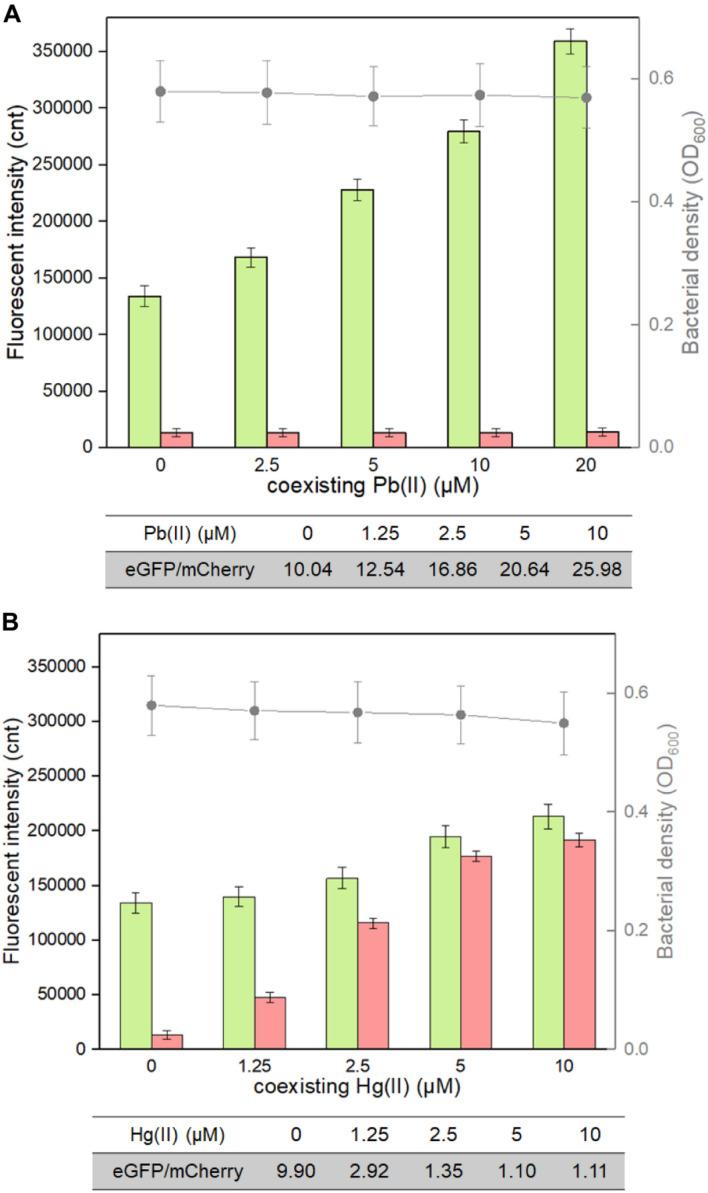
Cadmium (Cd) is carcinogenic to humans and can accumulate in the liver, kidneys, and bones. There is widespread presence of cadmium in the environment as a consequence of anthropogenic activities. It is important to detect cadmium in the environment to prevent further exposure to humans. Previous whole-cell biosensor designs were focused on single-sensing constructs but have had difficulty in distinguishing cadmium from other metal ions such as lead (Pb) and mercury (Hg). We developed a dual-sensing bacterial bioreporter system to detect bioavailable cadmium by employing CadC and CadR as separate metal sensory elements and eGFP and mCherry as fluorescent reporters in one genetic construct. The capability of this dual-sensing biosensor was proved to simultaneously detect bioavailable cadmium and its toxic effects using two sets of sensing systems while still maintaining similar specificity and sensitivity of respective signal-sensing biosensors. The productions of double-color fluorescence were directly proportional to the exposure concentration of cadmium, thereby serving as an effective quantitative biosensor to detect bioavailable cadmium. This novel dual-sensing biosensor was then validated to respond to Cd(II) spiked in environmental water samples. This is the first report of the development of a novel dual-sensing, whole-cell biosensor for simultaneous detection of bioavailable cadmium. The application of two biosensing modules provides versatile biosensing signals and improved performance that can make a significant impact on monitoring high concentration of bioavailable Cd(II) in environmental water to reduce human exposure to the harmful effects of cadmium.
镉(Cd)对人类具有致癌性,可在肝脏、肾脏和骨骼中蓄积。由于人为活动,镉在环境中广泛存在。检测环境中的镉以防止人类进一步接触至关重要。以往的全细胞生物传感器设计侧重于单传感构建体,但在区分镉与其他金属离子(如铅(Pb)和汞(Hg))方面存在困难。我们开发了一种双传感细菌生物报告系统,通过在一个基因构建体中采用CadC和CadR作为单独的金属传感元件以及eGFP和mCherry作为荧光报告基因来检测生物可利用的镉。该双传感生物传感器能够利用两组传感系统同时检测生物可利用的镉及其毒性效应,同时仍保持各自信号传感生物传感器的相似特异性和灵敏度。双色荧光的产生与镉的暴露浓度成正比,从而成为检测生物可利用镉的有效定量生物传感器。然后,这种新型双传感生物传感器被验证对环境水样中添加的Cd(II)有响应。这是关于开发一种新型双传感全细胞生物传感器以同时检测生物可利用镉的首次报道。两个生物传感模块的应用提供了多功能的生物传感信号和改进的性能,这对监测环境水中高浓度的生物可利用Cd(II)以减少人类接触镉的有害影响可能产生重大影响。




 Zotero 插件