Dong Yonghao, Li Tong, Liu Jin, Sun Meixue, Chen Xingyu, Liu Yongjie, Xu Pengjun
College of Plant Protection, Shandong Agricultural University, Taian, Shandong Province, China.
Qingdao Special Crops Research Center, Chinese Academy of Agricultural Sciences, Qingdao, Shandong Province, China.
PeerJ. 2021 Sep 13;9:e12132. doi: 10.7717/peerj.12132. eCollection 2021.
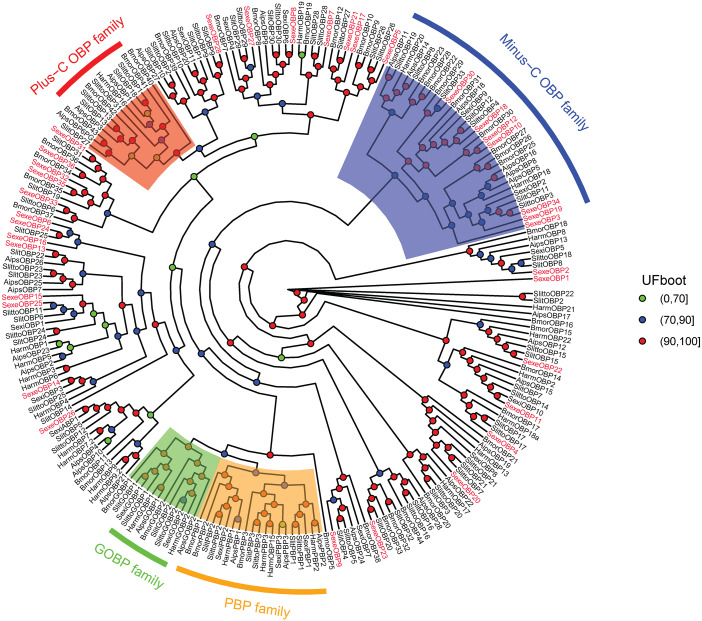
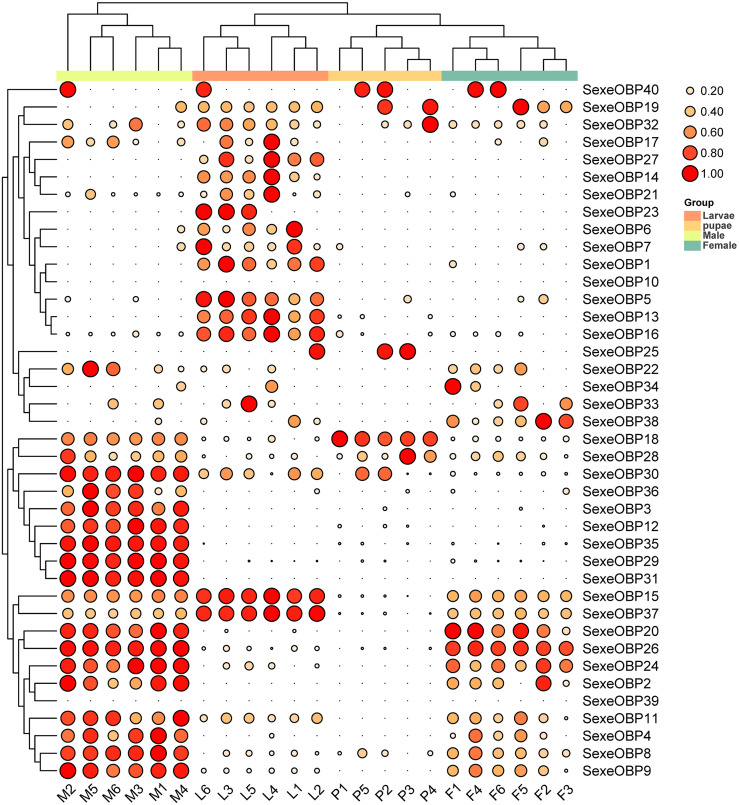
As potential molecular targets for developing novel pest management strategies, odorant-binding proteins (OBPs) and chemosensory proteins (CSPs) have been considered to initiate odor recognition in insects. Herein, we investigated the OBPs and CSPs in a major global crop pest (). Using transcriptome analysis, we identified 40 OBPs and 33 CSPs in , among which 35 OBPs and 29 CSPs had intact open reading frames. Sequence alignment indicated that 30 OBPs and 23 CSPs completely contained the conserved cysteines. OBPs of lepidopteran insects usually belonged to classical, minus-C, and plus-C groups. However, phylogenetic analyses indicated that we only identified 28 classical and seven minus-C OBPs in , suggesting that we might have missed some typical OBPs in lepidopteran insects, probably due to their low expression levels. All of the CSPs from clustered with the orthologs of other moths. The identification and expression of the OBPs and CSPs were well studied in insect adults by transcriptional analyses, and herein we used samples at different stages to determine the expression of OBPs and CSPs in . Interestingly, our data indicated that several OBPs and CSPs were especially or more highly expressed in larvae or pupae than other stages, including three exclusively (SexeOBP13, SexeOBP16 and SexeCSP23) and six more highly (SexeOBP15, SexeOBP37, SexeCSP4, SexeCSP8, SexeCSP19, and SexeCSP33) expressed in larvae, two exclusively (SexeCSP6 and SexeCSP20) and three more highly (SexeOBP18, SexeCSP17, and SexeCSP26) expressed in pupae. Usually, OBPs and CSPs had both male- and female-biased expression patterns in adult antennae. However, our whole-body data indicated that all highly expressed OBPs and CSPs in adults were male-biased or did not differ, suggesting diverse OBP and CSP functions in insect adults. Besides identifying OBPs and CSPs as well as their expression patterns, these results provide a molecular basis to facilitate functional studies of OBPs and CSPs for exploring novel management strategies to control .
作为开发新型害虫管理策略的潜在分子靶点,气味结合蛋白(OBPs)和化学感受蛋白(CSPs)被认为在昆虫中启动气味识别。在此,我们研究了一种全球主要农作物害虫()中的OBPs和CSPs。通过转录组分析,我们在()中鉴定出40种OBPs和33种CSPs,其中35种OBPs和29种CSPs具有完整的开放阅读框。序列比对表明,30种OBPs和23种CSPs完全包含保守的半胱氨酸。鳞翅目昆虫的OBPs通常属于经典型、缺C型和加C型。然而,系统发育分析表明,我们在()中仅鉴定出28种经典型和7种缺C型OBPs,这表明我们可能遗漏了鳞翅目昆虫中的一些典型OBPs,可能是由于它们的表达水平较低。来自()的所有CSPs都与其他蛾类的直系同源物聚类。通过转录分析对昆虫成虫中OBPs和CSPs的鉴定和表达进行了深入研究,在此我们使用不同发育阶段的样本确定()中OBPs和CSPs的表达。有趣的是,我们的数据表明,几种OBPs和CSPs在幼虫或蛹期比其他阶段表达量特别高或更高,包括在幼虫中特异性表达的3种(SexeOBP13、SexeOBP16和SexeCSP23)以及表达量更高的6种(SexeOBP15、SexeOBP37、SexeCSP4、SexeCSP8、SexeCSP19和SexeCSP33),在蛹期特异性表达的2种(SexeCSP6和SexeCSP20)以及表达量更高的3种(SexeOBP18、SexeCSP17和SexeCSP26)。通常,OBPs和CSPs在成虫触角中具有雄雌偏向的表达模式。然而,我们的全身数据表明,成虫中所有高表达的OBPs和CSPs都是雄性偏向的或没有差异,这表明OBPs和CSPs在昆虫成虫中具有多种功能。除了鉴定OBPs和CSPs及其表达模式外,这些结果为促进OBPs和CSPs的功能研究提供了分子基础,以探索控制()的新型管理策略。