Tao Huangheng, Liao Yixiang, Yan Youji, He Zhiwen, Zhou Jiajie, Wang Xinghuan, Peng Jianping, Li Shangze, Liu Tao
Department of Urology, Zhongnan Hospital of Wuhan University, Wuhan, China.
Medical Science Research Center, Zhongnan Hospital of Wuhan University, Wuhan, China.
Front Cell Dev Biol. 2021 Sep 16;9:720349. doi: 10.3389/fcell.2021.720349. eCollection 2021.
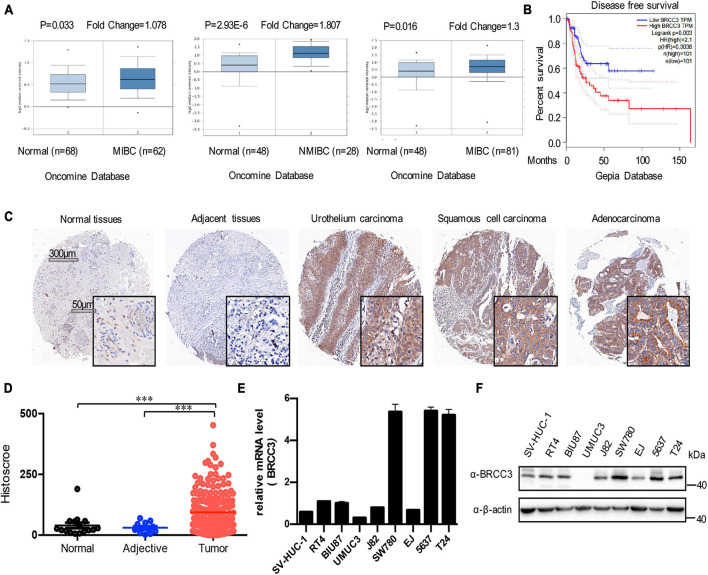
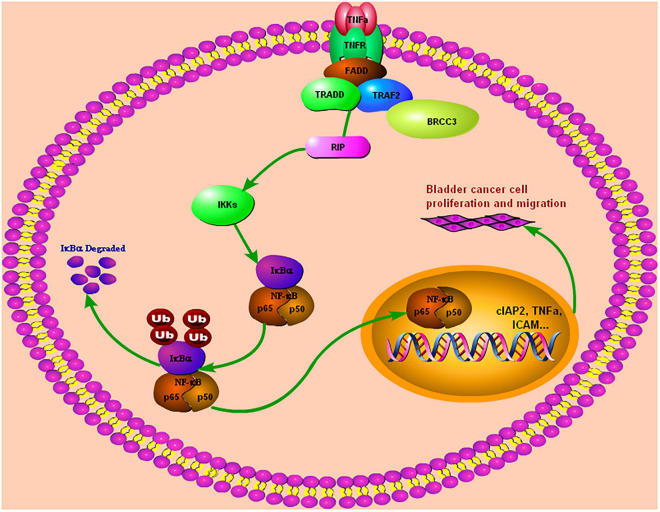
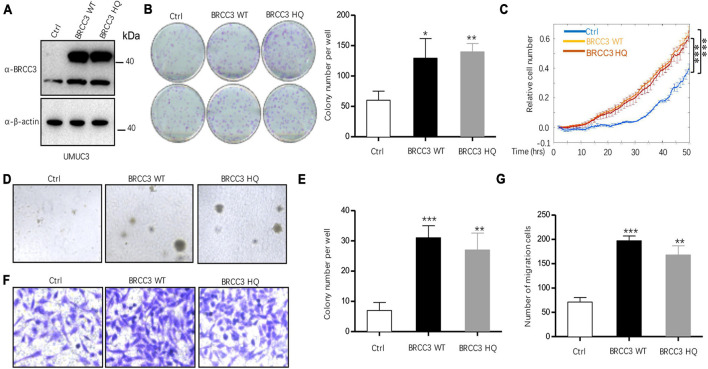
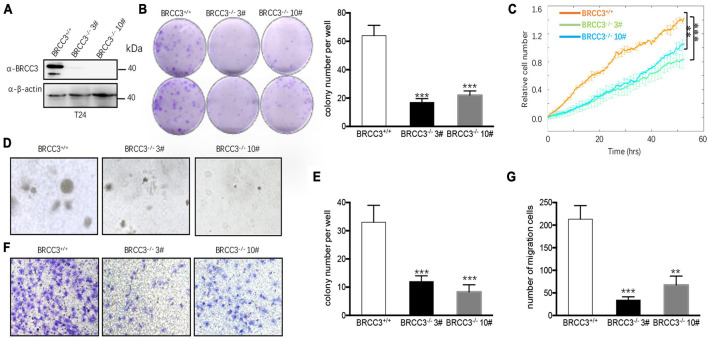
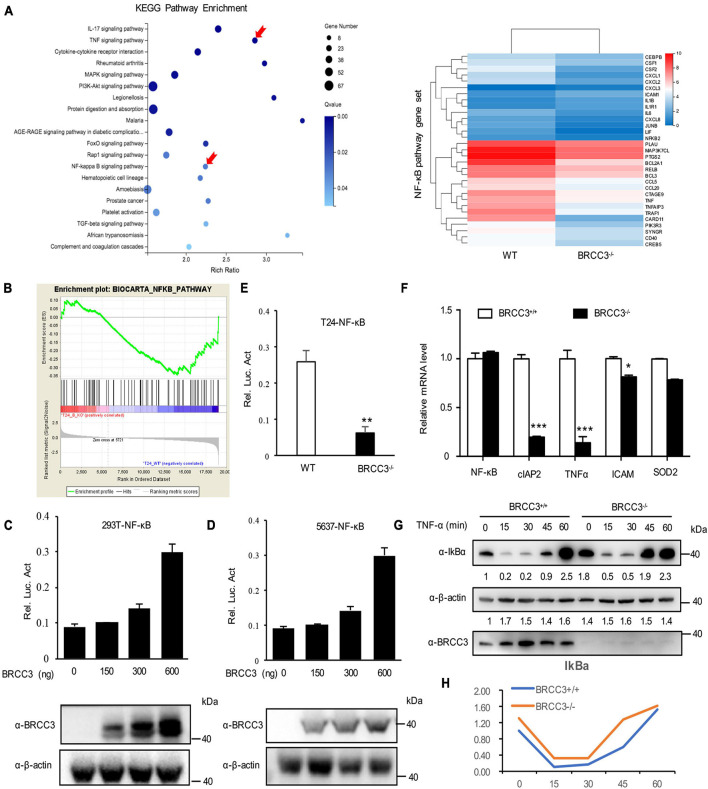
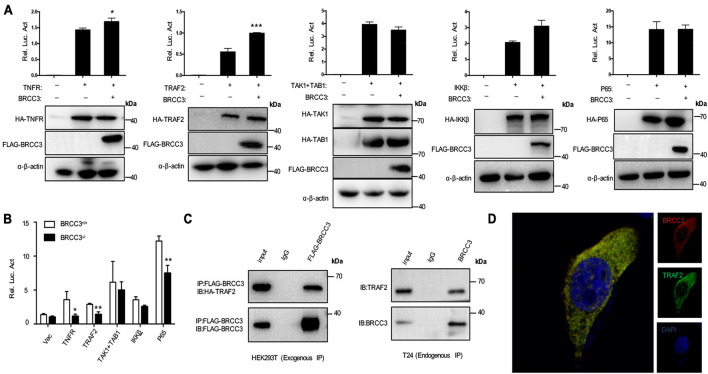
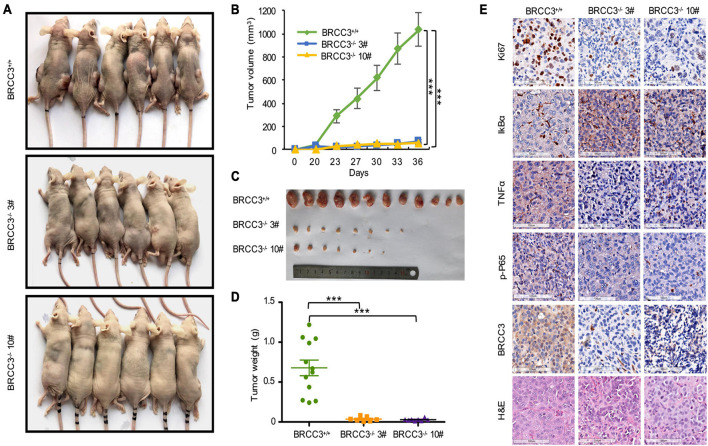
NF-κB signaling is very important in cancers. However, the role of BRCC3-associated NF-κB signaling activation in bladder cancer remains to be characterized. Western blotting and IHC of tissue microarray were used to confirm the abnormal expression of BRCC3 in bladder cancer. Growth curve, colony formation, soft agar assay and Xenograft model were performed to identify the role of BRCC3 over-expression or knock-out in bladder cancer. Further, RNA-Seq and luciferase reporter assays were used to identify the down-stream signaling pathway. Finally, co-immunoprecipitation and fluorescence confocal assay were performed to verify the precise target of BRCC3. Here, we found that high expression of BRCC3 promoted tumorigenesis through targeting the TRAF2 protein. BRCC3 expression is up-regulated in bladder cancer patients which indicates a negative prognosis. By and assays, we found genetic BRCC3 ablation markedly blocks proliferation, viability and migration of bladder cancer cells. Mechanistically, RNA-Seq analysis shows that NF-κB signaling is down-regulated in BRCC3-deficient cells. BRCC3 binds to and synergizes with TRAF2 to activate NF-κB signaling. Our results indicate that high BRCC3 expression activates NF-κB signaling by targeting TRAF2 for activation, which in turn facilitates tumorigenesis in bladder cancer. This finding points to BRCC3 as a potential target in bladder cancer patients.
NF-κB信号通路在癌症中非常重要。然而,BRCC3相关的NF-κB信号通路激活在膀胱癌中的作用仍有待明确。采用蛋白质免疫印迹法和组织芯片免疫组化法来证实BRCC3在膀胱癌中的异常表达。通过生长曲线、集落形成、软琼脂试验和异种移植模型来确定BRCC3过表达或敲除在膀胱癌中的作用。此外,利用RNA测序和荧光素酶报告基因检测来确定下游信号通路。最后,通过免疫共沉淀和荧光共聚焦试验来验证BRCC3的确切靶点。在此,我们发现BRCC3的高表达通过靶向TRAF2蛋白促进肿瘤发生。BRCC3在膀胱癌患者中表达上调,这表明预后不良。通过[具体试验名称1]和[具体试验名称2]试验,我们发现基因敲除BRCC3可显著阻断膀胱癌细胞的增殖、活力和迁移。从机制上讲,RNA测序分析表明在BRCC3缺陷型细胞中NF-κB信号通路下调。BRCC3与TRAF2结合并协同激活NF-κB信号通路。我们的结果表明,BRCC3的高表达通过靶向TRAF2激活NF-κB信号通路,进而促进膀胱癌的肿瘤发生。这一发现表明BRCC3是膀胱癌患者的一个潜在靶点。