Heart Center and Beijing Key Laboratory of Hypertension, Beijing Chaoyang Hospital, Capital Medical University, Beijing 100020, China.
Department of Critical Care Medicine, Shanghai General Hospital, Shanghai Jiao Tong University School of Medicine, Shanghai 201600, China.
Chin Med J (Engl). 2022 May 5;135(9):1019-1026. doi: 10.1097/CM9.0000000000001766.
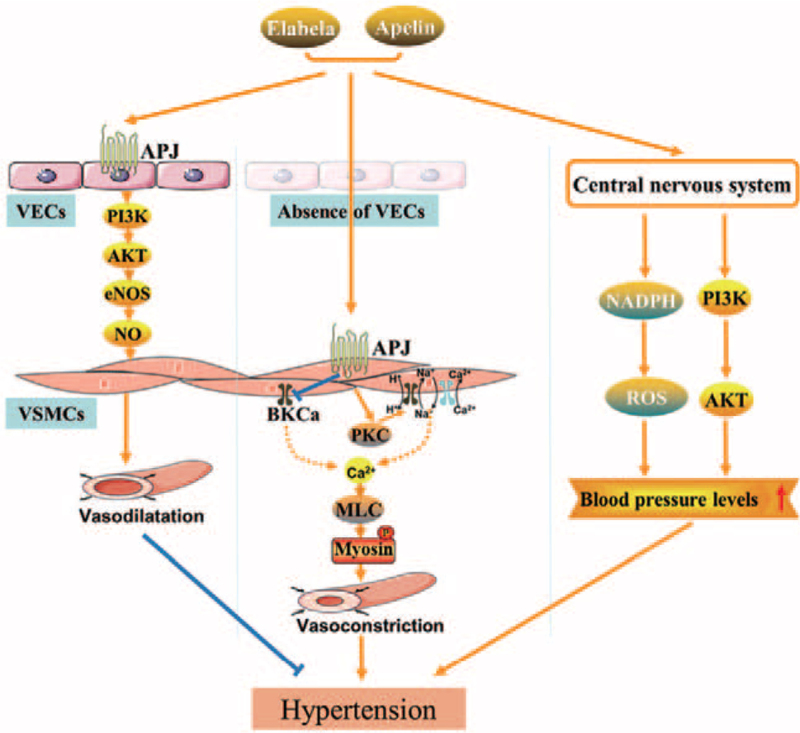
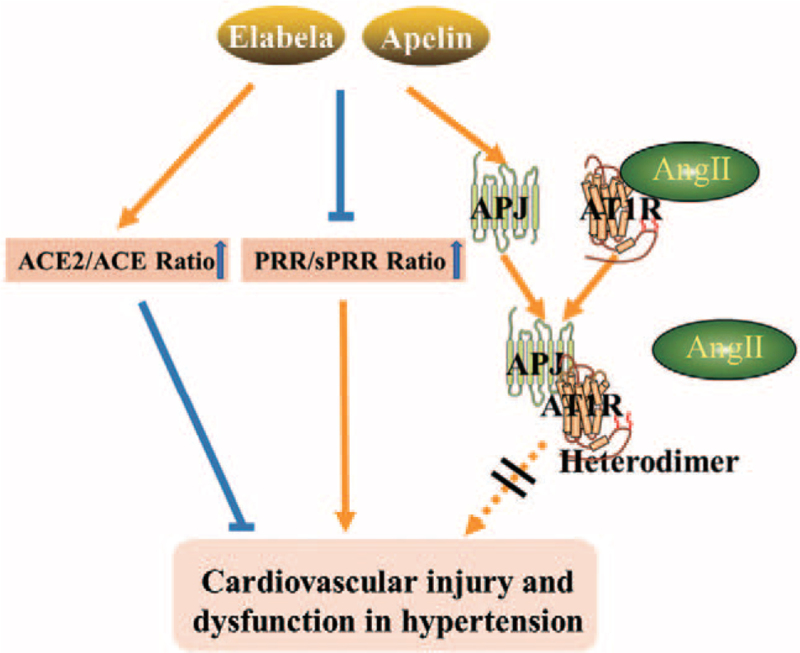
Hypertension is the leading risk factor for global mortality and morbidity and those with hypertension are more likely to develop severe symptoms in cardiovascular and cerebrovascular system, which is closely related to abnormal renin-angiotensin system and elabela/apelin-apelin receptor (APJ) axis. The elabela/apelin-APJ axis exerts essential roles in regulating blood pressure levels, vascular tone, and cardiovascular dysfunction in hypertension by counterbalancing the action of the angiotensin II/angiotensin II type 1 receptor axis and enhancing the endothelial nitric oxide (NO) synthase/NO signaling. Furthermore, the elabela/apelin-APJ axis demonstrates beneficial effects in cardiovascular physiology and pathophysiology, including angiogenesis, cellular proliferation, fibrosis, apoptosis, oxidative stress, and cardiovascular remodeling and dysfunction during hypertension. More importantly, effects of the elabela/apelin-APJ axis on vascular tone may depend upon blood vessel type or various pathological conditions. Intriguingly, the broad distribution of elabela/apelin and alternative isoforms implicates its distinct functions in diverse cardiac and vascular cells and tissue types. Finally, both loss-of-function and gain-of-function approaches have defined critical roles of the elabela/apelin-APJ axis in reducing the development and severity of hypertensive diseases. Thus, targeting the elabela/apelin-APJ axis has emerged as a pre-warning biomarker and a novel therapeutic approach against progression of hypertension, and an increased understanding of cardiovascular actions of the elabela/apelin-APJ axis will help to develop effective interventions for hypertension. In this review, we focus on the physiology and biochemistry, diverse actions, and underlying mechanisms of the elabela/apelin-APJ axis, highlighting its role in hypertension and hypertensive cardiovascular injury and dysfunction, with a view to provide a prospective strategy for hypertensive disease therapy.
高血压是全球死亡率和发病率的主要危险因素,高血压患者更容易在心血管和脑血管系统中出现严重症状,这与肾素-血管紧张素系统和埃拉贝拉/阿普林-阿普林受体(APJ)轴的异常密切相关。埃拉贝拉/阿普林-APJ 轴通过平衡血管紧张素 II/血管紧张素 II 型 1 受体轴的作用和增强内皮型一氧化氮合酶/一氧化氮信号,在调节血压水平、血管张力和高血压中心血管功能障碍方面发挥重要作用。此外,埃拉贝拉/阿普林-APJ 轴在心血管生理学和病理生理学中具有有益作用,包括血管生成、细胞增殖、纤维化、细胞凋亡、氧化应激以及高血压期间的心血管重塑和功能障碍。更重要的是,埃拉贝拉/阿普林-APJ 轴对血管张力的影响可能取决于血管类型或各种病理状况。有趣的是,埃拉贝拉/阿普林的广泛分布和替代异构体暗示其在不同的心脏和血管细胞和组织类型中具有不同的功能。最后,失活和激活功能的方法都确定了埃拉贝拉/阿普林-APJ 轴在减少高血压疾病的发展和严重程度中的关键作用。因此,针对埃拉贝拉/阿普林-APJ 轴已成为预防高血压进展的预警生物标志物和新的治疗方法,对埃拉贝拉/阿普林-APJ 轴的心血管作用的深入了解将有助于开发针对高血压的有效干预措施。在这篇综述中,我们重点介绍了埃拉贝拉/阿普林-APJ 轴的生理学和生物化学、多样化作用及其潜在机制,强调了其在高血压和高血压心血管损伤和功能障碍中的作用,以期为高血压疾病治疗提供前瞻性策略。