Cui Shangbin, Zhou Zhiyu, Chen Xu, Wei Fuxin, Richards R Geoff, Alini Mauro, Grad Sibylle, Li Zhen
AO Research Institute Davos Davos Switzerland.
Guangdong Provincial Key Laboratory of Orthopedics and Traumatology The First Affiliated Hospital of Sun Yat-sen University Guangzhou China.
JOR Spine. 2021 Apr 8;4(3):e1146. doi: 10.1002/jsp2.1146. eCollection 2021 Sep.
The goal of this study is to characterize transcriptome changes and gene regulation networks in an organ culture system that mimics early post-traumatic intervertebral disc (IVD) degeneration.
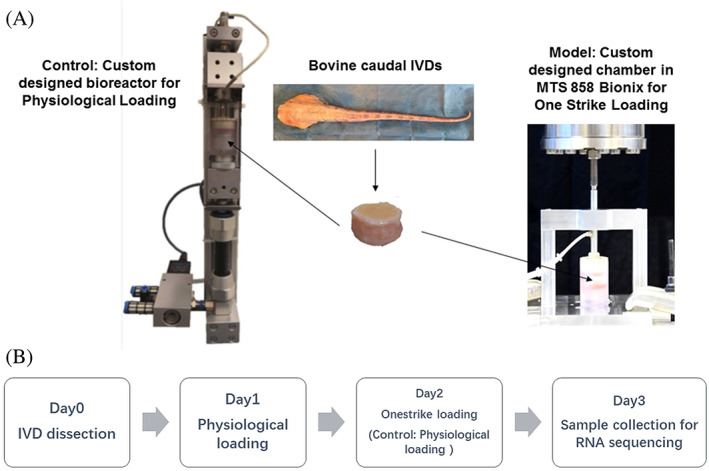
To mimic a traumatic insult, bovine caudal IVDs underwent one strike loading. The control group was cultured under physiological loading. At 24 hours after one strike or physiological loading, RNA was extracted from nucleus pulposus (NP) and annulus fibrosus (AF) tissue. High throughput next generation RNA sequencing was performed to identify differentially expressed genes (DEGs) between the one strike loading group and the control group. Gene Ontology (GO) functional and Kyoto Encyclopedia of Genes and Genomes analyses were performed to analyze DEGs and pathways. Protein-protein interaction (PPI) network was analyzed with cytoscape software. DEGs were verified using qRT-PCR. Degenerated human IVD tissue was collected for immunofluorescence staining to verify the expression of DEGs in human disc tissue.
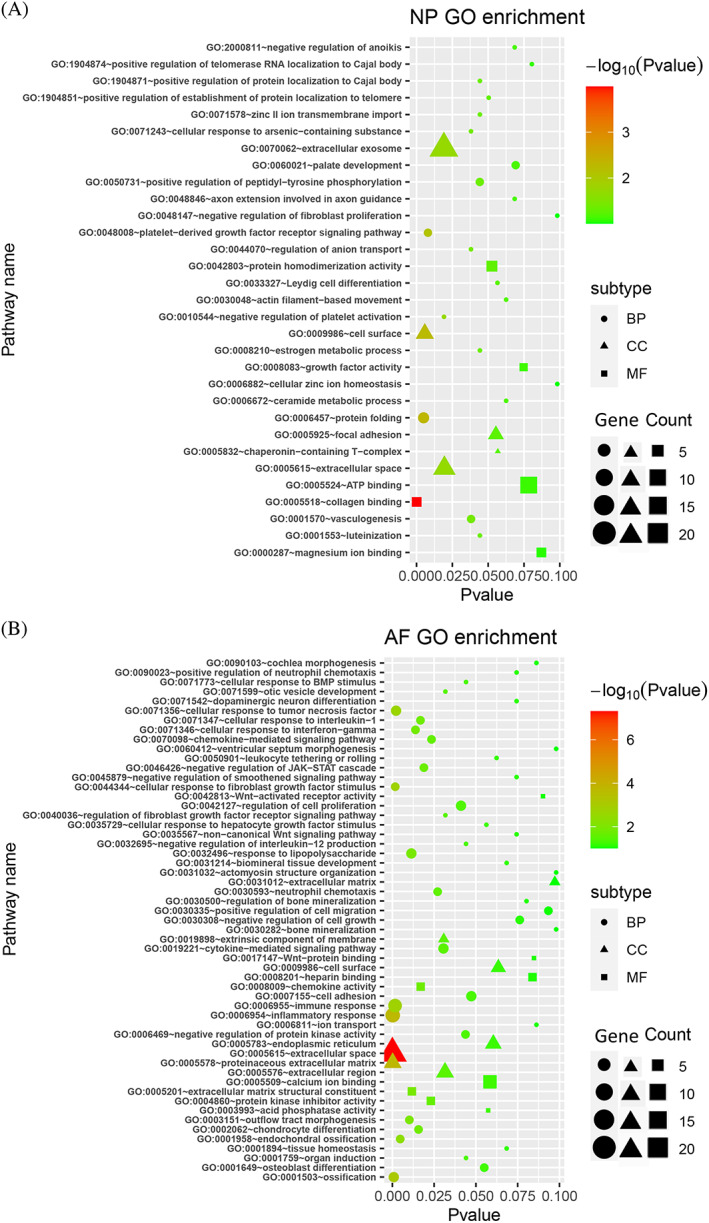
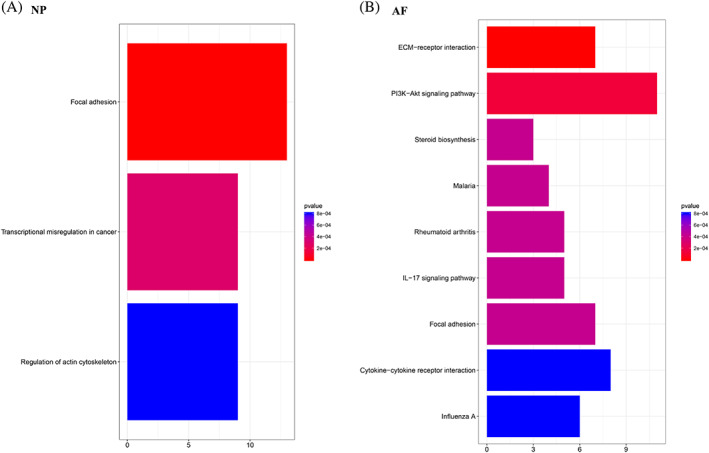
One strike loading resulted in significant gene expression changes compared with physiological loading. In total 253 DEGs were found in NP tissue and 208 DEGs in AF tissue. Many of the highly dysregulated genes have known functions in disc degeneration and extracellular matrix (ECM) homeostasis. ACTB, ACTG, PFN1, MYL12B in NP tissue and FGF1, SPP1 in AF tissue were verified by qRT-PCR and immunofluorescence imaging. The identified DEGs were involved in focal adhesion, ECM-receptor interaction, PI3K-AKT, and cytokine-cytokine receptor interaction pathways. Three clusters of PPI networks were identified. GO enrichment revealed that these DEGs were mainly involved in inflammatory response, the ECM and growth factor signaling and protein folding biological process.
Our study revealed different DEGs, pathways, biological process and PPI networks involved in post-traumatic IVD degeneration. These findings will advance the understanding of the pathogenesis of IVD degeneration, and help to identify novel biomarkers for the disease diagnosis.
本研究的目的是在模拟创伤后早期椎间盘(IVD)退变的器官培养系统中,表征转录组变化和基因调控网络。
为模拟创伤性损伤,对牛尾IVD进行单次打击加载。对照组在生理负荷下培养。在单次打击或生理负荷后24小时,从髓核(NP)和纤维环(AF)组织中提取RNA。进行高通量下一代RNA测序,以鉴定单次打击加载组和对照组之间的差异表达基因(DEG)。进行基因本体(GO)功能分析和京都基因与基因组百科全书分析,以分析DEG和通路。使用Cytoscape软件分析蛋白质-蛋白质相互作用(PPI)网络。使用qRT-PCR验证DEG。收集退变的人IVD组织进行免疫荧光染色,以验证DEG在人椎间盘组织中的表达。
与生理负荷相比,单次打击加载导致显著的基因表达变化。在NP组织中总共发现253个DEG,在AF组织中发现208个DEG。许多高度失调的基因在椎间盘退变和细胞外基质(ECM)稳态中具有已知功能。NP组织中的ACTB、ACTG、PFN1、MYL12B和AF组织中的FGF1、SPP1通过qRT-PCR和免疫荧光成像得到验证。鉴定出的DEG参与粘着斑、ECM-受体相互作用、PI3K-AKT和细胞因子-细胞因子受体相互作用通路。确定了三个PPI网络簇。GO富集显示这些DEG主要参与炎症反应、ECM和生长因子信号传导以及蛋白质折叠生物学过程。
我们的研究揭示了创伤后IVD退变中涉及的不同DEG、通路、生物学过程和PPI网络。这些发现将推进对IVD退变发病机制的理解,并有助于识别该疾病诊断的新型生物标志物。