Kim Joong-Yub, Park Samina, Park In Kyu, Kang Chang Hyun, Kim Young Tae, Koh Jaemoon, Yim Jae-Joon, Kwak Nakwon
Division of Pulmonary and Critical Care Medicine, Department of Internal Medicine, Seoul National University Hospital, Seoul, South Korea.
Department of Thoracic and Cardiovascular Surgery, Seoul National University Hospital, Seoul, South Korea.
BMC Pulm Med. 2021 Oct 6;21(1):312. doi: 10.1186/s12890-021-01679-0.
Owing to the unsatisfactory results of antibiotic treatment alone, surgical resection is currently considered as adjunctive therapy in patients with nontuberculous mycobacterial pulmonary disease (NTM-PD). However, reports regarding the outcomes of surgery vary considerably by institution. Here, we investigated the surgical outcomes and risk factors associated with unfavorable outcomes after surgery.
We analyzed patients with NTM-PD who underwent pulmonary resection at Seoul National University Hospital between January 1, 2006, and December 31, 2020, and assessed the types of surgical procedures, complications, and long-term outcomes. Multivariate logistic regression analysis was used to identify the risk factors associated with treatment refractoriness or recurrence after surgery.
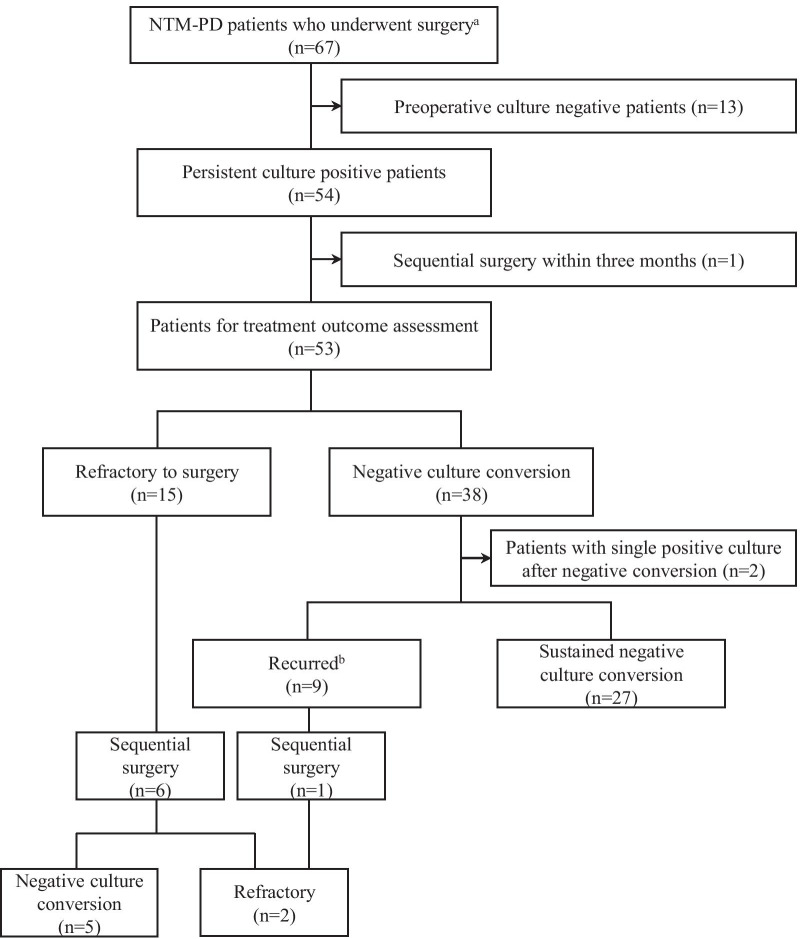
Among 67 patients who underwent surgery during the study period, the most common indication for surgery was persistent culture positivity despite rigorous medical treatment (80.6%), followed by longstanding cavitary lesions or radiographic aggravation (10.4%) and massive hemoptysis (4.5%). Among 53 patients with positive mycobacterial cultures at the time of surgery, 38 (71.7%) achieved initial negative culture conversion, 9 (17.0%) of whom experienced recurrence. Nine (13.4%) patients experienced postoperative complications, which were managed without lasting morbidity and mortality. Female sex (adjusted odds ratio [aOR] 6.63; 95% confidence interval [CI] 1.04-42.4; P = .046), preoperative positive mycobacterial culture (aOR 5.87; 95 %CI 1.04-33.08; P = .045), and residual lesions (aOR 6.86; 95 %CI 1.49-31.56; P = .013) were associated with refractoriness or recurrence.
Pulmonary resection is a reasonable treatment modality for patients with refractory NTM-PD or major complications such as massive hemoptysis. The potential risk factors associated with unfavorable outcomes included female sex, preoperative positive mycobacterial culture, and residual lesions after surgery.
由于单纯抗生素治疗效果不理想,手术切除目前被视为非结核分枝杆菌肺病(NTM-PD)患者的辅助治疗方法。然而,不同机构关于手术结果的报告差异很大。在此,我们调查了手术结果以及与术后不良结果相关的危险因素。
我们分析了2006年1月1日至2020年12月31日在首尔国立大学医院接受肺切除的NTM-PD患者,并评估了手术方式、并发症和长期结果。采用多因素逻辑回归分析确定与术后治疗难治性或复发相关的危险因素。
在研究期间接受手术的67例患者中,最常见的手术指征是尽管进行了严格的药物治疗但培养仍持续阳性(80.6%),其次是长期空洞性病变或影像学加重(10.4%)和大量咯血(4.5%)。在手术时结核分枝杆菌培养阳性的53例患者中,38例(71.7%)实现了初始培养转阴,其中9例(17.0%)复发。9例(13.4%)患者出现术后并发症,经处理后未出现持续的发病率和死亡率。女性(调整优势比[aOR]6.63;95%置信区间[CI]1.04 - 42.4;P = 0.046)、术前结核分枝杆菌培养阳性(aOR 5.87;95%CI 1.04 - 33.08;P = 0.045)和残留病变(aOR 6.86;95%CI 1.49 - 31.56;P = 0.013)与难治性或复发相关。
肺切除对于难治性NTM-PD或诸如大量咯血等主要并发症的患者是一种合理的治疗方式。与不良结果相关的潜在危险因素包括女性、术前结核分枝杆菌培养阳性和术后残留病变。