Department of Rheumatology, Erasmus Medical Center, Rotterdam, Netherlands.
Department of Dermatology, Erasmus Medical Center, Rotterdam, Netherlands.
Front Immunol. 2021 Sep 20;12:719562. doi: 10.3389/fimmu.2021.719562. eCollection 2021.
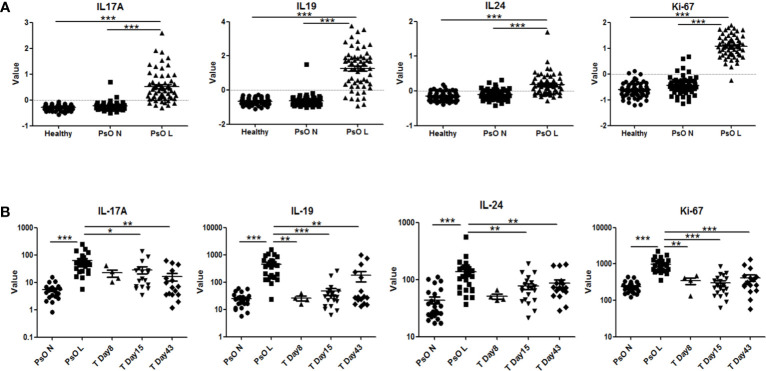
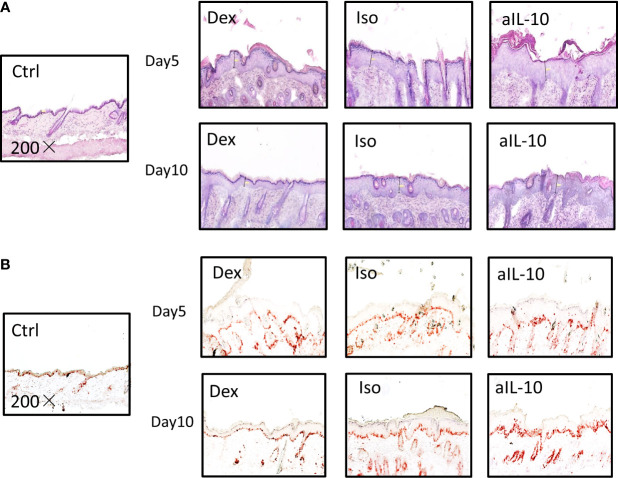
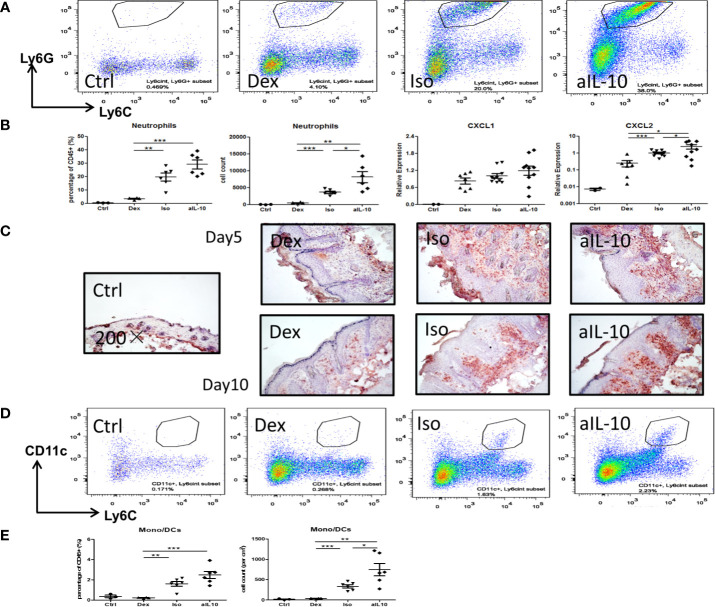
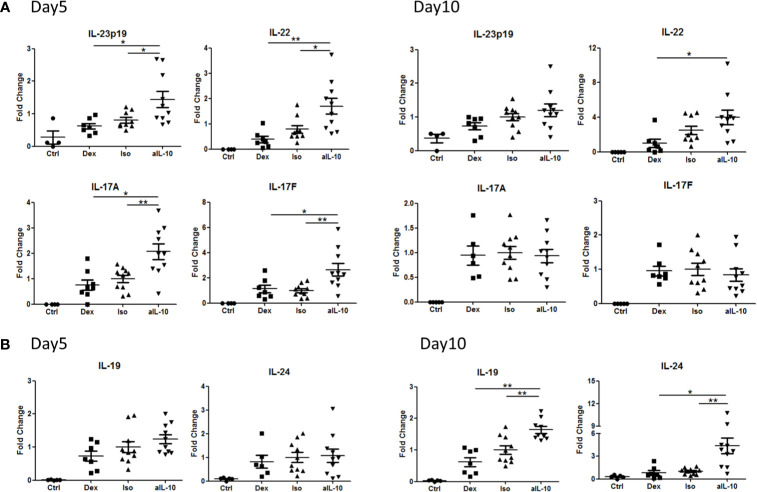
IL-17A has been shown to be up-regulated in psoriasis lesions and is central to psoriasis pathogenesis. IL-19, along with other IL-20 subfamily cytokines such as IL-20 and IL-24, is induced by IL-17A and contributes especially to epidermal hyperplasia in psoriasis. However, the regulation, cellular sources of IL-19 and whether targeting of IL-17A by biologics influence IL-19 expression is not completely understood. To investigate the regulation of IL-19 by IL-17A in psoriasis, the imiquimod-induced psoriasis mouse (IMQ) model was used. Enhanced expression of IL-17A in the IMQ model was achieved by anti-IL-10 antibody treatment. Assessments of skin inflammation macroscopically, by histology and flow cytometry, all confirmed increased psoriatic symptoms. Interestingly, depletion of IL-10 markedly upregulated IL-23/IL-17 pathway related cytokines followed by a significant increase in IL-19 and IL-24. The up-regulation of IL-19 and IL-24, but not IL-17A, coincided with increased keratinocyte proliferation. To investigate the cellular source and effects of biologics on IL-19, human skin fibroblasts from healthy controls and psoriasis patients were cultured alone or co-cultured with activated memory CD4+ T cells. Besides IL-1β, IL-17A induced direct expression of IL-19 and IL-24 in skin fibroblasts and keratinocytes. Importantly, intrinsic higher expression of IL-19 in psoriatic skin fibroblasts was observed in comparison to healthy skin fibroblasts. Neutralization of IL-17A in the human skin fibroblast-T cell co-culture system significantly suppressed IL-19 and IL-24 expression. Together, our data show that IL-17A-induced IL-19 and IL-24 expression in skin stromal cells contribute to keratinocyte proliferation.
白细胞介素-17A(IL-17A)在银屑病皮损中呈上调表达,并且是银屑病发病机制的核心。白细胞介素-19(IL-19)与其他白细胞介素-20 亚家族细胞因子(如白细胞介素-20 和白细胞介素-24)一起,由白细胞介素-17A 诱导产生,尤其有助于银屑病中的表皮过度增生。然而,IL-19 的调控、细胞来源以及生物制剂靶向 IL-17A 是否影响 IL-19 的表达尚不完全清楚。为了研究 IL-17A 在银屑病中的调控作用,我们使用咪喹莫特诱导的银屑病小鼠(IMQ)模型。通过抗白细胞介素-10 抗体治疗,在 IMQ 模型中增强了 IL-17A 的表达。通过组织学和流式细胞术对皮肤炎症进行宏观评估,均证实了银屑病症状的加重。有趣的是,IL-10 的耗竭显著上调了 IL-23/IL-17 通路相关细胞因子,随后 IL-19 和 IL-24 显著增加。IL-19 和 IL-24 的上调,而非 IL-17A,与角质形成细胞增殖增加一致。为了研究细胞来源和生物制剂对 IL-19 的影响,我们单独培养来自健康对照者和银屑病患者的皮肤成纤维细胞,或与激活的记忆 CD4+T 细胞共培养。除了白细胞介素-1β(IL-1β),白细胞介素-17A 还可直接诱导皮肤成纤维细胞和角质形成细胞表达白细胞介素-19 和白细胞介素-24。重要的是,与健康皮肤成纤维细胞相比,银屑病皮肤成纤维细胞中观察到 IL-19 的固有高表达。在人皮肤成纤维细胞-T 细胞共培养系统中,IL-17A 的中和显著抑制了 IL-19 和 IL-24 的表达。总之,我们的数据表明,IL-17A 诱导皮肤基质细胞中 IL-19 和 IL-24 的表达,有助于角质形成细胞增殖。