Gastroenterology and Department of Internal Medicine, Yonsei University College of Medicine, 50-1 Yonsei-ro, Seodaemun-gu, Seoul, 03722, Republic of Korea.
Division of Colon and Rectal Surgery, Department of Surgery, Yonsei University College of Medicine, 50-1 Yonsei-ro, Seodaemun-gu, Seoul, 03722, Republic of Korea.
BMC Gastroenterol. 2021 Oct 7;21(1):362. doi: 10.1186/s12876-021-01922-2.
Patients with intestinal Behçet's disease (BD) frequently undergo intestinal resections, which significantly affects postoperative morbidity and mortality. The aim of this study was to identify the association between C-reactive protein (CRP) levels and postoperative outcomes in patients with intestinal BD who underwent surgical bowel resection.
Patients who were diagnosed with intestinal BD and underwent intestinal surgery due to BD at Severance Hospital between November 2005 and April 2018 were retrospectively investigated. Clinical relapse was defined as a disease activity index of BD (DAIBD) > 40, existence of newly added medications, re-hospitalization, or re-operation related to intestinal BD. The relationship between CRP level and postoperative outcomes was analyzed, and a receiver operating characteristic (ROC) curve was drawn to specify a cut-off value.
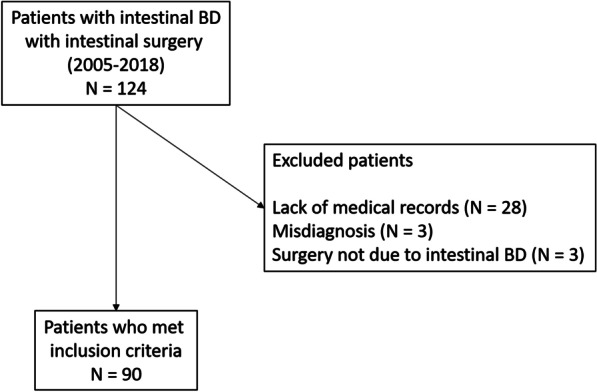
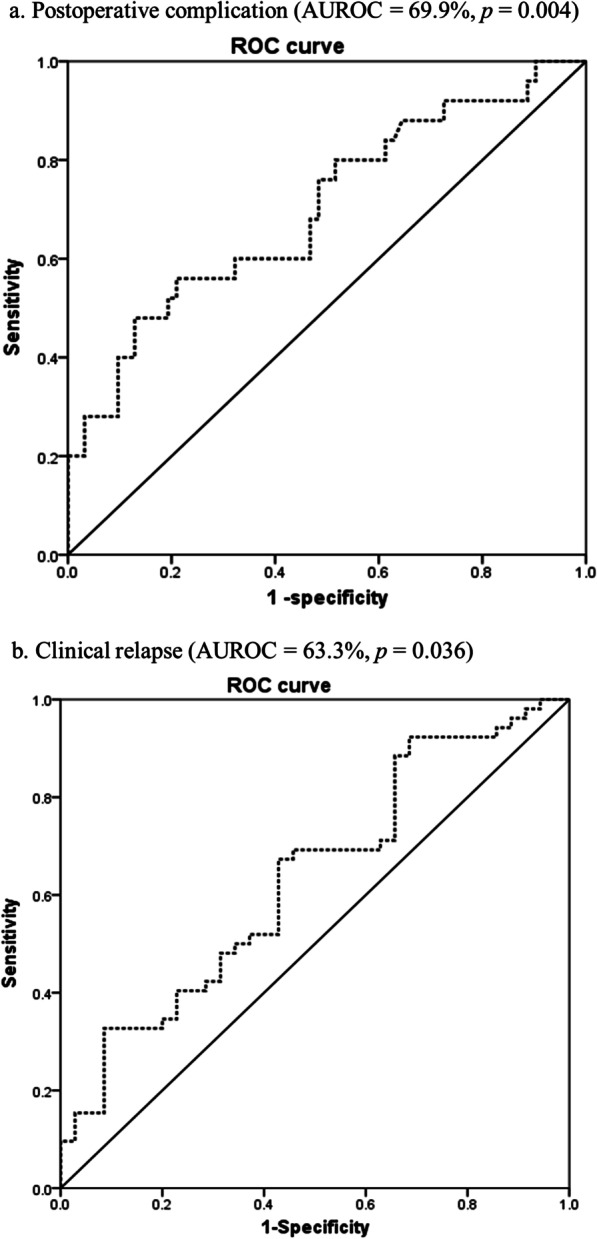
Ninety patients with intestinal BD were included. Among them, 44 were male (48.9%), and the median age at diagnosis was 38 years (range, 11-69 years). The median total disease follow-up duration was 130 months (range, 3-460 months). Forty patients (44.4%) underwent laparoscopic surgery. A higher CRP level immediately after surgery was significantly associated with postoperative complications (OR 1.01, 95% CI 1.004-1.018, p < 0.01), re-operation (hazard ratio [HR] 1.01, 95% CI 1.005-1.020, p < 0.01), and re-admission (HR 1.01, 95% CI 1.006-1.017 p < 0.01). The ROC curve showed that CRP predicts the risk of postoperative complications (p < 0.01) at a cut-off value of 41.9% with a sensitivity of 60.0% and specificity of 67.7%.
Postoperative CRP levels in patients with intestinal BD undergoing surgical resection were associated with postoperative outcomes.
患有肠道贝赫切特病(BD)的患者经常需要进行肠道切除术,这会显著影响术后发病率和死亡率。本研究旨在确定 C 反应蛋白(CRP)水平与接受肠道 BD 手术的患者术后结局之间的关系。
回顾性调查了 2005 年 11 月至 2018 年 4 月在 Severance 医院因 BD 接受肠道手术的肠道 BD 患者。临床复发定义为 BD 疾病活动指数(DAIBD)>40、存在新添加的药物、因 BD 再次住院或再次手术。分析了 CRP 水平与术后结局的关系,并绘制了受试者工作特征(ROC)曲线以确定临界值。
纳入了 90 例肠道 BD 患者,其中 44 例为男性(48.9%),诊断时的中位年龄为 38 岁(范围,11-69 岁)。中位总疾病随访时间为 130 个月(范围,3-460 个月)。40 例(44.4%)接受了腹腔镜手术。术后即刻 CRP 水平较高与术后并发症显著相关(OR 1.01,95%CI 1.004-1.018,p<0.01)、再次手术(风险比 [HR] 1.01,95%CI 1.005-1.020,p<0.01)和再次入院(HR 1.01,95%CI 1.006-1.017,p<0.01)。ROC 曲线显示 CRP 在截值为 41.9%时预测术后并发症的风险(p<0.01),敏感性为 60.0%,特异性为 67.7%。
接受肠道切除术的肠道 BD 患者术后 CRP 水平与术后结局相关。