
经颅直流电刺激和功能性电刺激对中风患者下肢功能的影响。
The Effect of Transcranial Direct Current Stimulation and Functional Electrical Stimulation on the Lower Limb Function of Stroke Patients.
作者信息
Zhang Xiao-Hua, Gu Tao, Liu Xuan-Wei, Han Ping, Lv Hui-Lan, Wang Yu-Long, Xiao Peng
机构信息
Department of Rehabilitation, Shenzhen Dapeng New District Nanao People's Hospital, Shenzhen, China.
Department of Rehabilitation, The First Affiliated Hospital, Shenzhen University, Shenzhen Second People's Hospital, Shenzhen, China.
出版信息
Front Neurosci. 2021 Sep 21;15:685931. doi: 10.3389/fnins.2021.685931. eCollection 2021.
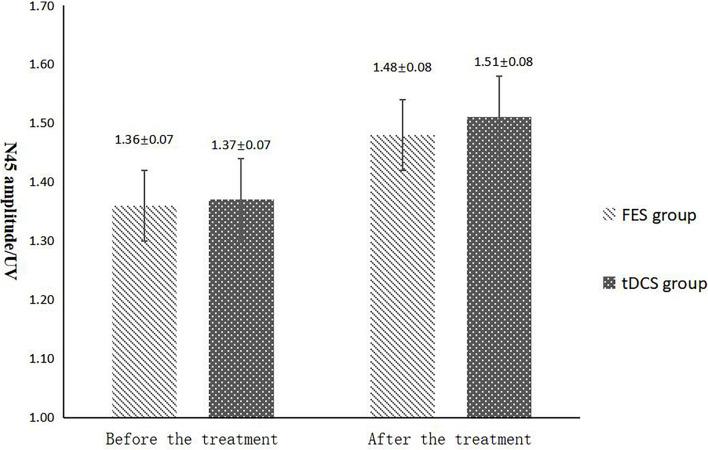
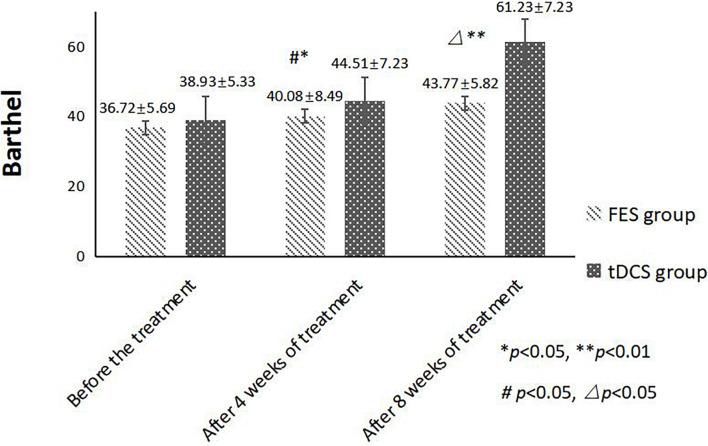
This study aimed to research the effect of transcranial direct current stimulation (tDCS) and functional electrical stimulation (FES) on the lower limb function of post-convalescent stroke patients. A total of 122 patients in the stroke recovery stage who suffered from leg dysfunction were randomly divided into two groups: a tDCS group ( = 61) and a FES group ( = 61). All patients received same routine rehabilitation and equal treatment quality, the tDCS group was treated with tDCS, while the FES group received FES. The lower limb Fugl-Meyer assessment (FMA), modified Barthel index (MBI), functional ambulatory category (FAC), and somatosensory evoked potential (SEP) were used to assess the patients at three different stages: prior to treatment, 4 weeks after treatment, and 8 weeks after treatment. The assessment scores for FMA, MBI, and FAC for the lower extremities after treatment ( > 0.05) were compared with those before treatment. The FMA, MBI, and FAC scores of the tDCS group were significantly higher than those of the FES group in all three stages ( < 0.05). The FMA, MBI, and FAC assessment scores of both groups were significantly higher after 4 weeks of treatment than that before treatment, and the scores after 8 weeks of treatment were significantly higher than those after 4 weeks after treatment ( < 0.05). The P40, N45 latencies decreased and the P40, N45 amplitudes increased, but there was no significant difference before treatment and after treatment ( >0.05), and there was no significant difference of the tDCS and FES groups before treatment and after treatment. In conclusion, FMA, MBI, and FAC indicate that both tDCS and FES can significantly promote the recovery of a patient's leg motor function and tDCS is more effective than FES in the stroke recovery stage. The application value of SEP in stroke patients remains to be further studied.
本研究旨在探讨经颅直流电刺激(tDCS)和功能性电刺激(FES)对脑卒中恢复期患者下肢功能的影响。将122例处于脑卒中恢复阶段且存在腿部功能障碍的患者随机分为两组:tDCS组(n = 61)和FES组(n = 61)。所有患者均接受相同的常规康复治疗且治疗质量均等,tDCS组采用tDCS治疗,而FES组接受FES治疗。采用下肢Fugl - Meyer评估量表(FMA)、改良Barthel指数(MBI)、功能性步行分类(FAC)和体感诱发电位(SEP)在三个不同阶段对患者进行评估:治疗前、治疗后4周和治疗后8周。比较治疗后(P>0.05)下肢FMA、MBI和FAC的评估得分与治疗前的得分。在所有三个阶段,tDCS组的FMA、MBI和FAC得分均显著高于FES组(P<0.05)。两组的FMA、MBI和FAC评估得分在治疗4周后均显著高于治疗前,且治疗8周后的得分显著高于治疗4周后的得分(P<0.05)。P40、N45潜伏期缩短,P40、N45波幅增大,但治疗前后无显著差异(P>0.05),tDCS组和FES组治疗前后也无显著差异。总之,FMA、MBI和FAC表明tDCS和FES均可显著促进患者腿部运动功能的恢复,且在脑卒中恢复阶段tDCS比FES更有效。SEP在脑卒中患者中的应用价值仍有待进一步研究。



 Zotero 插件