Hureaux Marguerite, Mazurkiewicz Stephani, Boccio Valerie, Vargas-Poussou Rosa, Jeunemaitre Xavier
Université de Paris, INSERM, Paris Cardiovascular Research Centre, Paris, France.
Assistance Publique-Hôpitaux de Paris, Hôpital Européen Georges Pompidou, Service de Génétique et Centre de Référence des Maladies Rénales Héréditaires Rares (MARHEA), Paris, France.
Kidney Int Rep. 2021 Aug 2;6(10):2639-2652. doi: 10.1016/j.ekir.2021.07.025. eCollection 2021 Oct.
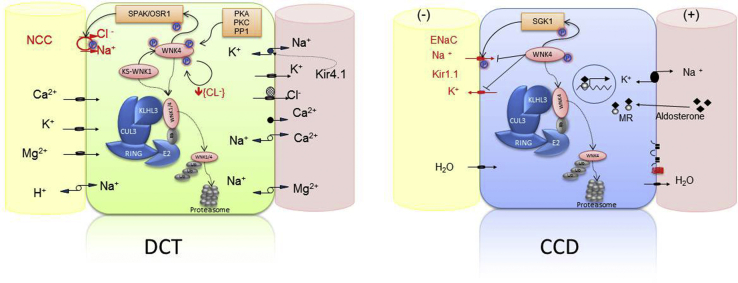
Familial hyperkalemic hypertension is a rare inherited form of arterial hypertension. Four genes are responsible for this disease, the variants of these genes cause disruption in the regulation of ion transport in the distal renal tubule. Whether the genotype explains the large phenotypic heterogeneity has not been fully explored.
We retrospectively analyzed clinical and genetic data of 153 cases (84 probands, 69 relatives) with familial hyperkalemic hypertension.
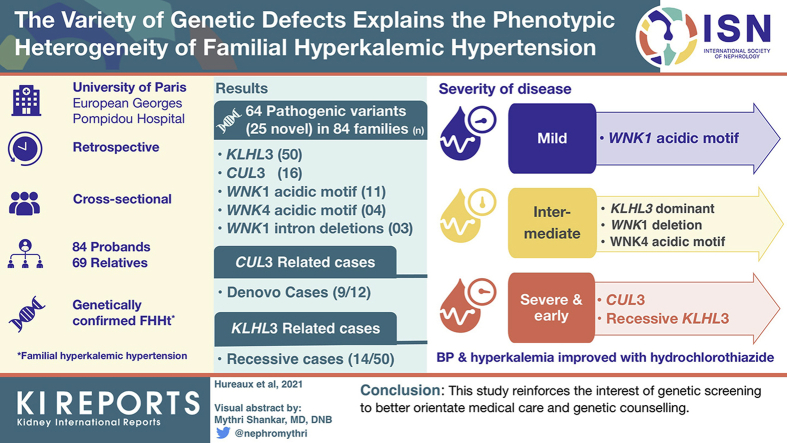
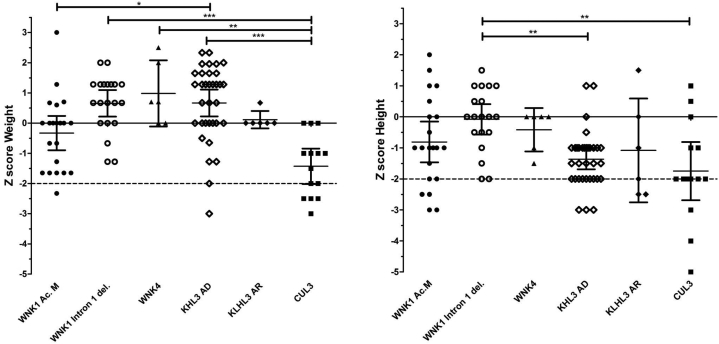
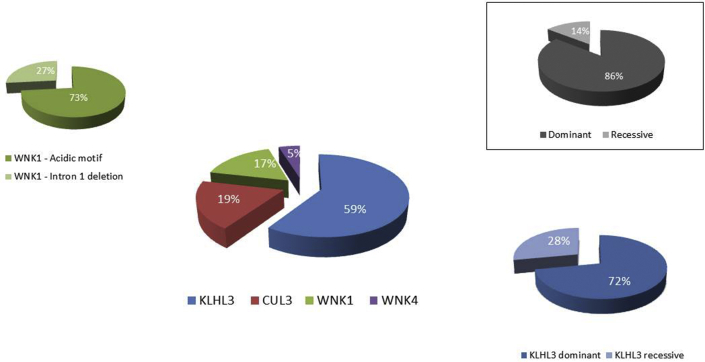
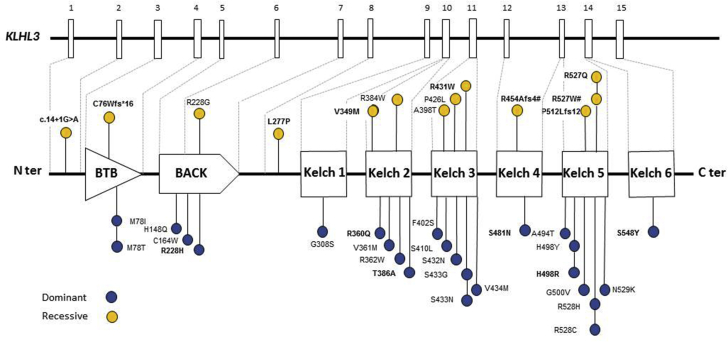
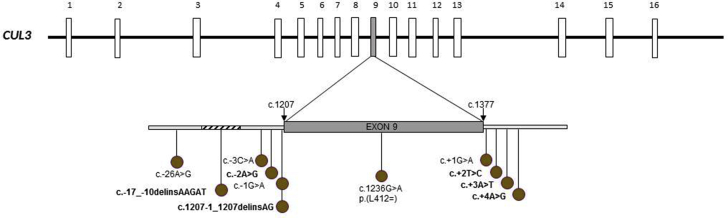
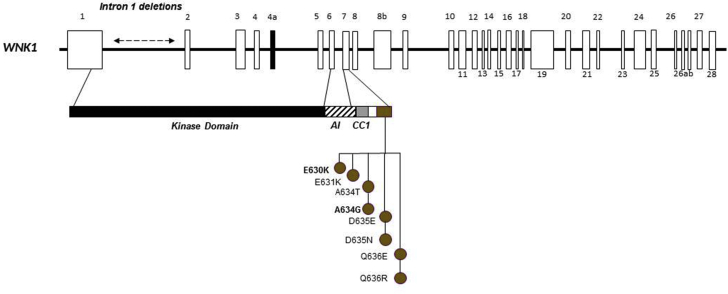
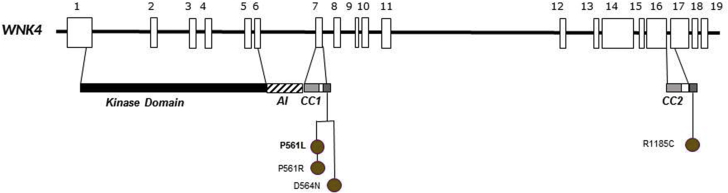
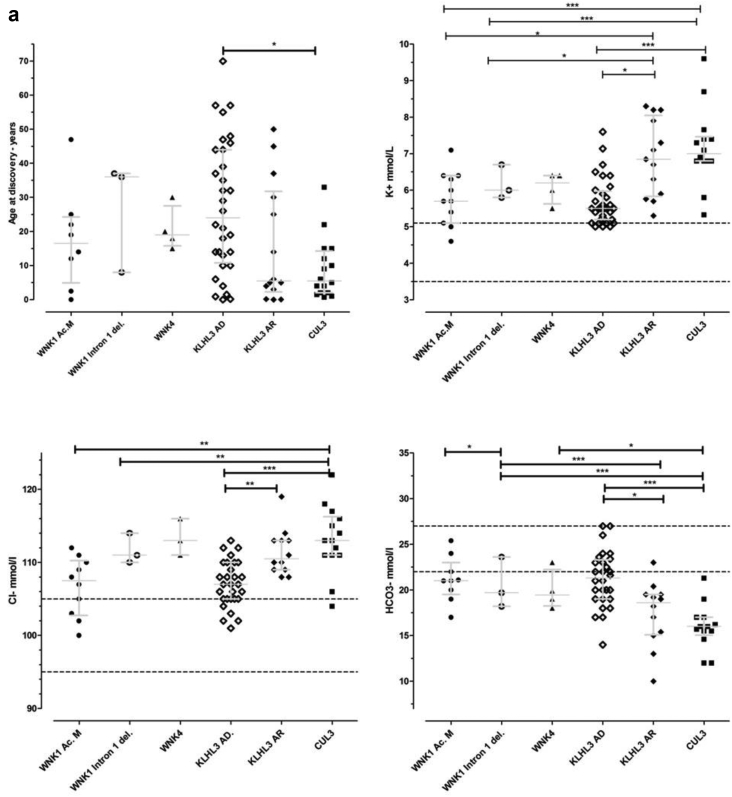
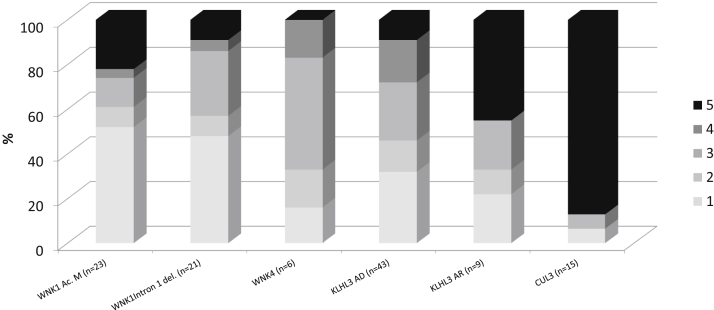
Pathogenic variants (25 novel variants) were identified as follows: (n = 50), (n = 16), acidic motif (n = 11), acidic motif (n = 4) and intron 1 deletions (n = 3). cases were mainly observed in the -related cases (9 of 12) and recessive cases were only observed in -related cases (14 of 50). More severe forms were observed in recessive and cases that were also associated with growth retardation. Patients with acidic motif variants had a typical biological phenotype and lower frequency of hypertension conversely to variants affecting the same motif. Patients with heterozygous and deletions had milder forms. Familial screening in 178 relatives allowed detection and care for 69 positive cases. Blood pressure and hyperkalemia were improved by hydrochlorothiazide in all groups.
This study confirms the phenotypic variability ranging from the severe and early forms associated with and recessive genotypes through intermediate forms associated with dominant, and deletion to mild form associated with acidic motif genotype and reinforces the interest of genetic screening to better orientate medical care and genetic counseling.
家族性高钾性高血压是一种罕见的遗传性动脉高血压形式。有四个基因与这种疾病相关,这些基因的变异会导致远端肾小管离子转运调节的紊乱。基因型是否能解释巨大的表型异质性尚未得到充分探索。
我们回顾性分析了153例家族性高钾性高血压患者(84例先证者,69例亲属)的临床和基因数据。
鉴定出致病性变异(25个新变异)如下:(n = 50),(n = 16),酸性基序(n = 11),酸性基序(n = 4)和内含子1缺失(n = 3)。病例主要在相关病例中观察到(12例中的9例),隐性病例仅在相关病例中观察到(50例中的14例)。在隐性和病例中观察到更严重的形式,这些病例也与生长发育迟缓有关。与影响相同基序的变异相反,具有酸性基序变异的患者具有典型的生物学表型且高血压发生率较低。杂合子和缺失患者的病情较轻。对178名亲属进行家族筛查,发现并护理了69例阳性病例。所有组中氢氯噻嗪均可改善血压和高钾血症。
本研究证实了表型变异性,范围从与和隐性基因型相关的严重和早期形式,到与显性、和缺失相关的中间形式,再到与酸性基序基因型相关的轻度形式,并强化了基因筛查对于更好地指导医疗护理和遗传咨询的重要性。