State Key Laboratory of Mycology, Institute of Microbiology, Chinese Academy of Sciences, Beijing, China.
University of Chinese Academy of Sciences, Beijing, China.
PLoS Genet. 2021 Oct 8;17(10):e1009817. doi: 10.1371/journal.pgen.1009817. eCollection 2021 Oct.
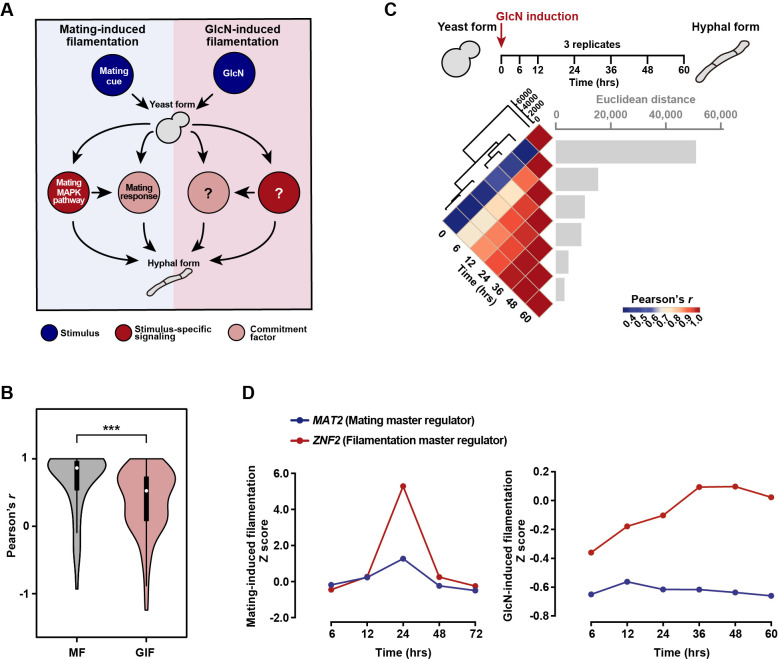
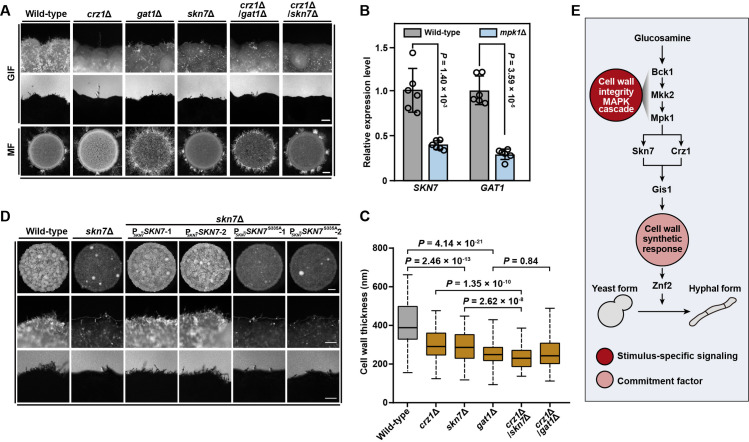
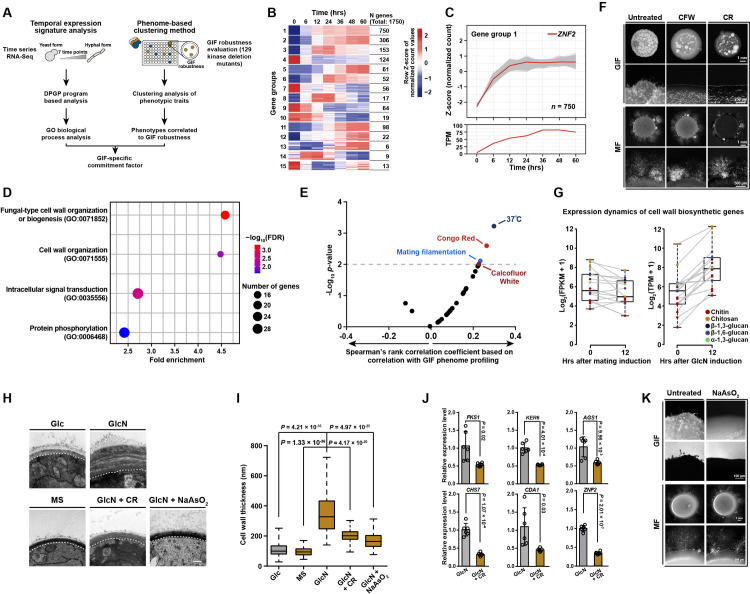
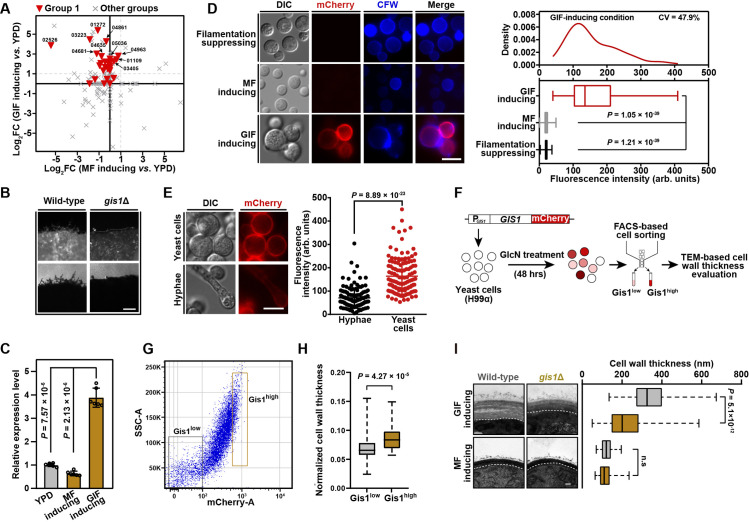
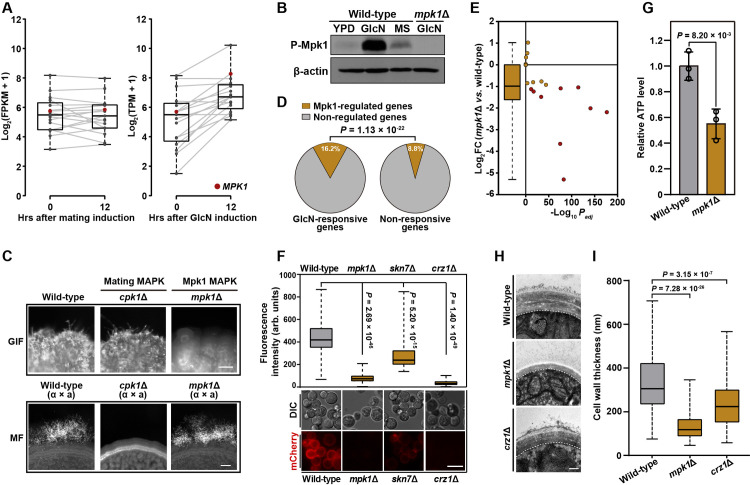
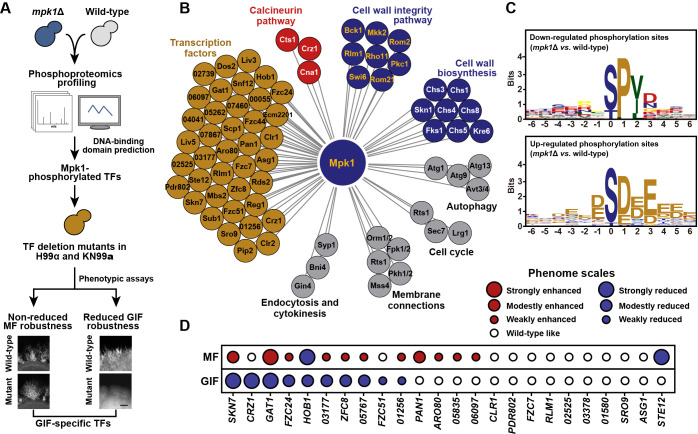
The yeast-to-hypha transition is tightly associated with pathogenicity in many human pathogenic fungi, such as the model fungal pathogen Cryptococcus neoformans, which is responsible for approximately 180,000 deaths annually. In this pathogen, the yeast-to-hypha transition can be initiated by distinct stimuli: mating stimulation or glucosamine (GlcN), the monomer of cell wall chitosan. However, it remains poorly understood how the signal specificity for Cryptococcus morphological transition by disparate stimuli is ensured. Here, by integrating temporal expression signature analysis and phenome-based clustering evaluation, we demonstrate that GlcN specifically triggers a unique cellular response, which acts as a critical determinant underlying the activation of GlcN-induced filamentation (GIF). This cellular response is defined by an unusually hyperactive cell wall synthesis that is highly ATP-consuming. A novel cell surface protein Gis1 was identified as the indicator molecule for the GlcN-induced cell wall response. The Mpk1-directed cell wall pathway critically bridges global cell wall gene induction and intracellular ATP supply, ensuring the Gis1-dependent cell wall response and the stimulus specificity of GIF. We further reveal that the ability of Mpk1 to coordinate the cell wall response and GIF activation is conserved in different Cryptococcus pathogens. Phosphoproteomics-based profiling together with genetic and phenotypic analysis revealed that the Mpk1 kinase mediates the regulatory specificity of GIF through a coordinated downstream regulatory network centered on Skn7 and Crz1. Overall, our findings discover an unprecedented and conserved cell wall biosynthesis-dependent fungal differentiation commitment mechanism, which enables the signal specificity of pathogenicity-related dimorphism induced by GlcN in Cryptococcus pathogens.
酵母到菌丝的转变与许多人类致病真菌的致病性密切相关,例如模型真菌病原体新型隐球菌,它每年导致约 18 万人死亡。在这种病原体中,酵母到菌丝的转变可以由不同的刺激物引发:交配刺激或葡糖胺(GlcN),即几丁质细胞壁的单体。然而,不同刺激物如何确保隐球菌形态转变的信号特异性仍然知之甚少。在这里,通过整合时间表达特征分析和表型聚类评估,我们证明 GlcN 特异性地触发独特的细胞反应,这是激活 GlcN 诱导丝状形成(GIF)的关键决定因素。这种细胞反应的特点是细胞壁合成异常活跃,高度消耗 ATP。一种新型细胞表面蛋白 Gis1 被鉴定为 GlcN 诱导的细胞壁反应的指示分子。Mpk1 定向的细胞壁途径将全局细胞壁基因诱导和细胞内 ATP 供应关键联系起来,确保了 Gis1 依赖性细胞壁反应和 GIF 的刺激特异性。我们进一步揭示,Mpk1 协调细胞壁反应和 GIF 激活的能力在不同的隐球菌病原体中是保守的。基于磷酸化蛋白质组学的分析以及遗传和表型分析表明,Mpk1 激酶通过以 Skn7 和 Crz1 为中心的协调下游调控网络介导 GIF 的调控特异性。总的来说,我们的发现揭示了一种前所未有的、保守的细胞壁生物合成依赖性真菌分化决定机制,它使葡糖胺在隐球菌病原体中诱导的致病性相关二态性的信号特异性成为可能。