School of Public Health, University of Health and Allied Sciences, Hohoe, Ghana.
Department of Public Health, Yonsei University Graduate School, Seoul, Republic of Korea.
PLoS One. 2021 Oct 8;16(10):e0258105. doi: 10.1371/journal.pone.0258105. eCollection 2021.
Over the past two decades, there have been several global interventions including the Sustainable Development Goals (SDGs), aimed at improving health outcomes. Despite efforts by countries to achieve the SDG targets, mental health challenges remain major public health concerns globally. We examined the prevalence and predictors of depression, anxiety, and stress as well as the comorbidities of these mental health issues among adults.
This was a community-based cross-sectional study conducted among 2456 adults in four districts of the Volta Region of Ghana using data from the UHAS-Yonsei University Partnership Project. We analysed the data using frequency, percentage, mean, standard deviation, correlation, and binary logistic regression.
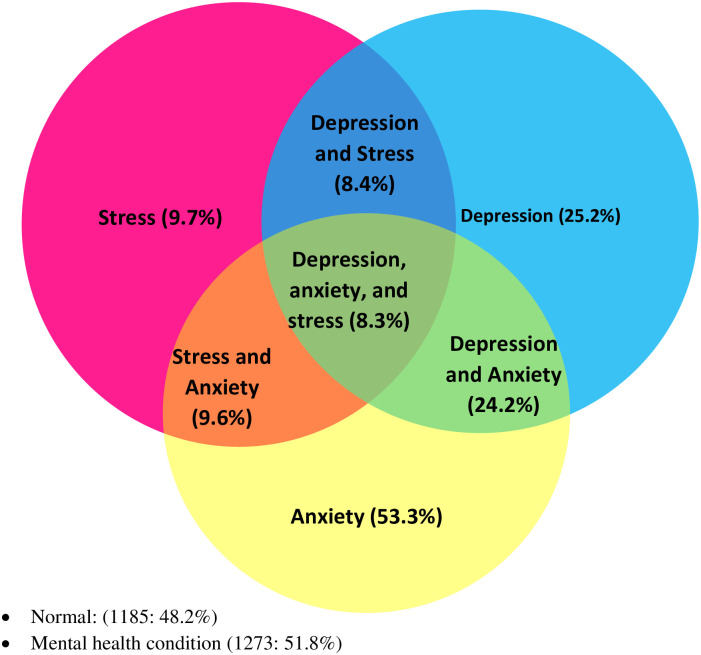
Overall, 51.8% of the participants had at least one of the mental health issues examined. The prevalence of a mental health issue was 25.2%, 53.3%, and 9.7% for depression, anxiety, and stress respectively. Participants constituting 8.3% experienced all three mental health issues as comorbidities. Participants' level of formal education and income significantly predicted depression, anxiety, and stress respectively at the multivariable level. Adults with a tertiary level of education were, for instance, 68% (AOR = 0.32, 95%CI = 0.15-0.66), 65% (AOR = 0.35, 95%CI = 0.17-0.73), and 50% (AOR = 0.50, 95%CI = 0.33-0.76) less likely to experience depression, anxiety, and stress, respectively compared with those who had no formal education.
The majority of our study participants either experienced depression, anxiety, or stress. There were quite high comorbidities of the mental health issues among the adult population. To accelerate progress towards the achievement of SDG 3.4 target of promoting mental health and wellbeing for all by the year 2030, there is a need for effective implementation of the country's 2012 Mental Health Act which makes provisions for the establishment of a Mental Health Fund. This could improve the financial circumstances of indigenes as income has been realised in the present study as an important factor influencing depression, anxiety, and stress among the adult population.
在过去的二十年中,全球范围内开展了多项干预措施,包括可持续发展目标(SDGs),旨在改善健康结果。尽管各国努力实现 SDG 目标,但精神健康挑战仍是全球主要的公共卫生关注点。我们研究了成年人中抑郁、焦虑和压力的患病率和预测因素,以及这些心理健康问题的合并症。
这是一项在加纳沃尔特地区四个区进行的基于社区的横断面研究,使用了 UHAS-延世大学伙伴关系项目的数据,共纳入 2456 名成年人。我们使用频率、百分比、均值、标准差、相关性和二元逻辑回归分析数据。
总体而言,51.8%的参与者至少存在一种研究的心理健康问题。抑郁、焦虑和压力的患病率分别为 25.2%、53.3%和 9.7%。8.3%的参与者同时患有这三种心理健康问题。参与者的正规教育程度和收入水平在多变量水平上显著预测抑郁、焦虑和压力。例如,具有高等教育程度的成年人患抑郁、焦虑和压力的风险分别降低 68%(AOR=0.32,95%CI=0.15-0.66)、65%(AOR=0.35,95%CI=0.17-0.73)和 50%(AOR=0.50,95%CI=0.33-0.76)。
我们的大多数研究参与者经历了抑郁、焦虑或压力。成年人的心理健康问题合并症相当高。为了加快实现 2030 年实现人人享有促进精神健康和幸福的可持续发展目标 3.4 的进展,需要有效执行该国 2012 年的《精神卫生法》,该法规定设立精神卫生基金。这可以改善当地人的财务状况,因为收入是本研究中影响成年人中抑郁、焦虑和压力的一个重要因素。