Faculty of Psychology, University of Warsaw, 5/7 Stawki St., 00-183, Warsaw, Poland.
J Psycholinguist Res. 2023 Feb;52(1):33-56. doi: 10.1007/s10936-021-09815-x. Epub 2021 Oct 10.
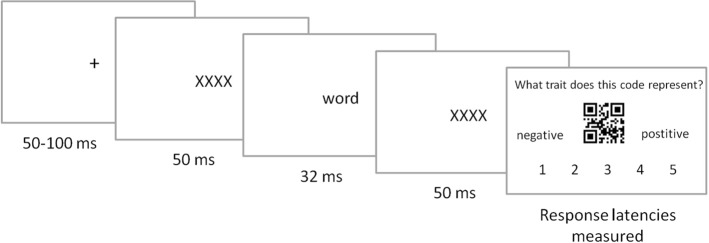
In the verbal affective priming paradigm, the properties of a subliminally presented stimulus alter the interpretation of neutral target stimulus. In the experiment reported here, we tested the role of four factors (valence, origin, arousing properties and subjective significance) that determine the emotional reactions to words in affective priming. Subliminal masked presentation of words preceded the explicit task, which was assessment of neutral Quick Response code (QR code) stimuli. The QRs were codes for words representing personality traits. The results showed the effect of assimilation (negative words caused a negative interpretation, positive caused a positive interpretation) for words' emotional valence and no effects for origin. Concerning arousal, we found a weak negative trend. In the case of subjective significance, a moderate positive trend was found. These results suggest that affective priming effects are susceptible not only to the valence of priming stimuli but also to activation factors.
在言语情感启动范式中,潜意识呈现的刺激的属性会改变对中性目标刺激的解释。在本实验中,我们测试了四个因素(情感效价、来源、唤醒特性和主观意义)在情感启动中对单词的情感反应的作用。在明确任务(即评估代表个性特征的单词的中性快速响应码 (QR) 码)之前,对单词进行了潜意识的掩蔽呈现。结果表明,对于单词的情感效价,同化效应(负面单词导致负面解释,正面单词导致正面解释),而对于来源则没有影响。关于唤醒,我们发现了一个微弱的负趋势。在主观意义方面,发现了一个中等的正趋势。这些结果表明,情感启动效应不仅受启动刺激的效价影响,还受激活因素的影响。