Rousslang Lee K, Rooks Elizabeth A, Meldrum Jaren T, Hooten Kristopher G, Wood Jonathan R
Department of Radiology, Tripler Army Medical Center, Medical Center, HI 96859, United States.
Department of Neuroscience, Duke University, Durham, NC 27708, United States.
World J Radiol. 2021 Sep 28;13(9):307-313. doi: 10.4329/wjr.v13.i9.307.
Symptomatic neonatal subdural hematomas usually result from head trauma incurred during vaginal delivery, most commonly during instrument assistance. Symptomatic subdural hematomas are rare in C-section deliveries that were not preceded by assisted delivery techniques. Although the literature is inconclusive, another possible cause of subdural hematomas is therapeutic hypothermia.
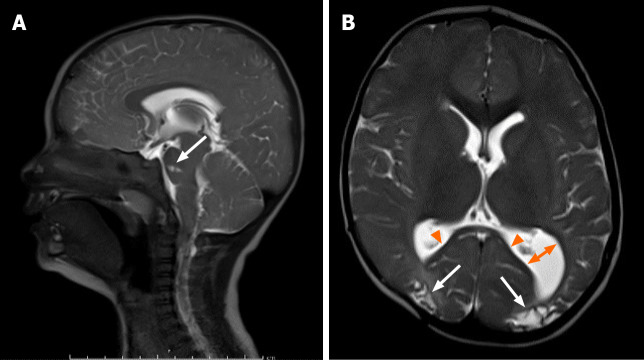
We present a case of a term neonate who underwent therapeutic whole-body cooling for hypoxic ischemic encephalopathy following an emergent C-section delivery for prolonged decelerations. Head ultrasound on day of life 3 demonstrated a rounded mass in the posterior fossa. A follow-up brain magnetic resonance imaging confirmed hypoxic ischemic encephalopathy and clarified the subdural hematomas in the posterior fossa causing mass effect and obstructive hydrocephalus.
The aim of this report is to highlight the rarity and importance of mass-like subdural hematomas causing obstructive hydrocephalus, particularly in the setting of hypoxic ischemic encephalopathy and therapeutic whole-body cooling.
有症状的新生儿硬膜下血肿通常由阴道分娩时的头部创伤引起,最常见于器械助产过程中。在未采用助产技术的剖宫产分娩中,有症状的硬膜下血肿很少见。尽管文献尚无定论,但硬膜下血肿的另一个可能原因是治疗性低温。
我们报告一例足月儿,因长时间减速行急诊剖宫产术后,因缺氧缺血性脑病接受了治疗性全身降温。出生第3天的头部超声显示后颅窝有一个圆形肿块。后续的脑部磁共振成像证实了缺氧缺血性脑病,并明确了后颅窝硬膜下血肿导致占位效应和梗阻性脑积水。
本报告的目的是强调导致梗阻性脑积水的肿块样硬膜下血肿的罕见性和重要性,尤其是在缺氧缺血性脑病和治疗性全身降温的情况下。