Manaseer Thaer, Whittaker Jackie L, Isaac Codi, Schneider Kathryn J, Gross Douglas P
Department of Physical Therapy, Faculty of Rehabilitation Medicine, University of Alberta;Department of Sport Rehabilitation, Faculty of Physical Education and Sport Sciences, the Hashemite University.
Department of Physical Therapy, Faculty of Rehabilitation Medicine, University of Alberta; Department of Physical Therapy, Faculty of Medicine, University of British Columbia; Arthritis Research Canada.
Int J Sports Phys Ther. 2021 Sep 1;16(5):1250-1259. doi: 10.26603/001c.28157. eCollection 2021.
There is no clinical tool that assesses multiple components of postural control potentially impacted by sport-related concussion (SRC).
To develop and assess the feasibility and construct validity of the Functional Assessment of Balance in Concussion (FAB-C) battery.
Cross-sectional study.
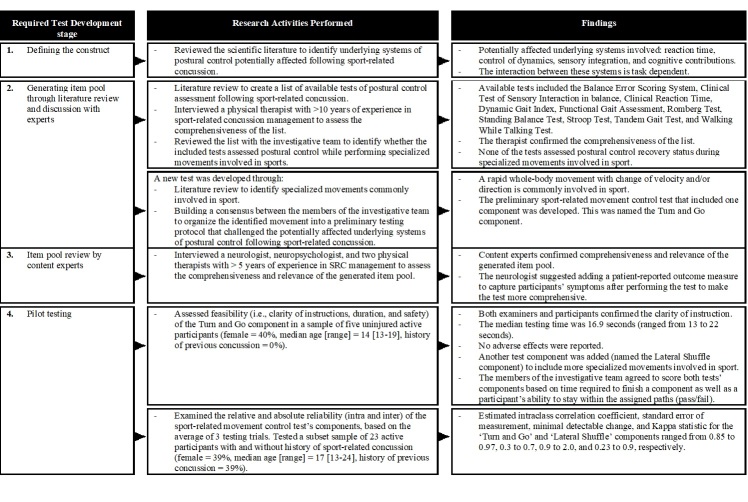
Tests for inclusion in the FAB-C battery were identified through a search of the literature. The feasibility and construct validity of the battery was assessed with a convenience sample of active individuals (13-24 years) with and without a SRC. Feasibility outcomes included battery completion (yes/no), number of adverse events, time to administer (minutes) and cost of the battery (Canadian Dollars). Construct validity was assessed by examining correlations between tests included in the battery, and describing differences [mean (standard deviation), median (range) or proportion] in outcomes between uninjured participants and participants with SRC.
Seven tests were included in the FAB-C battery. All 40 uninjured participants [12 female; median age 17 years] completed the FAB-C assessment compared to 86% of seven participants with SRC [1 female; median age 17]. No participants demonstrated adverse effects. The median administration time of the battery was 49 minutes (range 44-60). The cost of the battery was low (~$100 Canadian Dollars). Limited correlations (r<0.7) between tests in the battery were observed. A greater percentage of uninjured participants (52% to 82%) passed individual tests in the battery compared to participants with SRC (17% to 66%).
Although promising, the FAB-C battery requires further evaluation before adoption for widespread clinical use.
Level 3b.
目前尚无临床工具可评估可能受运动相关脑震荡(SRC)影响的姿势控制的多个组成部分。
开发并评估脑震荡平衡功能评估(FAB-C)测试组合的可行性和结构效度。
横断面研究。
通过文献检索确定纳入FAB-C测试组合的测试项目。采用便利抽样法,选取有或无SRC的活跃个体(13 - 24岁),评估该测试组合的可行性和结构效度。可行性结果包括测试组合完成情况(是/否)、不良事件数量、测试用时(分钟)以及测试组合成本(加元)。通过检查测试组合中各测试之间的相关性,并描述未受伤参与者与SRC参与者在结果上的差异[均值(标准差)、中位数(范围)或比例]来评估结构效度。
FAB-C测试组合包括七项测试。所有40名未受伤参与者[12名女性;年龄中位数17岁]完成了FAB-C评估,而7名SRC参与者中有86%[1名女性;年龄中位数17岁]完成了评估。没有参与者出现不良反应。测试组合的中位用时为49分钟(范围44 - 60分钟)。测试组合成本较低(约100加元)。观察到测试组合中各测试之间的相关性有限(r<0.7)。与SRC参与者(17%至66%)相比,未受伤参与者通过测试组合中单个测试的比例更高(52%至82%)。
尽管前景乐观,但FAB-C测试组合在广泛应用于临床之前还需要进一步评估。
3b级。