Ryu Dong Jin, Lee Sung-Sahn, Jung Eui Yub, Kim Joo Hwan, Shin Tae Soo, Wang Joon Ho
Department of Orthopaedic Surgery, Inha University Hospital, Incheon, Republic of Korea.
Department of Orthopaedic Surgery, Ilsan Paik Hospital, Inje University School of Medicine, Goyang-si, Republic of Korea.
Orthop J Sports Med. 2021 Oct 5;9(10):23259671211034151. doi: 10.1177/23259671211034151. eCollection 2021 Oct.
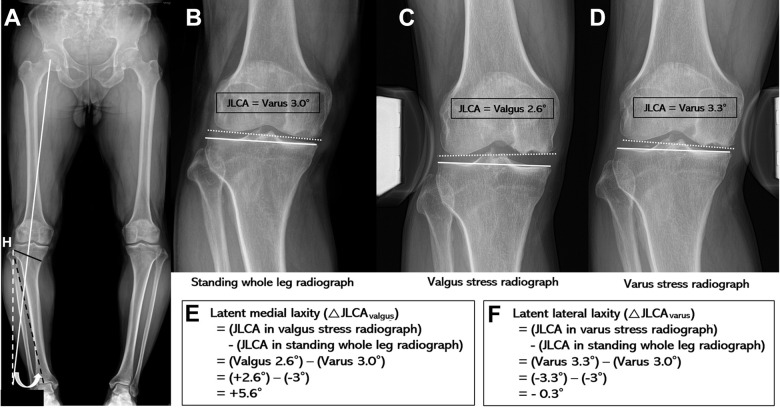
Soft tissue laxity around the knee joint has been recognized as a crucial factor affecting correction error during medial open-wedge proximal tibial osteotomy (MOWPTO). Medial laxity in particular, which represents the changes in joint-line convergence angle (JLCA), affects soft tissue correction.
The purpose of this study was to quantify medial laxity and develop a preoperative planning method that considers medial laxity.
Cohort study; Level of evidence, 3.
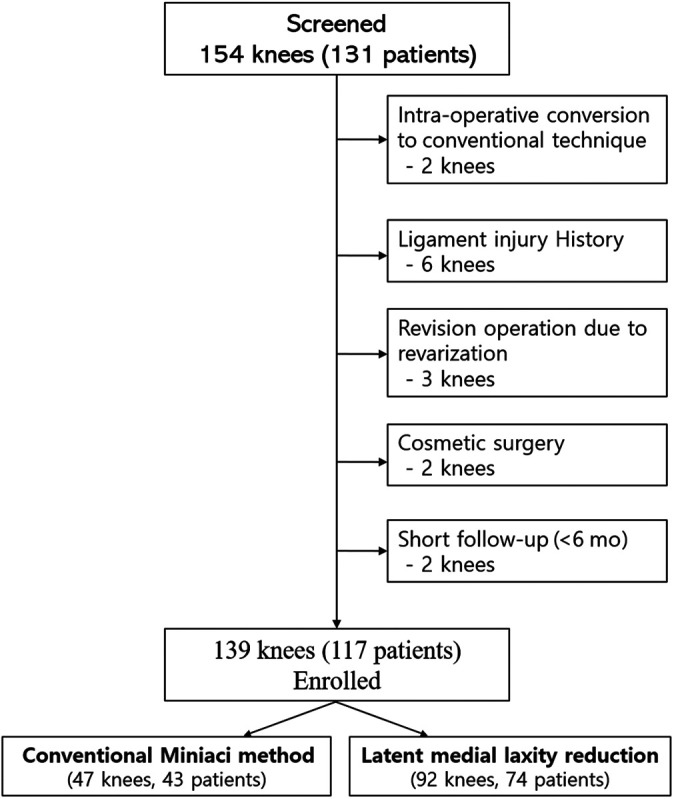
This study retrospectively reviewed 139 knees in 117 patients who underwent navigation-assisted MOWPTO from January 2014 to July 2019 for symptomatic medial compartment osteoarthritis with varus alignment >5°. We compared the results of 2 preoperative planning methods: conventional Miniaci (n = 47) and latent medial laxity reduction (LMLR) (n = 92). We evaluated the incidence of undercorrection, acceptable correction, and overcorrection. The radiologic parameters were analyzed using multiple linear regression with a stepwise selection model to establish an equation for the optimal preoperative planning method. The intraclass correlation coefficients (ICCs) of intraobserver, interobserver, and intermethod reliability were calculated.
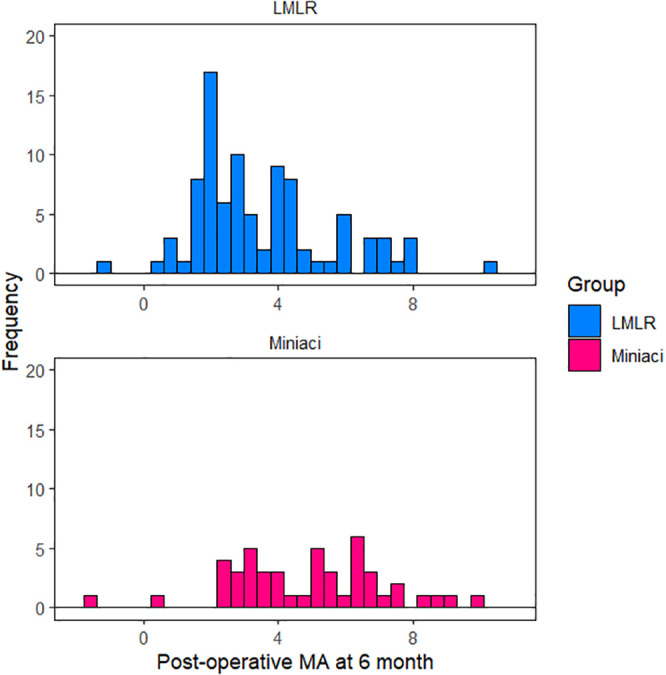
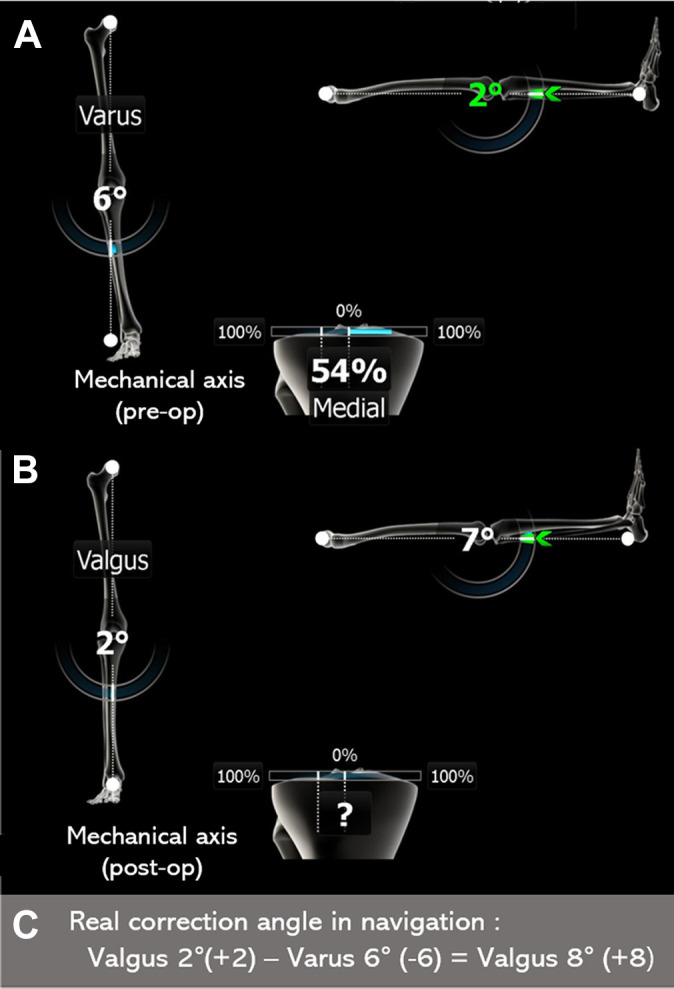
The Miniaci method showed a higher incidence of overcorrection (55.3%) than the LMLR method (22.8%) at postoperative 6 months ( = .0006). Multiple linear regression with a stepwise selection model revealed a high correlation coefficient ( = 0.888) for the following equation: = 0.596 + 0.891 × - 0.255 × Δ . Upon simplification, the following equation showed the highest intermethod ICC value (0.991): - ⅓Δ , while the Miniaci method showed a relatively low ICC value of 0.875.
There was a risk of overcorrection after MOWPTO using the conventional Miniaci method. An equation that considers medial laxity may help during preoperative planning for optimal correction during MOWPTO.
膝关节周围软组织松弛被认为是影响胫骨近端内侧开放性楔形截骨术(MOWPTO)矫正误差的关键因素。特别是内侧松弛,它代表关节线会聚角(JLCA)的变化,会影响软组织的矫正。
本研究的目的是量化内侧松弛,并开发一种考虑内侧松弛的术前规划方法。
队列研究;证据等级,3级。
本研究回顾性分析了2014年1月至2019年7月期间117例因症状性内侧间室骨关节炎且内翻畸形>5°接受导航辅助MOWPTO治疗的患者的139个膝关节。我们比较了两种术前规划方法的结果:传统的Miniaci法(n = 47)和潜在内侧松弛减少法(LMLR)(n = 92)。我们评估了矫正不足、可接受矫正和矫正过度的发生率。使用逐步选择模型的多元线性回归分析放射学参数,以建立最佳术前规划方法的方程。计算观察者内、观察者间和方法间可靠性的组内相关系数(ICC)。
术后6个月,Miniaci法的矫正过度发生率(55.3%)高于LMLR法(22.8%)(P = 0.0006)。逐步选择模型的多元线性回归显示,以下方程的相关系数较高(R = 0.888):矫正角度 = 0.596 + 0.891×目标矫正角度 - 0.255×JLCA变化量。简化后,以下方程显示出最高的方法间ICC值(0.991):矫正角度 - ⅓JLCA变化量,而Miniaci法的ICC值相对较低,为0.875。
使用传统Miniaci法进行MOWPTO术后存在矫正过度的风险。考虑内侧松弛的方程可能有助于MOWPTO术前规划以实现最佳矫正。