• 文献检索
  • 文档翻译
  • 深度研究
  • 学术资讯
  • Suppr Zotero 插件Zotero 插件
  • 邀请有礼
  • 套餐&价格
  • 历史记录
应用&插件
Suppr Zotero 插件Zotero 插件浏览器插件Mac 客户端Windows 客户端微信小程序
定价
高级版会员购买积分包购买API积分包
服务
文献检索文档翻译深度研究API 文档MCP 服务
关于我们
关于 Suppr公司介绍联系我们用户协议隐私条款
关注我们

Suppr 超能文献

核心技术专利:CN118964589B侵权必究
粤ICP备2023148730 号-1Suppr @ 2026

文献检索

告别复杂PubMed语法,用中文像聊天一样搜索,搜遍4000万医学文献。AI智能推荐,让科研检索更轻松。

立即免费搜索

文件翻译

保留排版,准确专业,支持PDF/Word/PPT等文件格式,支持 12+语言互译。

免费翻译文档

深度研究

AI帮你快速写综述,25分钟生成高质量综述,智能提取关键信息,辅助科研写作。

立即免费体验

累积围手术期模型:预测腹部外科癌症患者的30天死亡率

The Cumulative Perioperative Model: Predicting 30-Day Mortality in Abdominal Surgery Cancer Patients.

作者信息

Myers Risa B, Ruiz Joseph R, Jermaine Christopher M, Nates Joseph L

机构信息

Department of Computer Science, Rice University, Texas, USA.

Children's Environmental Health Initiative, Rice University, Texas, USA.

出版信息

J Surg Oncol (Tallinn). 2020;3. doi: 10.31487/j.jso.2020.01.10. Epub 2020 Mar 10.

DOI:10.31487/j.jso.2020.01.10
PMID:34632445
原文链接:https://pmc.ncbi.nlm.nih.gov/articles/PMC8496410/
Abstract

OBJECTIVES

  1. To develop a cumulative perioperative model (CPM) using the hospital clinical course of abdominal surgery cancer patients that predicts 30 and 90-day mortality risk; 2) To compare the predictive ability of this model to ten existing other models.

MATERIALS AND METHODS

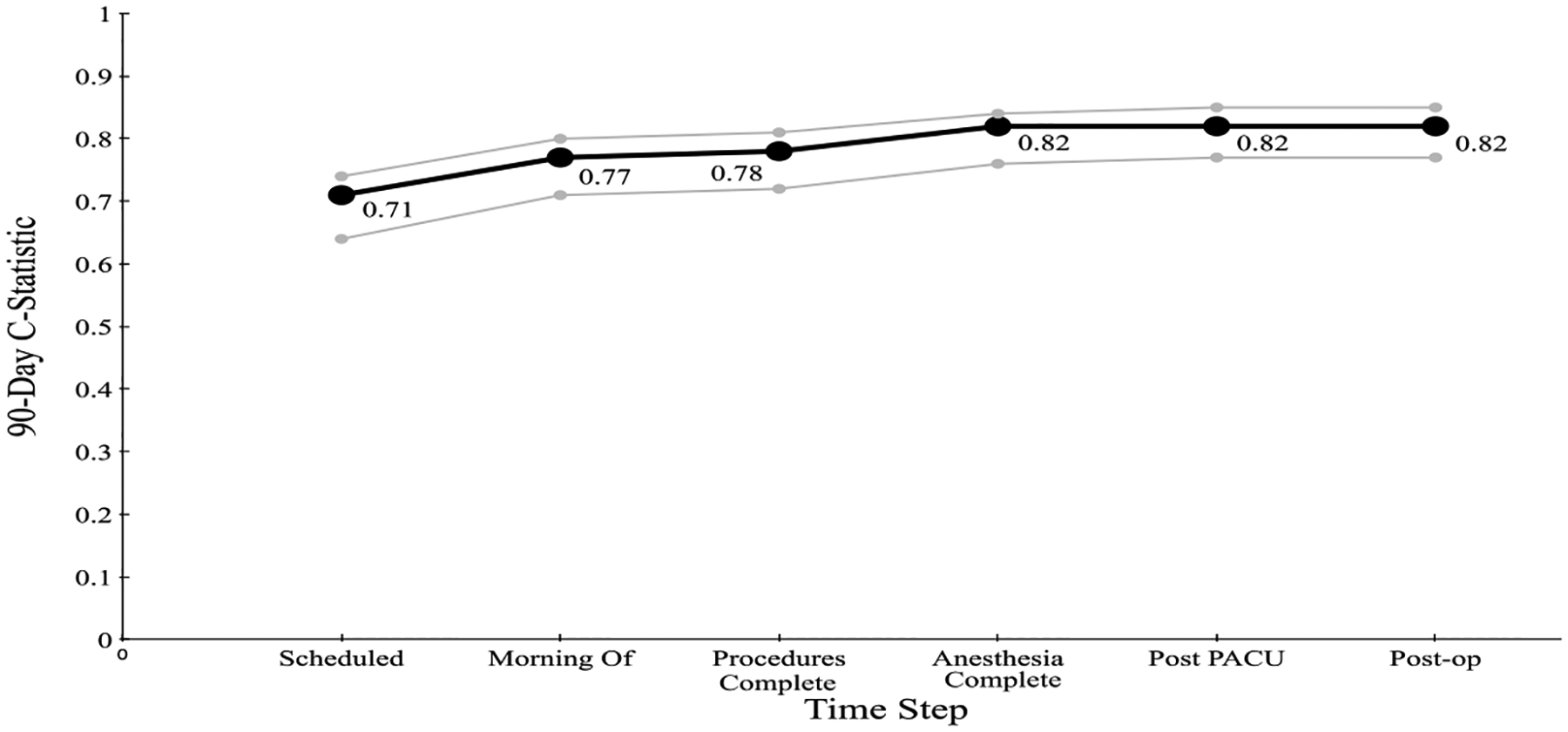
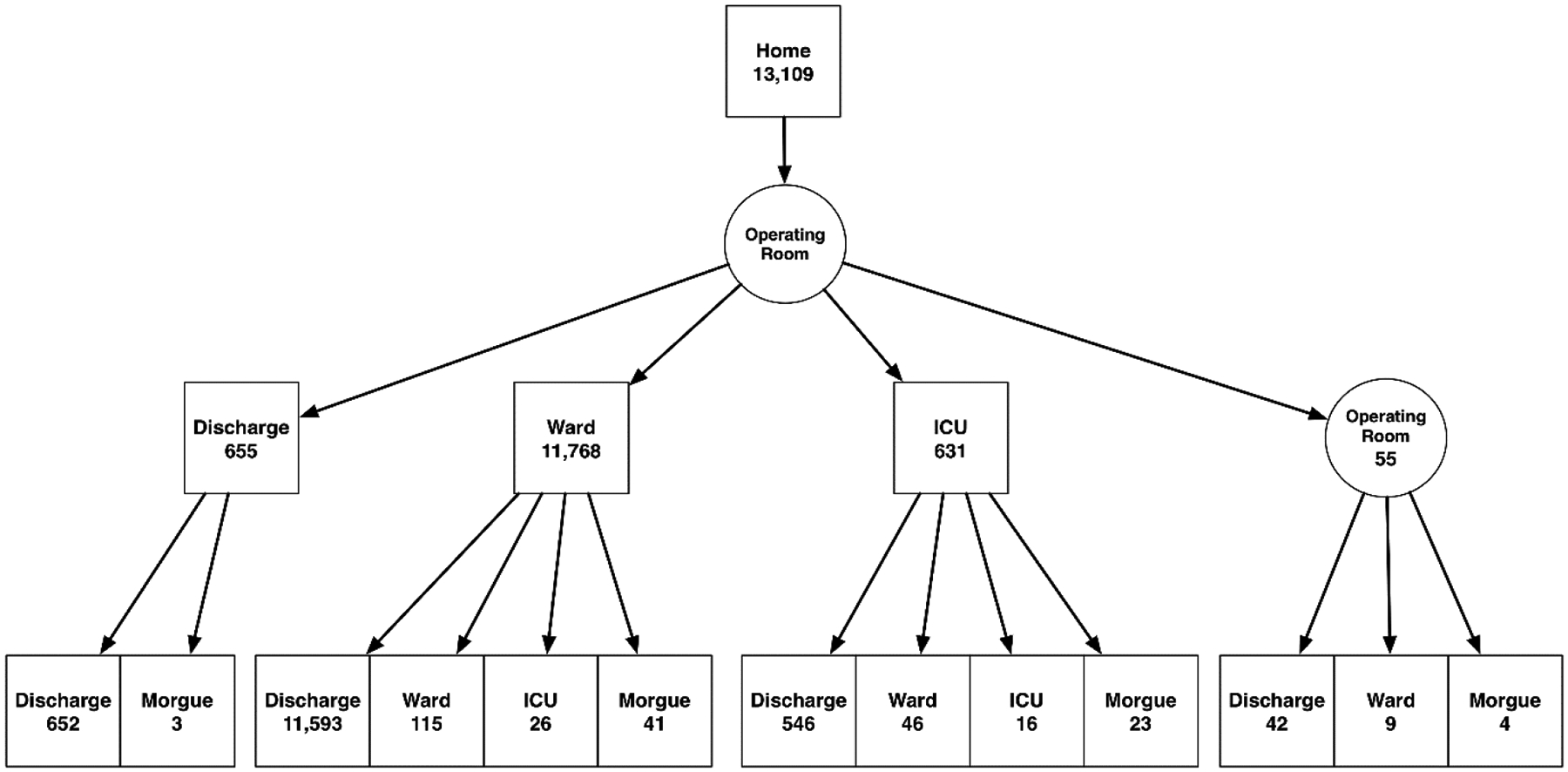
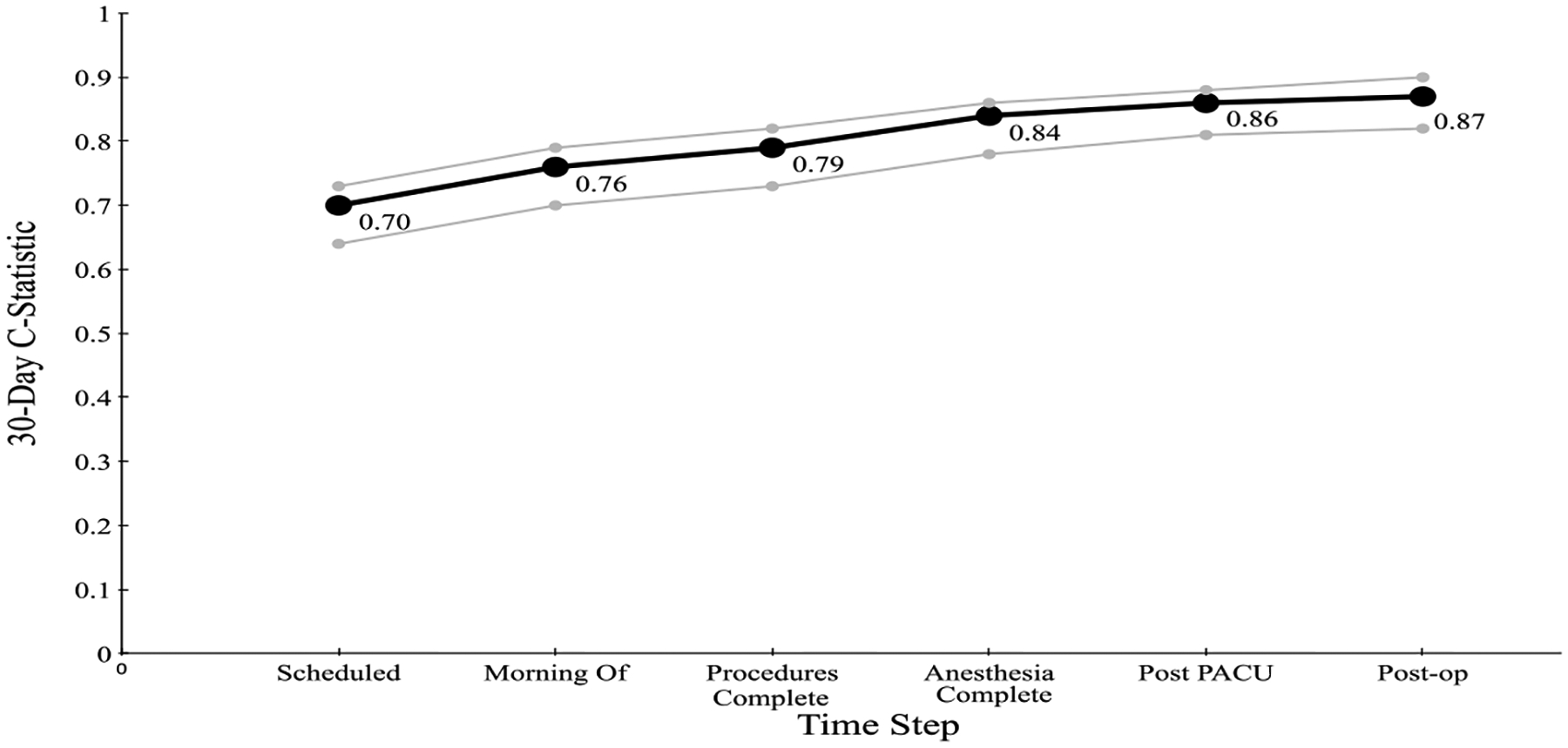
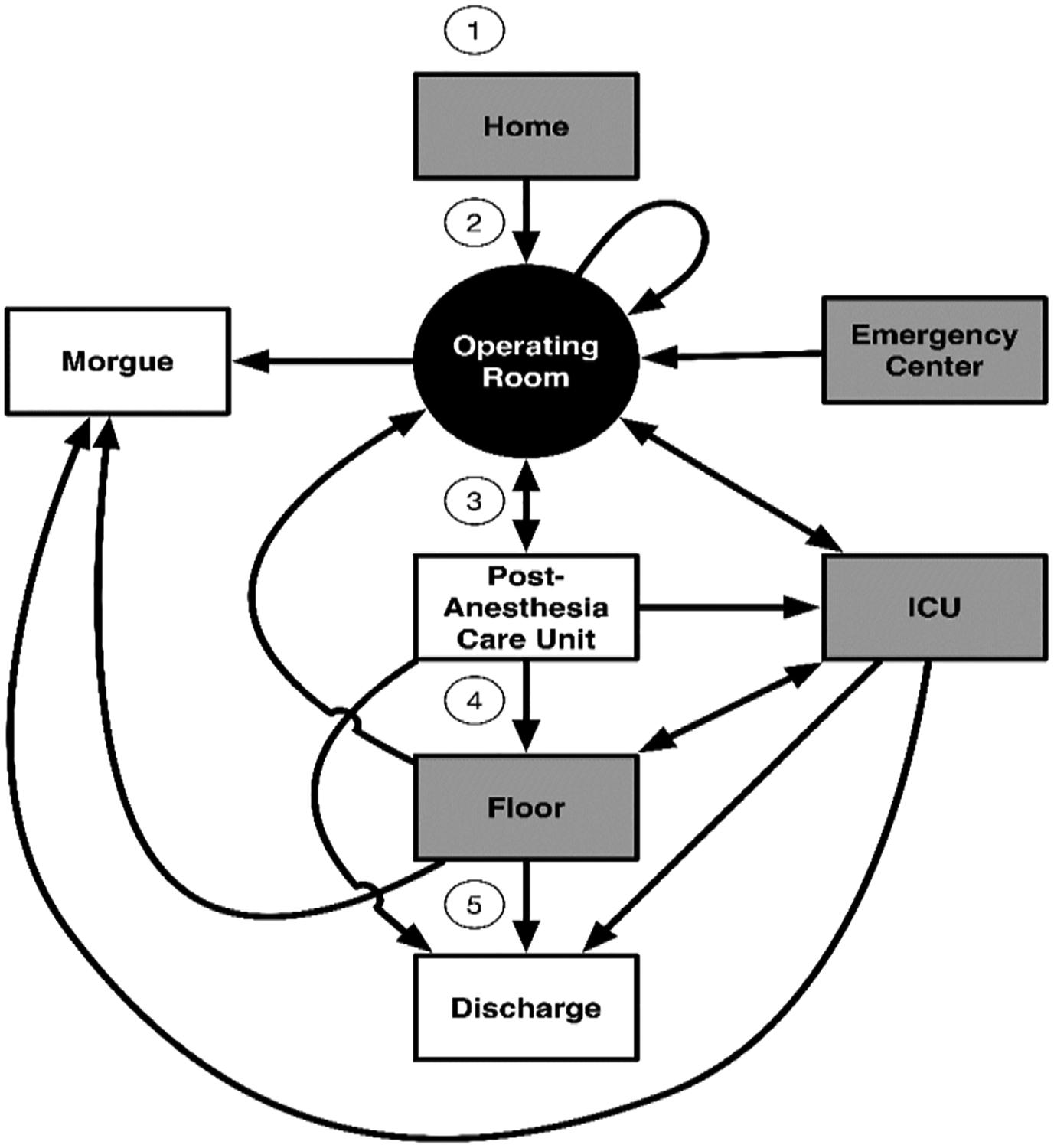
We constructed a multivariate logistic regression model of 30 (90)-day mortality, which occurred in 106 (290) of the cases, using 13,877 major abdominal surgical cases performed at the University of Texas MD Anderson Cancer Center from January 2007 to March 2014. The model includes race, starting location (home, inpatient ward, intensive care unit or emergency center), Charlson Comorbidity Index, emergency status, ASA-PS classification, procedure, surgical Apgar score, destination after surgery (hospital ward location) and delayed intensive care unit admit within six days. We computed and compared the model mortality prediction ability (C-statistic) as we accumulated features over time.

RESULTS

We were able to predict 30 (90)-day mortality with C-statistics from 0.70 (0.71) initially to 0.87 (0.84) within six days postoperatively.

CONCLUSION

We achieved a high level of model discrimination. The CPM enables a continuous cumulative assessment of the patient's mortality risk, which could then be used as a decision support aid regarding patient care and treatment, potentially resulting in improved outcomes, decreased costs and more informed decisions.

摘要

目的

1)利用腹部外科癌症患者的医院临床病程建立一个累积围手术期模型(CPM),以预测30天和90天的死亡风险;2)将该模型的预测能力与其他十个现有模型进行比较。

材料与方法

我们使用2007年1月至2014年3月在德克萨斯大学MD安德森癌症中心进行的13877例主要腹部外科手术病例,构建了一个30(90)天死亡率的多因素逻辑回归模型,其中106(290)例出现了30(90)天死亡。该模型包括种族、起始地点(家中、住院病房、重症监护病房或急诊中心)、查尔森合并症指数、急诊状态、美国麻醉医师协会身体状况分级(ASA-PS)、手术、手术阿普加评分、术后目的地(医院病房位置)以及术后六天内延迟入住重症监护病房的情况。随着时间的推移,我们在积累特征的过程中计算并比较了模型的死亡率预测能力(C统计量)。

结果

我们能够预测30(90)天死亡率,术后六天内C统计量从最初的0.70(0.71)提高到0.87(0.84)。

结论

我们实现了较高水平的模型区分度。CPM能够对患者的死亡风险进行连续的累积评估,进而可作为患者护理和治疗的决策支持工具,有可能改善治疗结果、降低成本并做出更明智的决策。
https://cdn.ncbi.nlm.nih.gov/pmc/blobs/1b4d/8496410/14e05aeee6a7/nihms-1578530-f0004.jpg
https://cdn.ncbi.nlm.nih.gov/pmc/blobs/1b4d/8496410/7513e950349b/nihms-1578530-f0001.jpg
https://cdn.ncbi.nlm.nih.gov/pmc/blobs/1b4d/8496410/0d7f4db91d67/nihms-1578530-f0002.jpg
https://cdn.ncbi.nlm.nih.gov/pmc/blobs/1b4d/8496410/9a50e2953737/nihms-1578530-f0003.jpg
https://cdn.ncbi.nlm.nih.gov/pmc/blobs/1b4d/8496410/14e05aeee6a7/nihms-1578530-f0004.jpg
https://cdn.ncbi.nlm.nih.gov/pmc/blobs/1b4d/8496410/7513e950349b/nihms-1578530-f0001.jpg
https://cdn.ncbi.nlm.nih.gov/pmc/blobs/1b4d/8496410/0d7f4db91d67/nihms-1578530-f0002.jpg
https://cdn.ncbi.nlm.nih.gov/pmc/blobs/1b4d/8496410/9a50e2953737/nihms-1578530-f0003.jpg
https://cdn.ncbi.nlm.nih.gov/pmc/blobs/1b4d/8496410/14e05aeee6a7/nihms-1578530-f0004.jpg

相似文献

1
The Cumulative Perioperative Model: Predicting 30-Day Mortality in Abdominal Surgery Cancer Patients.累积围手术期模型:预测腹部外科癌症患者的30天死亡率
J Surg Oncol (Tallinn). 2020;3. doi: 10.31487/j.jso.2020.01.10. Epub 2020 Mar 10.
2
Using the age-adjusted Charlson comorbidity index to predict outcomes in emergency general surgery.使用年龄调整后的查尔森合并症指数预测急诊普通外科手术的结局。
J Trauma Acute Care Surg. 2015 Feb;78(2):318-23. doi: 10.1097/TA.0000000000000457.
3
Surgical intensive care - current and future challenges?外科重症监护——当前及未来的挑战?
Qatar Med J. 2020 Jan 13;2019(2):3. doi: 10.5339/qmj.2019.qccc.3. eCollection 2019.
4
Combining the ASA Physical Classification System and Continuous Intraoperative Surgical Apgar Score Measurement in Predicting Postoperative Risk.将 ASA 身体状况分类系统与术中连续手术 Apgar 评分测量相结合预测术后风险。
J Med Syst. 2015 Nov;39(11):147. doi: 10.1007/s10916-015-0332-1. Epub 2015 Sep 10.
5
APACHE II score validation in emergency abdominal surgery. A post hoc analysis of the InCare trial.急性腹部外科手术中 APACHE II 评分的验证。InCare 试验的事后分析。
Acta Anaesthesiol Scand. 2020 Feb;64(2):180-187. doi: 10.1111/aas.13476. Epub 2019 Oct 14.
6
30-day mortality in patients after hip fracture surgery: A comparison of the Charlson Comorbidity Index score and ASA score used in two prediction models.髋部骨折手术后 30 天患者的死亡率:两种预测模型中 Charlson 合并症指数评分和 ASA 评分的比较。
Injury. 2021 Aug;52(8):2379-2383. doi: 10.1016/j.injury.2021.02.004. Epub 2021 Feb 4.
7
The Elixhauser comorbidity method outperforms the Charlson index in predicting inpatient death after orthopaedic surgery.在预测骨科手术后的住院患者死亡情况方面,埃利克斯豪泽共病法比查尔森指数表现更优。
Clin Orthop Relat Res. 2014 Sep;472(9):2878-86. doi: 10.1007/s11999-014-3686-7. Epub 2014 May 28.
8
9
Sarcopenia predicts 90-day mortality in elderly patients undergoing emergency abdominal surgery.肌少症预测行急诊腹部手术的老年患者 90 天死亡率。
Abdom Radiol (NY). 2019 Mar;44(3):1155-1160. doi: 10.1007/s00261-018-1870-z.
10
Prospective External Validation of the Pediatric Risk Assessment Score in Predicting Perioperative Mortality in Children Undergoing Noncardiac Surgery.前瞻性验证儿科风险评分在预测非心脏手术患儿围手术期死亡率中的作用。
Anesth Analg. 2019 Oct;129(4):1014-1020. doi: 10.1213/ANE.0000000000004197.

本文引用的文献

1
Opportunities and challenges in developing risk prediction models with electronic health records data: a systematic review.利用电子健康记录数据开发风险预测模型的机遇与挑战:一项系统综述
J Am Med Inform Assoc. 2017 Jan;24(1):198-208. doi: 10.1093/jamia/ocw042. Epub 2016 May 17.
2
Mortality Prediction in a Vertebral Compression Fracture Population: the ASA Physical Status Score versus the Charlson Comorbidity Index.椎体压缩性骨折人群的死亡率预测:美国麻醉医师协会身体状况评分与查尔森合并症指数的比较
Int J Spine Surg. 2015 Nov 12;9:63. doi: 10.14444/2063. eCollection 2015.
3
Age, American Society of Anesthesiologists physical status classification and Charlson score are independent predictors of 90-day mortality after radical cystectomy.
年龄、美国麻醉医师协会身体状况分级和查尔森评分是根治性膀胱切除术后90天死亡率的独立预测因素。
World J Urol. 2016 Aug;34(8):1123-9. doi: 10.1007/s00345-015-1744-8. Epub 2015 Dec 11.
4
Preoperative Score to Predict Postoperative Mortality (POSPOM): Derivation and Validation.术前评分预测术后死亡率(POSPOM):推导与验证。
Anesthesiology. 2016 Mar;124(3):570-9. doi: 10.1097/ALN.0000000000000972.
5
Electronic Health Record Adoption In US Hospitals: Progress Continues, But Challenges Persist.美国医院采用电子健康记录:进展仍在继续,但挑战依然存在。
Health Aff (Millwood). 2015 Dec;34(12):2174-80. doi: 10.1377/hlthaff.2015.0992. Epub 2015 Nov 11.
6
ASA Grade and Elderly Patients With Femoral Neck Fracture.美国麻醉医师协会(ASA)分级与老年股骨颈骨折患者
Geriatr Orthop Surg Rehabil. 2014 Dec;5(4):195-9. doi: 10.1177/2151458514560471.
7
Uses of electronic health records for public health surveillance to advance public health.利用电子健康记录进行公共卫生监测,以促进公共卫生。
Annu Rev Public Health. 2015 Mar 18;36:345-59. doi: 10.1146/annurev-publhealth-031914-122747. Epub 2015 Jan 2.
8
ASA score as a predictor of 30-day perioperative readmission in patients with orthopaedic trauma injuries: an NSQIP analysis.美国麻醉医师协会(ASA)评分作为骨科创伤患者围手术期30天再入院的预测指标:一项国家外科质量改进计划(NSQIP)分析
J Orthop Trauma. 2015 Mar;29(3):e127-32. doi: 10.1097/BOT.0000000000000200.
9
Why Summary Comorbidity Measures Such As the Charlson Comorbidity Index and Elixhauser Score Work.为何诸如查尔森合并症指数和埃利克斯豪泽评分等合并症简易测量方法有效。
Med Care. 2015 Sep;53(9):e65-72. doi: 10.1097/MLR.0b013e318297429c.
10
Use of different comorbidity scores for risk-adjustment in the evaluation of quality of colorectal cancer surgery: does it matter?不同合并症评分在结直肠癌手术质量评估中的风险调整作用:有影响吗?
Eur J Surg Oncol. 2012 Nov;38(11):1071-8. doi: 10.1016/j.ejso.2012.04.017. Epub 2012 Jun 15.