Institute for Nutrition Research, School of Medical and Health Sciences, Edith Cowan University, Perth, Western Australia, Australia.
Graduate School of Education, Faculty of Arts, Business, Law and Education, University of Western Australia, Perth, Western Australia, Australia.
Am J Clin Nutr. 2021 Dec 1;114(6):2025-2042. doi: 10.1093/ajcn/nqab288.
Limited evidence supports the common public health guideline that children >2 y of age should consume dairy with reduced fat content.
We aimed to investigate the effects of whole-fat compared with reduced-fat dairy intake on measures of adiposity and biomarkers of cardiometabolic risk in healthy 4- to 6-y-old children.
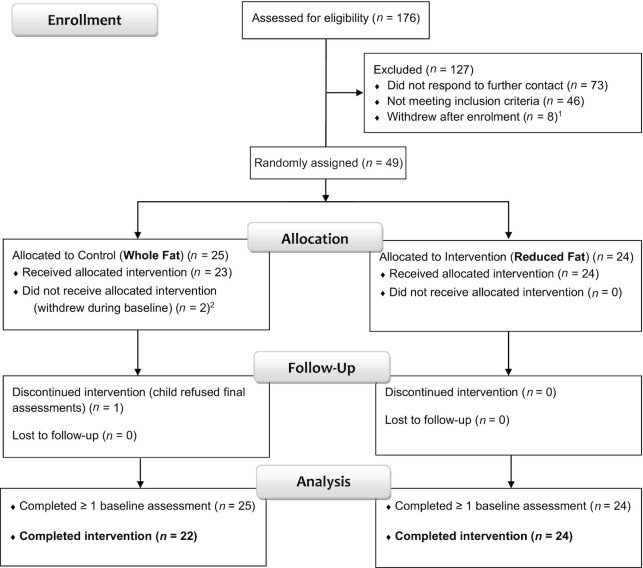
The Milky Way Study enrolled 49 children (mean ± SD age: 5.2 ± 0.9 y; 47% girls) who were habitual consumers of whole-fat dairy, then randomly assigned them in a double-blind fashion to remain on whole-fat dairy or switch their dairy consumption to reduced-fat products for 3 mo. Primary endpoints included measures of adiposity, body composition, blood pressure, fasting serum lipids, blood glucose, glycated hemoglobin (HbA1c), and C-reactive protein (CRP) and were assessed at baseline and study end. Pre- and postintervention results were compared using linear mixed models, adjusted for growth, age, and sex.
Dairy fat intake was reduced by an adjusted (mean ± SEM) 12.9 ± 4.1 g/d in the reduced-fat compared with the whole-fat dairy group (95% CI: -21.2, -4.6 g/d; P = 0.003), whereas dietary energy intakes remained similar (P = 0.936). We found no significant differential changes between dairy groups in any measure of adiposity, body composition, blood pressure, or fasting serum lipids, glucose, HbA1c, and CRP.
Our results suggest that although changing from whole-fat to reduced-fat dairy products does reduce dairy fat intake, it does not result in changes to markers of adiposity or cardiometabolic disease risk in healthy children.This trial was registered at www.anzctr.org.au as ACTRN12616001642471.
有限的证据支持儿童年龄超过 2 岁时应摄入低脂肪含量的乳制品这一常见的公共卫生指南。
我们旨在研究全脂与低脂乳制品摄入对健康 4 至 6 岁儿童肥胖指标和心血管代谢风险生物标志物的影响。
银河研究纳入了 49 名(平均年龄±标准差:5.2±0.9 岁;47%为女孩)习惯性摄入全脂乳制品的儿童,然后以双盲方式随机分配他们继续摄入全脂乳制品或在 3 个月内将其乳制品消费转换为低脂产品。主要终点包括肥胖指标、身体成分、血压、空腹血清脂质、血糖、糖化血红蛋白 (HbA1c) 和 C 反应蛋白 (CRP),并在基线和研究结束时进行评估。使用线性混合模型对干预前后的结果进行比较,并进行生长、年龄和性别调整。
与全脂乳制品组相比,低脂乳制品组的乳制品脂肪摄入量减少了 12.9±4.1g/d(调整后的平均值±SEM;95%置信区间:-21.2,-4.6g/d;P=0.003),而膳食能量摄入量保持相似(P=0.936)。我们没有发现两组在任何肥胖指标、身体成分、血压或空腹血清脂质、葡萄糖、HbA1c 和 CRP 方面有显著的差异变化。
我们的结果表明,尽管从全脂乳制品转换为低脂乳制品确实会减少乳制品脂肪的摄入量,但这并不会导致健康儿童的肥胖指标或心血管代谢疾病风险标志物发生变化。这项试验在 www.anzctr.org.au 上注册,注册号为 ACTRN12616001642471。