Indian Institute of Technology-Delhi, Hauz Khas, New Delhi 110016, India.
Block I, Room # 135, Department of Biochemical Engineering & Biotechnology, Indian Institute of Technology Delhi, Hauz Khas, New Delhi 110016, India.
Sci Total Environ. 2022 Feb 10;807(Pt 2):150873. doi: 10.1016/j.scitotenv.2021.150873. Epub 2021 Oct 8.
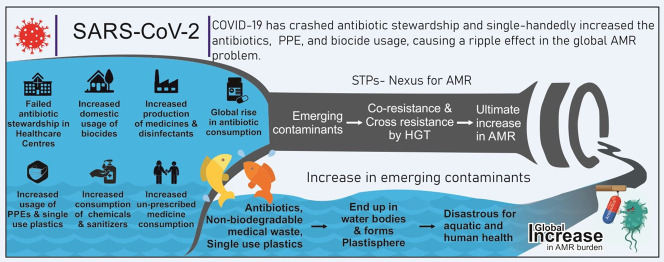
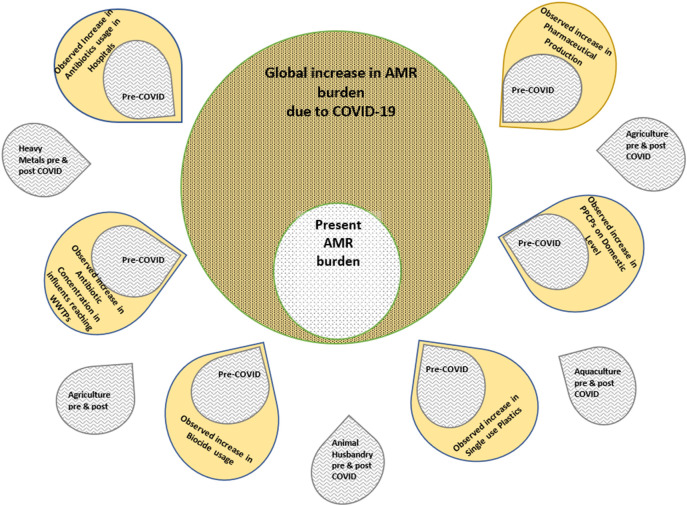
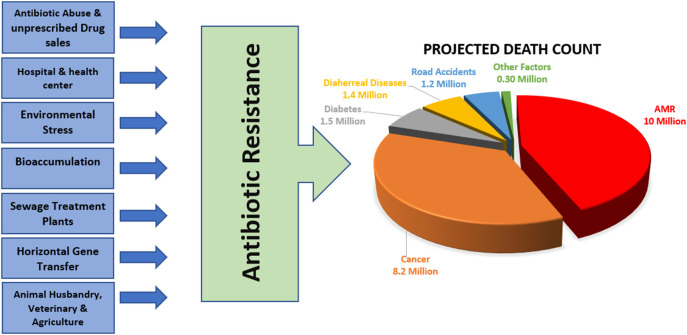
Antimicrobial resistance (AMR) is emerging as a severe concern due to the escalating instances of resistant human pathogens encountered by health workers. Consequently, there is a shortage of antibiotics to treat Multidrug Resistance (MDR) and Extensively Drug Resistance (XDR) patients. The primary cause of AMR is the vast array of anthropogenic disturbances in natural microfauna brought about by the extensive use of antibiotics. Coronavirus Disease of 2019 (COVID-19) has crashed antibiotic stewardship and single-handedly increased the global usage of antibiotics, Personal Protective Equipment (PPE), and biocide, causing a ripple effect in the existing global AMR problem. This surge in antibiotic usage has escalated the residual antibiotics reaching Wastewater Treatment Plants (WWTPs) from pharmaceutical companies, health care centers, and domestic settings. Ultimately the natural water bodies receiving their effluents will have higher concentrations of emerging contaminants as the WWTPs cannot remove the Pharmaceuticals and Personal Care Products (PPCPs) completely. Furthermore, increased biocides usage will increase AMR by co-resistance, and increasing plastics will turn into microplastics and get converted to plastisphere, which will further enhance its propagation. Therefore, it is crucial to curb antibiotic usage, implement antibiotic stewardship dynamically; and, ameliorate the present condition of WWTPs to remove residual PPCPs efficiently. The need of the hour is to address the grave threat of AMR, which is loitering silently; if not the mankind will endure more affliction hereafter.
由于医疗工作者面临越来越多的耐药人类病原体,抗菌药物耐药性(AMR)正成为一个严重的问题。因此,治疗多药耐药(MDR)和广泛耐药(XDR)患者的抗生素短缺。AMR 的主要原因是抗生素的广泛使用导致自然微生物区系受到大量人为干扰。2019 年冠状病毒病(COVID-19)破坏了抗生素管理,全球抗生素、个人防护设备(PPE)和杀生物剂的使用量单枪匹马地增加,对现有的全球 AMR 问题产生了连锁反应。抗生素使用量的增加导致来自制药公司、医疗保健中心和家庭环境的残留抗生素更多地进入到污水处理厂(WWTPs)。最终,接收废水的自然水体将含有更高浓度的新兴污染物,因为 WWTP 无法完全去除药品和个人护理产品(PPCPs)。此外,生物杀灭剂使用量的增加将通过共抗性增加 AMR,而增加的塑料将变成微塑料,并转化为塑料圈,从而进一步增强其传播。因此,必须控制抗生素的使用,动态实施抗生素管理,并改善 WWTP 的现状,以有效去除残留的 PPCPs。当务之急是要解决 AMR 这一潜在威胁,如果不加以解决,人类将会面临更多的苦难。