Institute of Molecular Biology and Biophysics, Department of Biology, ETH Zürich, Zürich, Switzerland.
Institute of Medical Microbiology, Faculty of Medicine, University of Zürich, Zürich, Switzerland.
mBio. 2021 Oct 26;12(5):e0218021. doi: 10.1128/mBio.02180-21. Epub 2021 Oct 12.
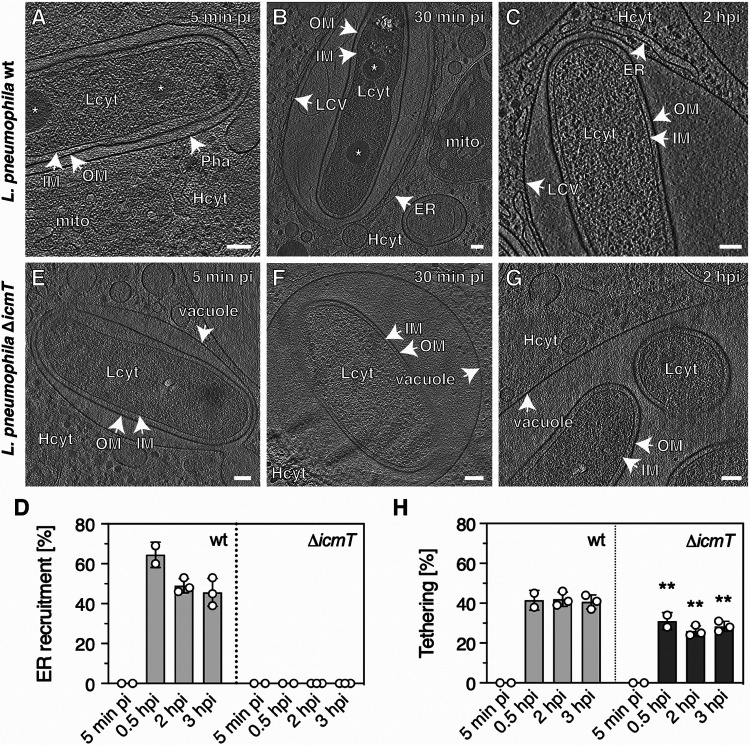
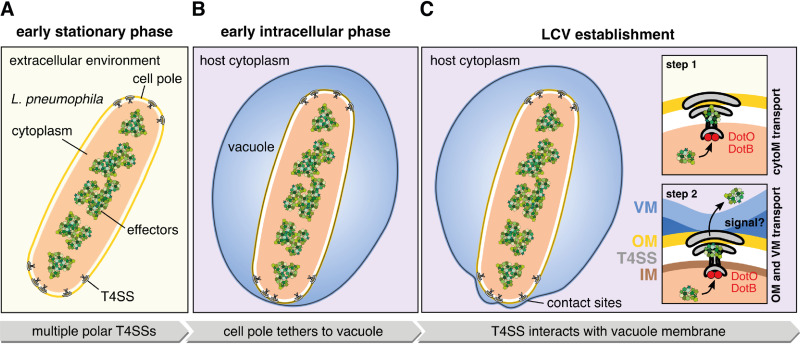
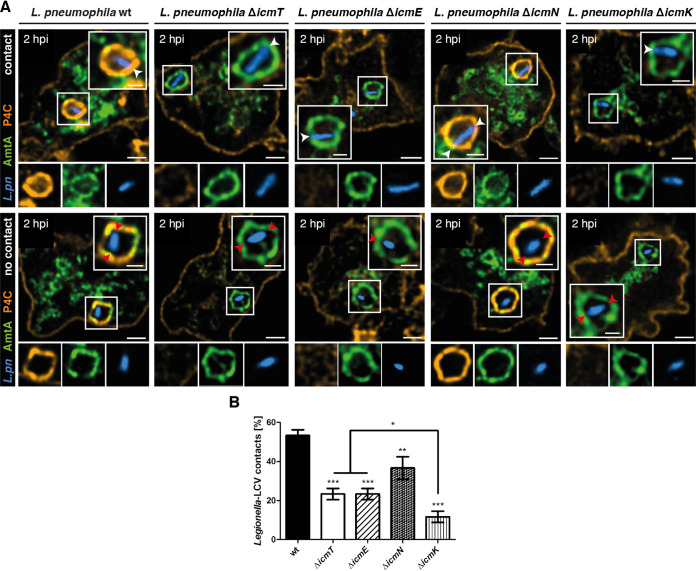
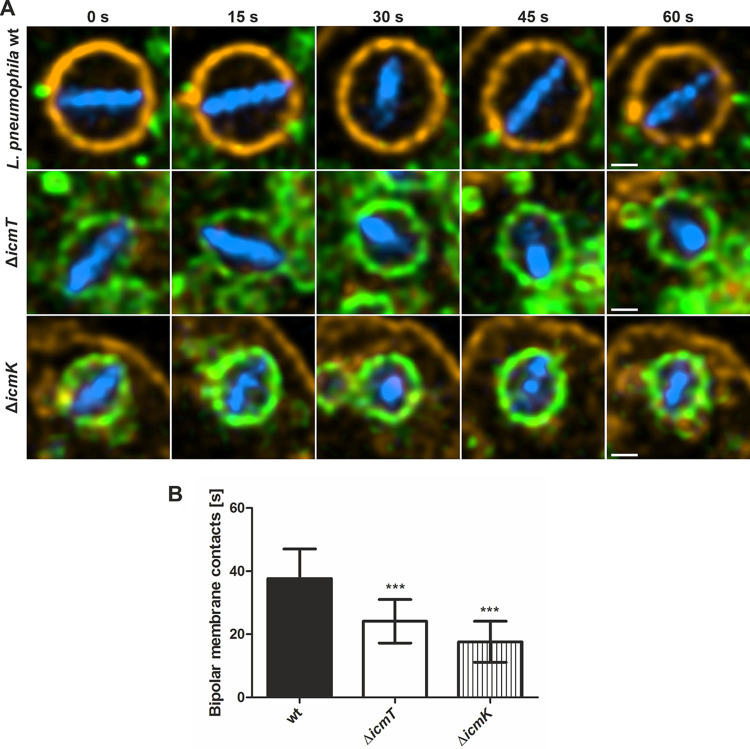
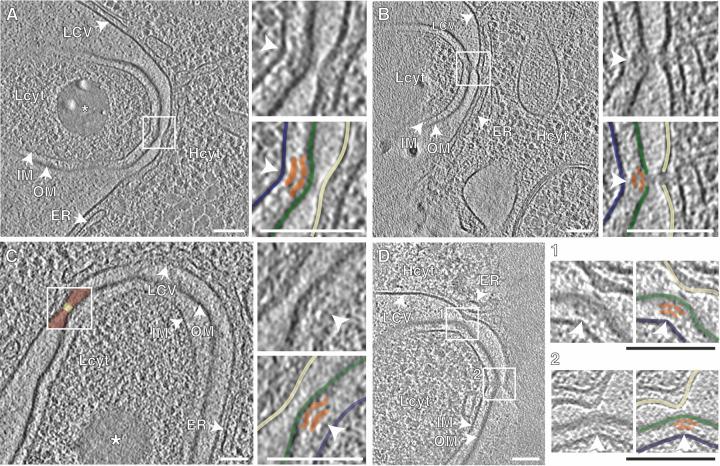
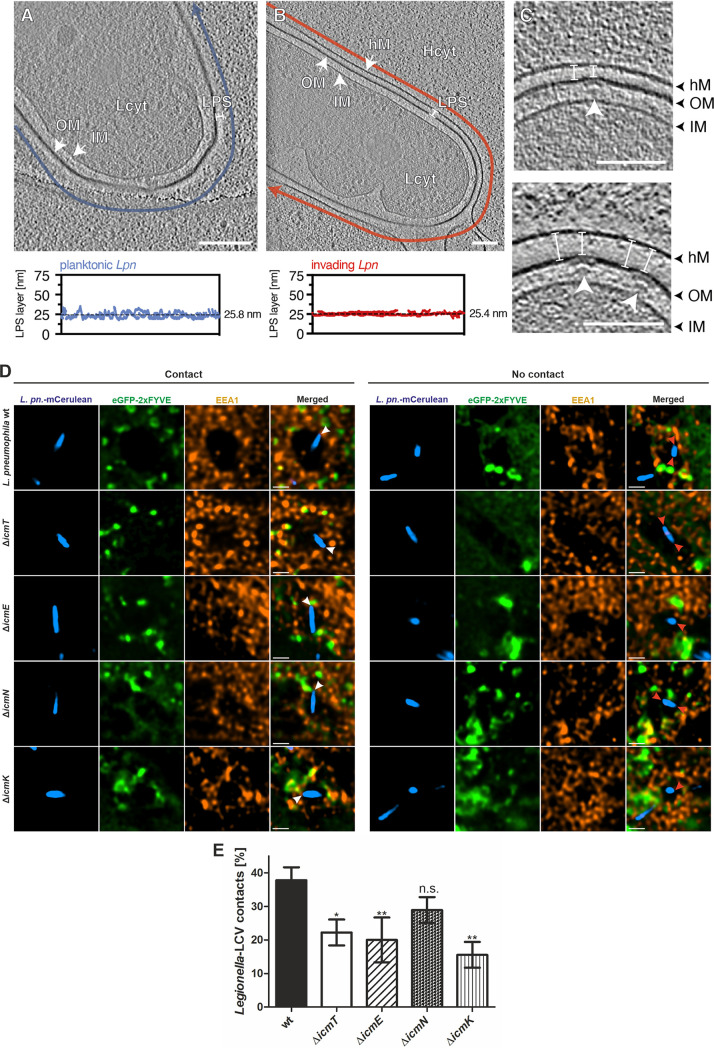
Legionella pneumophila, the causative agent of Legionnaires' disease, is a facultative intracellular pathogen that survives inside phagocytic host cells by establishing a protected replication niche, termed the "-containing vacuole" (LCV). To form an LCV and subvert pivotal host pathways, L. pneumophila employs a type IV secretion system (T4SS), which translocates more than 300 different effector proteins into the host cell. The L. pneumophila T4SS complex has been shown to span the bacterial cell envelope at the bacterial poles. However, the interactions between the T4SS and the LCV membrane are not understood. Using cryo-focused ion beam milling, cryo-electron tomography, and confocal laser scanning fluorescence microscopy, we show that up to half of the intravacuolar L. pneumophila bacteria tether their cell pole to the LCV membrane. Tethering coincides with the presence and function of T4SSs and likely promotes the establishment of distinct contact sites between T4SSs and the LCV membrane. Contact sites are characterized by indentations in the limiting LCV membrane and localize juxtaposed to T4SS machineries. The data are in agreement with the notion that effector translocation occurs by close membrane contact rather than by an extended pilus. Our findings provide novel insights into the interactions of the L. pneumophila T4SS with the LCV membrane . Legionnaires' disease is a life-threatening pneumonia, which is characterized by high fever, coughing, shortness of breath, muscle pain, and headache. The disease is caused by the amoeba-resistant bacterium L. pneumophila found in various soil and aquatic environments and is transmitted to humans via the inhalation of small bacteria-containing droplets. An essential virulence factor of L. pneumophila is a so-called "type IV secretion system" (T4SS), which, by injecting a plethora of "effector proteins" into the host cell, determines pathogen-host interactions and the formation of a distinct intracellular compartment, the "-containing vacuole" (LCV). It is unknown how the T4SS makes contact to the LCV membrane to deliver the effectors. In this study, we identify indentations in the host cell membrane in close proximity to functional T4SSs localizing at the bacterial poles. Our work reveals first insights into the architecture of -LCV contact sites.
嗜肺军团菌是军团病的病原体,它是一种兼性细胞内病原体,通过在吞噬宿主细胞内建立一个受保护的复制龛位,即“含有 vacuole”(LCV)来存活。为了形成 LCV 并颠覆关键的宿主途径,嗜肺军团菌利用一种 IV 型分泌系统(T4SS),将超过 300 种不同的效应蛋白转运到宿主细胞中。已经表明,嗜肺军团菌的 T4SS 复合物跨越细菌细胞包膜在细菌极。然而,T4SS 与 LCV 膜之间的相互作用尚不清楚。使用冷冻聚焦离子束铣削、冷冻电子断层扫描和共聚焦激光扫描荧光显微镜,我们表明,多达一半的囊内嗜肺军团菌细菌将其细胞极与 LCV 膜连接起来。这种连接与 T4SS 的存在和功能一致,可能促进了 T4SS 与 LCV 膜之间不同接触位点的建立。接触位点的特征是在限制 LCV 膜上的凹陷,并定位于与 T4SS 机械装置相邻。这些数据与效应蛋白转移通过紧密的膜接触而不是通过延伸的菌毛发生的观点一致。我们的发现为嗜肺军团菌 T4SS 与 LCV 膜相互作用提供了新的见解。军团病是一种危及生命的肺炎,其特征是高热、咳嗽、呼吸急促、肌肉疼痛和头痛。这种疾病是由各种土壤和水生环境中发现的抗变形虫细菌嗜肺军团菌引起的,通过吸入含有小细菌的飞沫传播给人类。嗜肺军团菌的一个重要毒力因子是一种所谓的“IV 型分泌系统”(T4SS),它通过将大量“效应蛋白”注入宿主细胞,决定病原体-宿主相互作用和形成一个独特的细胞内隔室,即“含有 vacuole”(LCV)。目前尚不清楚 T4SS 如何与 LCV 膜接触以输送效应蛋白。在这项研究中,我们在靠近定位于细菌极的功能 T4SS 的宿主细胞膜上识别出凹陷。我们的工作首次揭示了 LCV 接触位点的结构。