Department of Traditional Chinese Medicine, The First Affiliated Hospital of Shantou University Medical College, Shantou, Guangdong Province, China.
Department of Anesthesiology, The First Affiliated Hospital of Shantou University Medical College, 57 Changping Road, Shantou, 515041, Guangdong Province, China.
BMC Anesthesiol. 2021 Oct 11;21(1):242. doi: 10.1186/s12871-021-01459-7.
Evidence regarding the relationship between the type of anaesthesia and length of hospital stay is controversial. Therefore, the objective of this research was to investigate whether the type of anaesthesia was independently related to the length of hospital stay in patients undergoing unilateral total knee arthroplasty (TKA) after adjusting for other covariates.
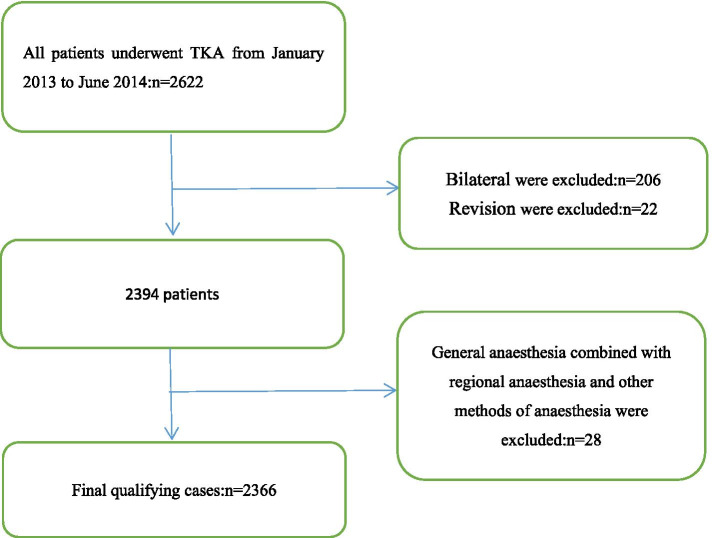
The present study was a cohort study. A total of 2622 participants underwent total knee arthroplasty (TKA) at a hospital in Singapore from 2013 to 1-1 to 2014-6-30. The target independent variable and the dependent variable were two types of anaesthesia and length of hospital stay, respectively. The covariates included age, BMI, hemoglobin (Hb), length of stay (LOS), duration of surgery, sex, ethnicity, American Society of Anesthesiologist (ASA) Status, smoking, obstructive sleep apnea (OSA), diabetes mellitus (DM), DM on insulin, ischemic heart disease (IHD), congestive cardiac failure (CCF), cerebrovascular accident (CVA), creatinine > 2 mg/dl, day of week of operation. Multivariate linear and logistic regression analyses were performed on the variables that might influence the choice of the two types of anaesthesia and the LOS. This association was then tested by subgroup analysis using hierarchical variables.
The average age of 2366 selected participants was 66.57 ± 8.23 years old, and approximately 24.18% of them were male. The average LOS of all enrolled patients was 5.37 ± 4.87 days, 5.92 ± 6.20 days for patients receiving general anaesthesia (GA) and 5.09 ± 3.98 days for patients receiving regional anaesthesia (RA), P < 0.05. The results of fully adjusted linear regression showed that GA lasted 0.93 days longer than RA (β = 0.93, 95% CI (0.54, 1.32)), P < 0.05. The results of fully adjusted logistic regression showed that LOS > 6 days was 45% higher for GA than for RA (OR = 1.45, 95% CI (1.15, 1.84)), P < 0.05. Through the subgroup analysis, the results were basically stable and reliable.
Our study showed that GA increased the length of stay during unilateral TKA compared with RA. This finding needs to be validated in future studies.
关于麻醉类型与住院时间之间的关系的证据存在争议。因此,本研究的目的是在调整其他协变量后,调查单侧全膝关节置换术(TKA)患者的麻醉类型是否与住院时间独立相关。
本研究为队列研究。2013 年 1 月 1 日至 2014 年 6 月 30 日,新加坡一家医院共有 2622 名患者接受了全膝关节置换术(TKA)。目标独立变量和因变量分别为两种麻醉类型和住院时间。协变量包括年龄、BMI、血红蛋白(Hb)、住院时间(LOS)、手术持续时间、性别、种族、美国麻醉师协会(ASA)状态、吸烟、阻塞性睡眠呼吸暂停(OSA)、糖尿病(DM)、胰岛素依赖性 DM、缺血性心脏病(IHD)、充血性心力衰竭(CCF)、脑血管意外(CVA)、肌酐>2mg/dl、手术日的星期几。对可能影响两种麻醉类型选择和 LOS 的变量进行多变量线性和逻辑回归分析。然后使用分层变量进行亚组分析来检验这种关联。
2366 名入选患者的平均年龄为 66.57±8.23 岁,约 24.18%为男性。所有入组患者的平均 LOS 为 5.37±4.87 天,全身麻醉(GA)组为 5.92±6.20 天,区域麻醉(RA)组为 5.09±3.98 天,P<0.05。完全调整后的线性回归结果显示,GA 比 RA 长 0.93 天(β=0.93,95%CI(0.54,1.32)),P<0.05。完全调整后的逻辑回归结果显示,GA 的 LOS>6 天的风险比 RA 高 45%(OR=1.45,95%CI(1.15,1.84)),P<0.05。通过亚组分析,结果基本稳定可靠。
我们的研究表明,与 RA 相比,GA 会增加单侧 TKA 的住院时间。这一发现需要在未来的研究中进一步验证。