Department of Medicine, Queen Mary Hospital, Hong Kong, People's Republic of China.
Department of Statistics, University of Wisconsin, Madison, Wisconsin, USA.
BMJ Open. 2021 Oct 11;11(10):e055575. doi: 10.1136/bmjopen-2021-055575.
To compare the incidence and severity of invasive pneumococcal diseases (IPDs), pneumococcal pneumonia and all-cause pneumonia during the COVID-19 pandemic period with universal masking and social distancing with that of previous 5 years.
Retrospective observational study on incidence of IPDs, pneumococcal pneumonia and all-cause pneumonia between January 2015-December 2019 and March 2020-March 2021. January-February 2020 was excluded from analysis as it was treated as a transitional period between normal time and pandemic.
Episode-based data by retrieval of hospitalisation records from the Hospital Authority's territory-wide electronic medical record database in Hong Kong.
Hospitalised patients with IPD (n=742), pneumococcal pneumonia (n=2163) and all-cause pneumonia (including COVID-19 pneumonia, n=453 999) aged 18 years or above. Control diagnoses were included to assess confounding from health-seeking behaviours.
Primary outcome is the incidence of diseases between two periods. Secondary outcomes include disease severity surrogated by length of stay and mortality.
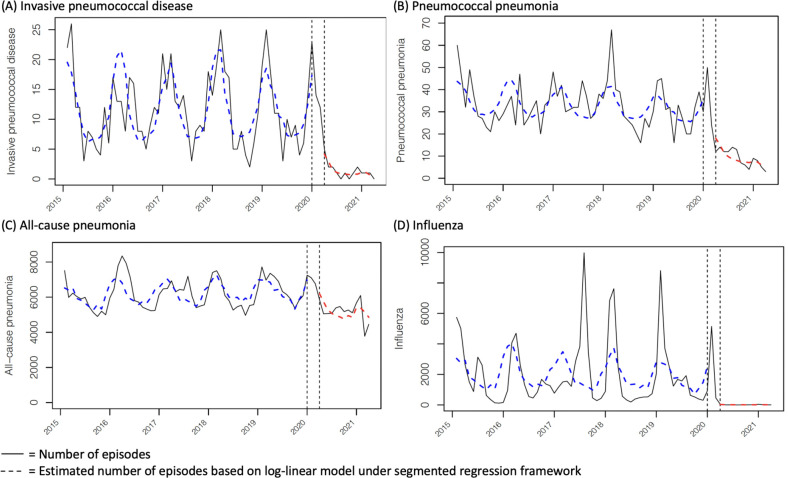
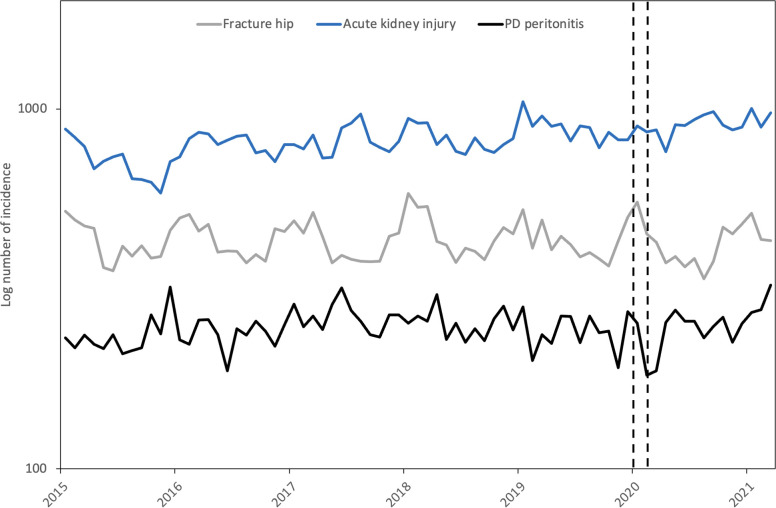
Monthly average number of IPD, pneumococcal pneumonia and all-cause pneumonia hospitalisation significantly decreased by 88.9% (95% CI 79.8% to 98.0%, p<0.0005), 72.5% (95% CI 65.9% to 79.1%, p<0.0005) and 17.5% (95% CI 16.8% to 18.2%, p<0.0005), respectively. Changes in trend from January 2015-December 2019 to March 2020-March 2021 were -70% (95% CI -87% to -35%, p=0.0025), -43% (95% CI -59% to -19%, p=0.0014) and -11% (95% CI -13% to -10%, p<0.0005), respectively. Length of stay for IPD and pneumococcal pneumonia episodes were insignificantly different in the two periods. No reductions in hospitalisations for control diagnoses were observed.
Incidence of IPD, pneumococcal pneumonia and all-cause pneumonia decreased during the COVID-19 pandemic. This was observed with universal masking and social distancing. We postulated this is related to reduced transmission of respiratory viruses and bacteria.
比较 COVID-19 大流行期间普遍戴口罩和保持社交距离与前 5 年期间侵袭性肺炎球菌病(IPD)、肺炎球菌性肺炎和所有原因肺炎的发病率和严重程度。
对 2015 年 1 月至 2019 年 12 月和 2020 年 3 月至 2021 年 3 月之间的 IPD、肺炎球菌性肺炎和所有原因肺炎的发病率进行了 IPD、肺炎球菌性肺炎和所有原因肺炎的回顾性观察性研究。2020 年 1 月至 2 月被排除在分析之外,因为它被视为正常时间和大流行之间的过渡时期。
通过检索香港医院管理局全港电子病历数据库中的住院记录进行基于事件的数据。
18 岁或以上的 IPD(n=742)、肺炎球菌性肺炎(n=2163)和所有原因肺炎(包括 COVID-19 肺炎,n=453999)住院患者。对照诊断包括在内,以评估从寻求医疗行为混杂的影响。
主要结果是两个时期疾病的发病率。次要结果包括以住院时间和死亡率表示的疾病严重程度。
IPD、肺炎球菌性肺炎和所有原因肺炎的每月平均住院人数分别显著下降 88.9%(95%CI 79.8%至 98.0%,p<0.0005)、72.5%(95%CI 65.9%至 79.1%,p<0.0005)和 17.5%(95%CI 16.8%至 18.2%,p<0.0005)。从 2015 年 1 月至 2019 年 12 月到 2020 年 3 月至 2021 年 3 月的趋势变化分别为-70%(95%CI-87%至-35%,p=0.0025)、-43%(95%CI-59%至-19%,p=0.0014)和-11%(95%CI-13%至-10%,p<0.0005)。两个时期 IPD 和肺炎球菌性肺炎发作的住院时间无显著差异。未观察到对照诊断住院人数减少。
在 COVID-19 大流行期间,侵袭性肺炎球菌病、肺炎球菌性肺炎和所有原因肺炎的发病率下降。这是在普遍戴口罩和保持社交距离的情况下观察到的。我们推测这与呼吸道病毒和细菌传播减少有关。