Bennett Julia C, Hetrich Marissa K, Garcia Quesada Maria, Sinkevitch Jenna N, Deloria Knoll Maria, Feikin Daniel R, Zeger Scott L, Kagucia Eunice W, Cohen Adam L, Ampofo Krow, Brandileone Maria-Cristina C, Bruden Dana, Camilli Romina, Castilla Jesús, Chan Guanhao, Cook Heather, Cornick Jennifer E, Dagan Ron, Dalby Tine, Danis Kostas, de Miguel Sara, De Wals Philippe, Desmet Stefanie, Georgakopoulou Theano, Gilkison Charlotte, Grgic-Vitek Marta, Hammitt Laura L, Hilty Markus, Ho Pak-Leung, Jayasinghe Sanjay, Kellner James D, Kleynhans Jackie, Knol Mirjam J, Kozakova Jana, Kristinsson Karl G, Ladhani Shamez N, MacDonald Laura, Mackenzie Grant A, Mad'arová Lucia, McGeer Allison, Mereckiene Jolita, Morfeldt Eva, Mungun Tuya, Muñoz-Almagro Carmen, Nuorti J Pekka, Paragi Metka, Pilishvili Tamara, Puentes Rodrigo, Saha Samir K, Sahu Khan Aalisha, Savrasova Larisa, Scott J Anthony, Skoczyńska Anna, Suga Shigeru, van der Linden Mark, Verani Jennifer R, von Gottberg Anne, Winje Brita A, Yildirim Inci, Zerouali Khalid, Hayford Kyla
Johns Hopkins Bloomberg School of Public Health, Baltimore, MD 21205, USA.
Independent Consultant, 1296 Coppet, Switzerland.
Microorganisms. 2021 Mar 27;9(4):696. doi: 10.3390/microorganisms9040696.
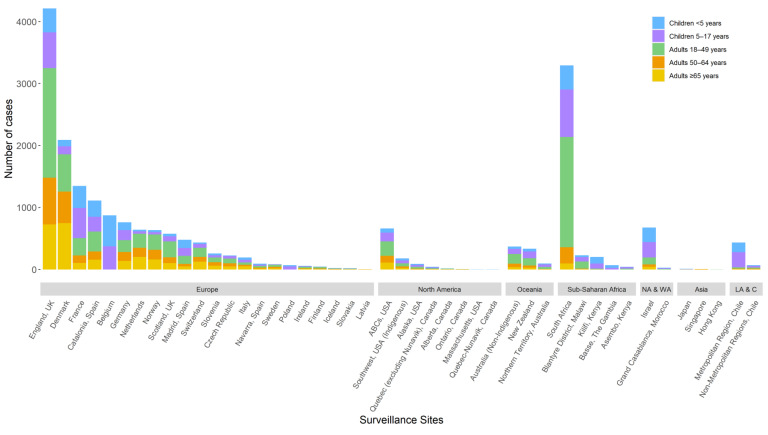
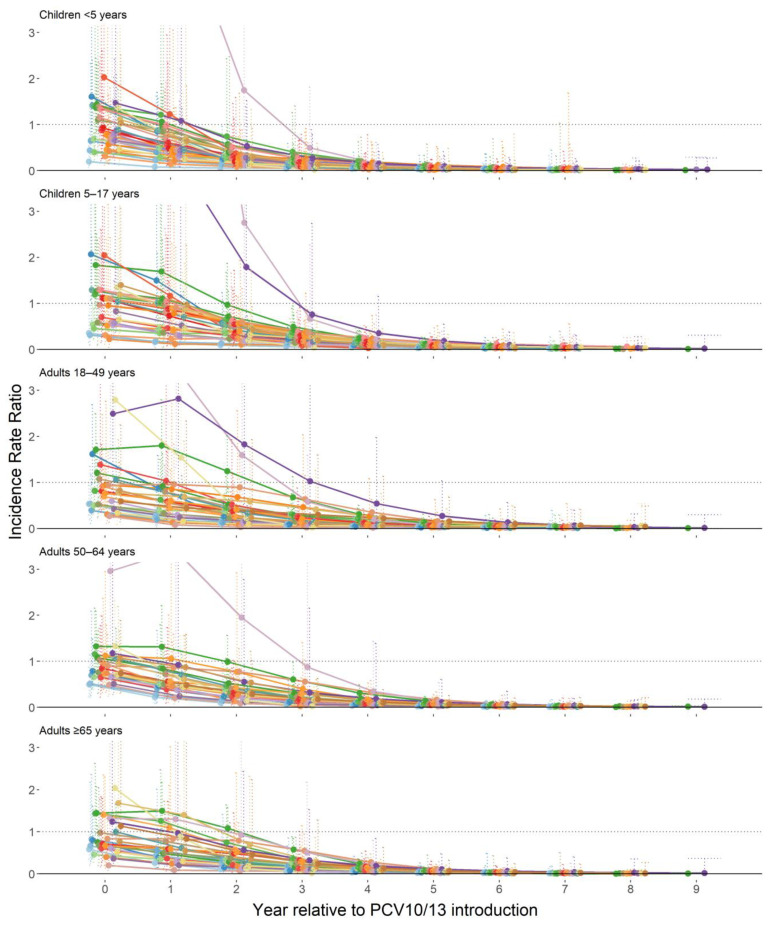
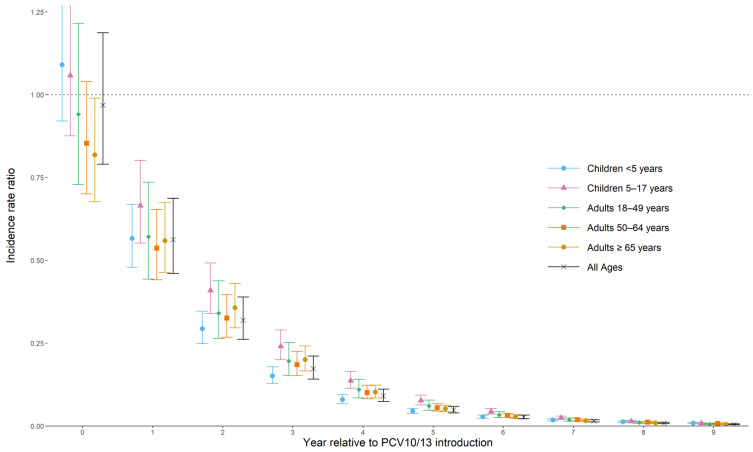
serotype 1 (ST1) was an important cause of invasive pneumococcal disease (IPD) globally before the introduction of pneumococcal conjugate vaccines (PCVs) containing ST1 antigen. The Pneumococcal Serotype Replacement and Distribution Estimation (PSERENADE) project gathered ST1 IPD surveillance data from sites globally and aimed to estimate PCV10/13 impact on ST1 IPD incidence. We estimated ST1 IPD incidence rate ratios (IRRs) comparing the pre-PCV10/13 period to each post-PCV10/13 year by site using a Bayesian multi-level, mixed-effects Poisson regression and all-site IRRs using a linear mixed-effects regression (N = 45 sites). Following PCV10/13 introduction, the incidence rate (IR) of ST1 IPD declined among all ages. After six years of PCV10/13 use, the all-site IRR was 0.05 (95% credibility interval 0.04-0.06) for all ages, 0.05 (0.04-0.05) for <5 years of age, 0.08 (0.06-0.09) for 5-17 years, 0.06 (0.05-0.08) for 18-49 years, 0.06 (0.05-0.07) for 50-64 years, and 0.05 (0.04-0.06) for ≥65 years. PCV10/13 use in infant immunization programs was followed by a 95% reduction in ST1 IPD in all ages after approximately 6 years. Limited data availability from the highest ST1 disease burden countries using a 3+0 schedule constrains generalizability and data from these settings are needed.
在含有1型血清型(ST1)抗原的肺炎球菌结合疫苗(PCV)引入之前,ST1是全球侵袭性肺炎球菌疾病(IPD)的一个重要病因。肺炎球菌血清型替代与分布估计(PSERENADE)项目收集了全球各地点的ST1 IPD监测数据,旨在评估PCV10/13对ST1 IPD发病率的影响。我们通过贝叶斯多层次混合效应泊松回归按地点估计了将PCV10/13接种前时期与PCV10/13接种后各年份进行比较的ST1 IPD发病率比(IRR),并使用线性混合效应回归估计了所有地点的IRR(N = 45个地点)。在引入PCV10/13后,所有年龄段的ST1 IPD发病率均下降。在使用PCV10/13六年之后,所有年龄段的全地点IRR为0.05(95%可信区间0.04 - 0.06),5岁以下儿童为0.05(0.04 - 0.05),5 - 17岁为0.08(0.06 - 0.09),18 - 49岁为0.06(0.05 - 0.08),50 - 64岁为0.06(0.05 - 0.07),65岁及以上为0.05(0.04 - 0.06)。在婴儿免疫规划中使用PCV10/13后,大约6年后所有年龄段的ST1 IPD减少了95%。使用3 + 0免疫程序的ST1疾病负担最高国家的数据可用性有限,限制了研究结果的普遍性,因此需要这些地区的数据。