Xiong Wei, Gu Xiang-Kui, Zhang Zhenhua, Chai Peng, Zang Yijing, Yu Zongyou, Li Dan, Zhang Hui, Liu Zhi, Huang Weixin
Hefei National Laboratory for Physical Sciences at the Microscale, Key Laboratory of Surface and Interface Chemistry and Energy Catalysis of Anhui Higher Education Institutes and Department of Chemical Physics, University of Science and Technology of China, 230026, Hefei, People's Republic of China.
School of Power and Mechanical Engineering, Wuhan University, 430072, Wuhan, People's Republic of China.
Nat Commun. 2021 Oct 11;12(1):5921. doi: 10.1038/s41467-021-26257-0.
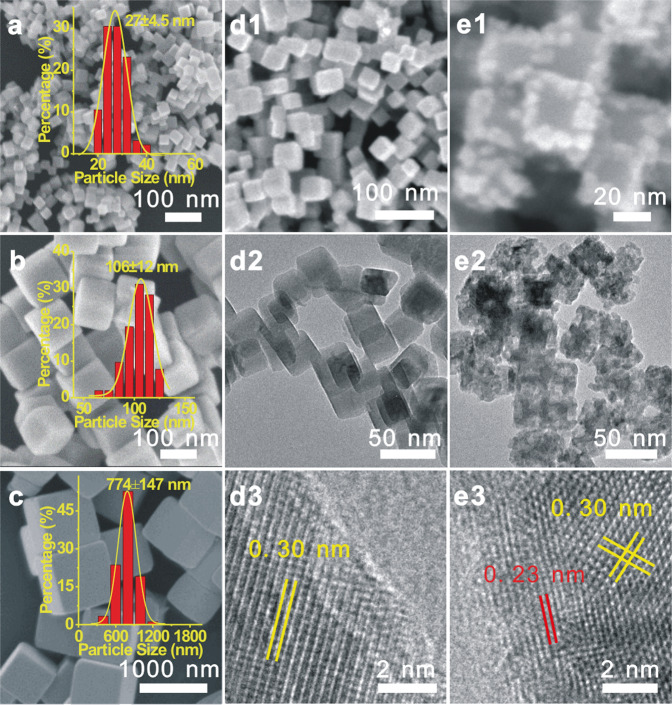
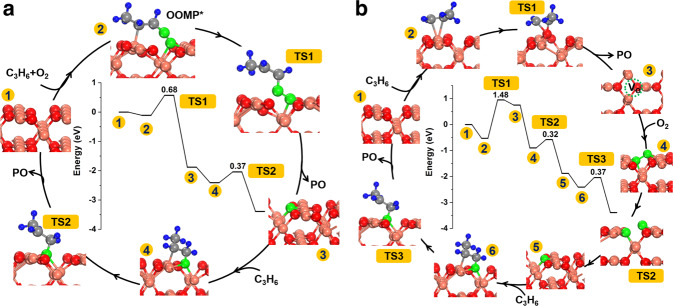
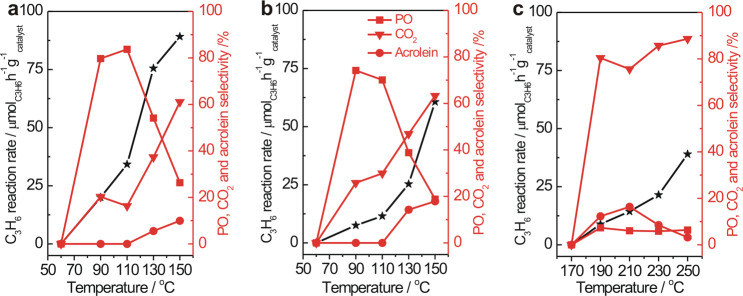
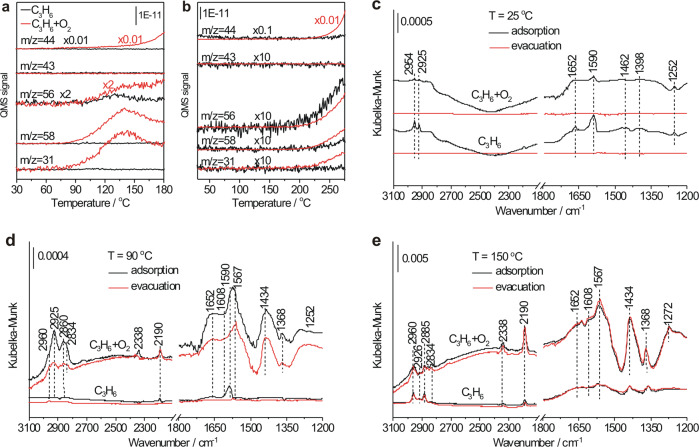
Propylene epoxidation with O to propylene oxide is a very valuable reaction but remains as a long-standing challenge due to unavailable efficient catalysts with high selectivity. Herein, we successfully explore 27 nm-sized cubic CuO nanocrystals enclosed with {100} faces and {110} edges as a highly selective catalyst for propylene epoxidation with O, which acquires propylene oxide selectivity of more than 80% at 90-110 °C. Propylene epoxidation with weakly-adsorbed O species at the {110} edge sites exhibits a low barrier and is the dominant reaction occurring at low reaction temperatures, leading to the high propylene oxide selectivity. Such a weakly-adsorbed O species is not stable at high reaction temperatures, and the surface lattice oxygen species becomes the active oxygen species to participate in propylene epoxidation to propylene oxide and propylene partial oxidation to acrolein at the {110} edge sites and propylene combustion to CO at the {100} face sites, which all exhibit high barriers and result in decreased propylene oxide selectivity.
用氧气将丙烯环氧化生成环氧丙烷是一个非常有价值的反应,但由于缺乏具有高选择性的高效催化剂,这仍然是一个长期存在的挑战。在此,我们成功地探索了由{100}面和{110}边包围的27纳米尺寸的立方氧化铜纳米晶体,作为用氧气进行丙烯环氧化的高选择性催化剂,在90-110°C下,该催化剂获得了超过80%的环氧丙烷选择性。在{110}边缘位点上与弱吸附氧物种进行的丙烯环氧化反应具有较低的势垒,是在低反应温度下发生的主要反应,从而导致了高环氧丙烷选择性。这种弱吸附氧物种在高反应温度下不稳定,表面晶格氧物种成为活性氧物种,在{110}边缘位点参与丙烯环氧化生成环氧丙烷和丙烯部分氧化生成丙烯醛,在{100}面位点参与丙烯燃烧生成二氧化碳,所有这些反应都具有高势垒,并导致环氧丙烷选择性降低。