Department of Structural Dynamics, Max Planck Institute for Biophysical Chemistry, Göttingen, Germany.
Department of Physical Biochemistry, Max Planck Institute for Biophysical Chemistry, Göttingen, Germany.
Nat Commun. 2021 Oct 11;12(1):5933. doi: 10.1038/s41467-021-26133-x.
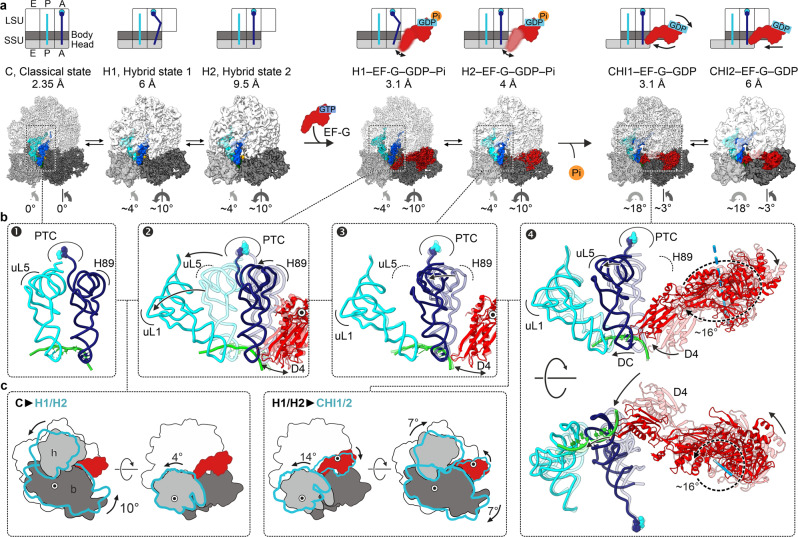
GTPases are regulators of cell signaling acting as molecular switches. The translational GTPase EF-G stands out, as it uses GTP hydrolysis to generate force and promote the movement of the ribosome along the mRNA. The key unresolved question is how GTP hydrolysis drives molecular movement. Here, we visualize the GTPase-powered step of ongoing translocation by time-resolved cryo-EM. EF-G in the active GDP-Pi form stabilizes the rotated conformation of ribosomal subunits and induces twisting of the sarcin-ricin loop of the 23 S rRNA. Refolding of the GTPase switch regions upon Pi release initiates a large-scale rigid-body rotation of EF-G pivoting around the sarcin-ricin loop that facilitates back rotation of the ribosomal subunits and forward swiveling of the head domain of the small subunit, ultimately driving tRNA forward movement. The findings demonstrate how a GTPase orchestrates spontaneous thermal fluctuations of a large RNA-protein complex into force-generating molecular movement.
GTPases 是细胞信号转导的调节因子,充当分子开关。翻译延伸因子 G(EF-G)是一种突出的 GTPase,它利用 GTP 水解产生力并促进核糖体沿着 mRNA 移动。关键的未解决问题是 GTP 水解如何驱动分子运动。在这里,我们通过时间分辨冷冻电镜可视化正在进行的易位的 GTPase 驱动步骤。处于活性 GDP-Pi 形式的 EF-G 稳定核糖体亚基的旋转构象,并诱导 23S rRNA 的 sarcin-ricin 环扭曲。Pi 释放后 GTPase 开关区的重折叠引发 EF-G 的大规模刚体旋转,围绕 sarcin-ricin 环旋转,这有助于核糖体亚基的反向旋转和小亚基头部结构域的向前旋转,最终推动 tRNA 向前移动。这些发现表明 GTPase 如何将大型 RNA-蛋白质复合物的自发热波动协调成产生力的分子运动。