Sridharan Niyanth, Gussev Maxim, Babu Sudarsanam
Oak Ridge National Laboratory, Oak Ridge, USA.
University of Tennessee at Knoxville, Knoxville, USA.
Sci Rep. 2021 Oct 11;11(1):20112. doi: 10.1038/s41598-021-98205-3.
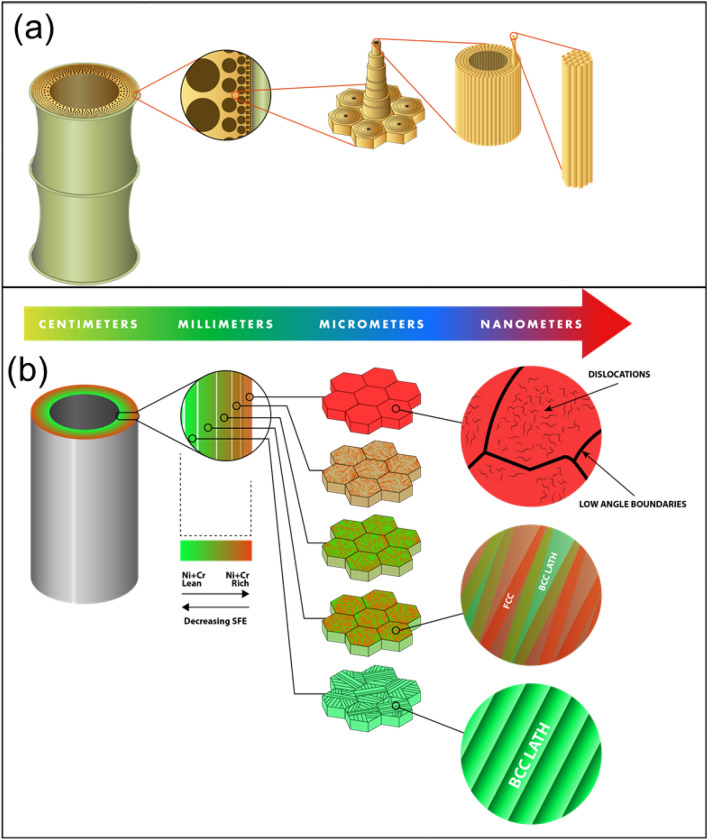
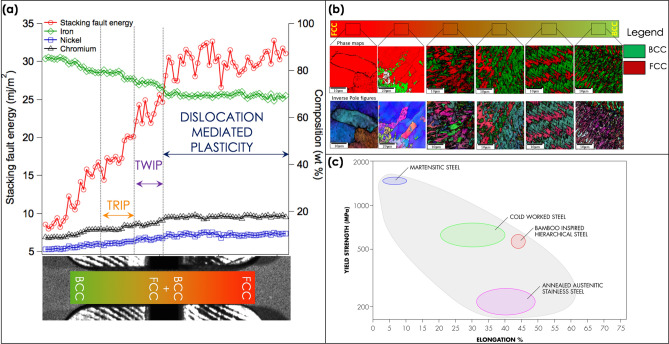
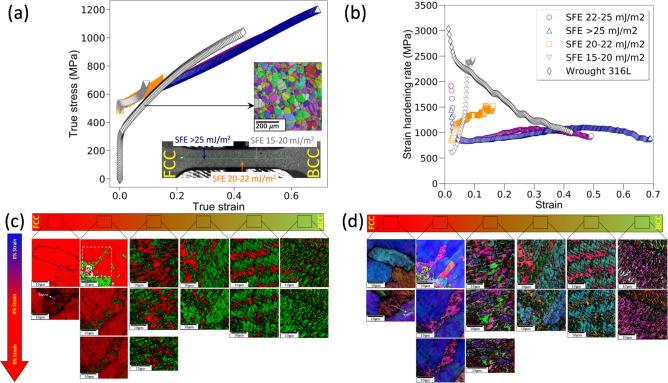
While there exists in nature abundant examples of materials with site-specific gradients in microstructures and properties, engineers and designers have traditionally used monolithic materials with discrete properties. Now, however, additive manufacturing (AM) offers the possibility of creating structures that mimic some aspects of nature. One example that has attracted attention in the recent years is the hierarchical structure in bamboo. The hierarchical architecture in bamboo is characterized by spatial gradients in properties and microstructures and is well suited to accommodate and survive complex stress states, severe mechanical forces, and large deformations. While AM has been used routinely to fabricate functionally graded materials, this study distinguishes itself by leveraging AM and physical metallurgy concepts to trigger cascading deformation in a single sample. Specifically, we have been successful in using AM to fabricate steel with unique spatial hierarchies in structure and property to emulate the structure and deformation mechanisms in natural materials. This study shows an improvement in the strength and ductility of the nature-inspired "hierarchical steel" compared with conventional cast stainless steels. In situ characterization proves that this improvement is due to the sequential activation of multiple deformation mechanisms namely twinning, transformation-induced plasticity, and dislocation-based plasticity. While significantly higher strengths can be achieved by refining the chemical and processing technique, this study sets the stage to achieve the paradigm of using AM to fabricate structures which emulate the flexibility in mechanical properties of natural materials and are able to adapt to in-service conditions.
虽然自然界中存在大量微观结构和性能具有特定位置梯度的材料实例,但工程师和设计师传统上使用的是具有离散性能的整体材料。然而,如今增材制造(AM)提供了创建模仿自然某些方面结构的可能性。近年来引起关注的一个例子是竹子的分层结构。竹子的分层结构以性能和微观结构的空间梯度为特征,非常适合承受和抵御复杂应力状态、强大机械力以及大变形。虽然增材制造已常规用于制造功能梯度材料,但本研究通过利用增材制造和物理冶金概念在单个样品中引发级联变形而脱颖而出。具体而言,我们成功地利用增材制造制造出结构和性能具有独特空间层次的钢材,以模拟天然材料的结构和变形机制。与传统铸造不锈钢相比,本研究表明受自然启发的“分层钢”的强度和延展性有所提高。原位表征证明,这种改进归因于多种变形机制的顺序激活,即孪生、相变诱发塑性和位错基塑性。虽然通过改进化学和加工技术可以实现显著更高的强度,但本研究为实现使用增材制造制造模仿天然材料机械性能灵活性并能够适应服役条件的结构这一范式奠定了基础。