Department of Biology and Pharmaceutical Botany, Medical University of Gdansk, Hallera 107, 80-416, Gdansk, Poland.
Department of Inorganic Chemistry, Medical University of Gdansk, Gdansk, Poland.
Cell Mol Life Sci. 2021 Nov;78(21-22):7061-7080. doi: 10.1007/s00018-021-03952-1. Epub 2021 Oct 12.
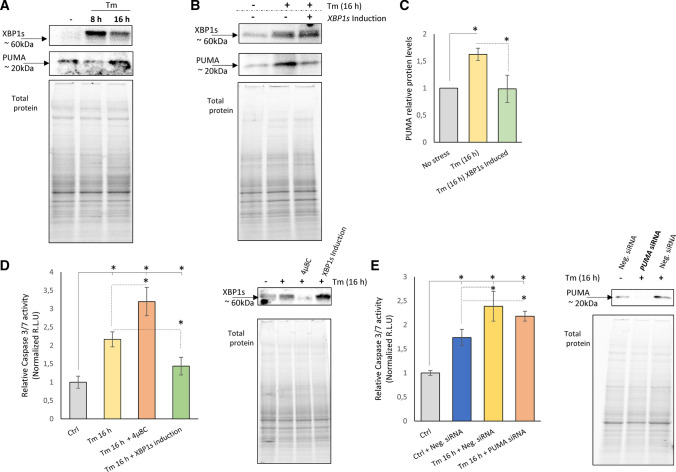
Accumulation of misfolded proteins in ER activates the unfolded protein response (UPR), a multifunctional signaling pathway that is important for cell survival. The UPR is regulated by three ER transmembrane sensors, one of which is inositol-requiring protein 1 (IRE1). IRE1 activates a transcription factor, X-box-binding protein 1 (XBP1), by removing a 26-base intron from XBP1 mRNA that generates spliced XBP1 mRNA (XBP1s). To search for XBP1 transcriptional targets, we utilized an XBP1s-inducible human cell line to limit XBP1 expression in a controlled manner. We also verified the identified XBP1-dependent genes with specific silencing of this transcription factor during pharmacological ER stress induction with both an N-linked glycosylation inhibitor (tunicamycin) and a non-competitive inhibitor of the sarco/endoplasmic reticulum Ca ATPase (SERCA) (thapsigargin). We then compared those results to the XBP1s-induced cell line without pharmacological ER stress induction. Using next-generation sequencing followed by bioinformatic analysis of XBP1-binding motifs, we defined an XBP1 regulatory network and identified XBP1 as a repressor of PUMA (a proapoptotic gene) and IRE1 mRNA expression during the UPR. Our results indicate impairing IRE1 activity during ER stress conditions accelerates cell death in ER-stressed cells, whereas elevating XBP1 expression during ER stress using an inducible cell line correlated with a clear prosurvival effect and reduced PUMA protein expression. Although further studies will be required to test the underlying molecular mechanisms involved in the relationship between these genes with XBP1, these studies identify a novel repressive role of XBP1 during the UPR.
错误折叠蛋白质在 ER 中的积累激活未折叠蛋白反应 (UPR),这是一种重要的细胞存活信号通路。UPR 由三个 ER 跨膜传感器调节,其中一个是肌醇需求蛋白 1 (IRE1)。IRE1 通过从 XBP1 mRNA 中去除 26 个碱基的内含子来激活转录因子 X 盒结合蛋白 1 (XBP1),从而产生剪接的 XBP1 mRNA (XBP1s)。为了寻找 XBP1 的转录靶点,我们利用 XBP1s 诱导的人细胞系以受控方式限制 XBP1 的表达。我们还通过使用 N-连接糖基化抑制剂 (衣霉素) 和肌浆/内质网 Ca ATP 酶 (SERCA) 的非竞争性抑制剂 (硫代秋水仙碱) 在药理学 ER 应激诱导下,用特定的沉默这种转录因子来验证鉴定的 XBP1 依赖性基因。然后,我们将这些结果与没有药理学 ER 应激诱导的 XBP1s 诱导细胞系进行比较。使用下一代测序技术,然后对 XBP1 结合基序进行生物信息学分析,我们定义了 XBP1 调节网络,并发现 XBP1 在 UPR 期间是 PUMA(促凋亡基因)和 IRE1 mRNA 表达的抑制剂。我们的结果表明,在 ER 应激条件下抑制 IRE1 活性会加速 ER 应激细胞的死亡,而在 ER 应激期间使用诱导细胞系升高 XBP1 表达与明显的生存促进作用和减少 PUMA 蛋白表达相关。尽管需要进一步的研究来测试这些基因与 XBP1 之间关系所涉及的潜在分子机制,但这些研究确定了 XBP1 在 UPR 期间的一种新的抑制作用。