Heiserman James Patrick, Nallanthighal Sameera, Gifford Cody C, Graham Kayla, Samarakoon Rohan, Gao Chao, Sage Jessica J, Zhang Wenzheng, Higgins Paul J, Cheon Dong-Joo
Department of Regenerative and Cancer Cell Biology, Albany Medical College, Albany, NY 12208, USA.
Cancers (Basel). 2021 Sep 28;13(19):4855. doi: 10.3390/cancers13194855.
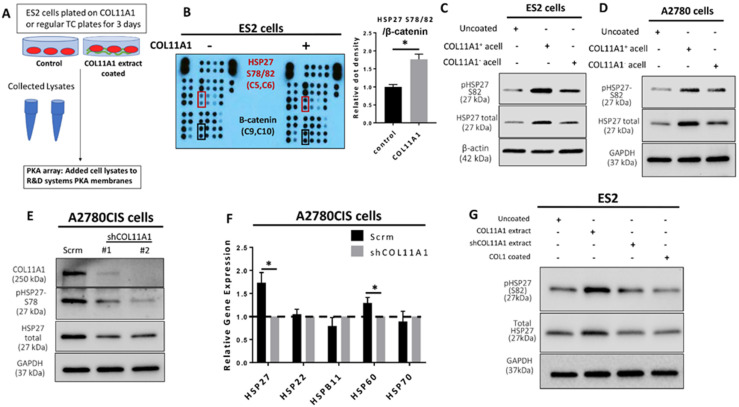
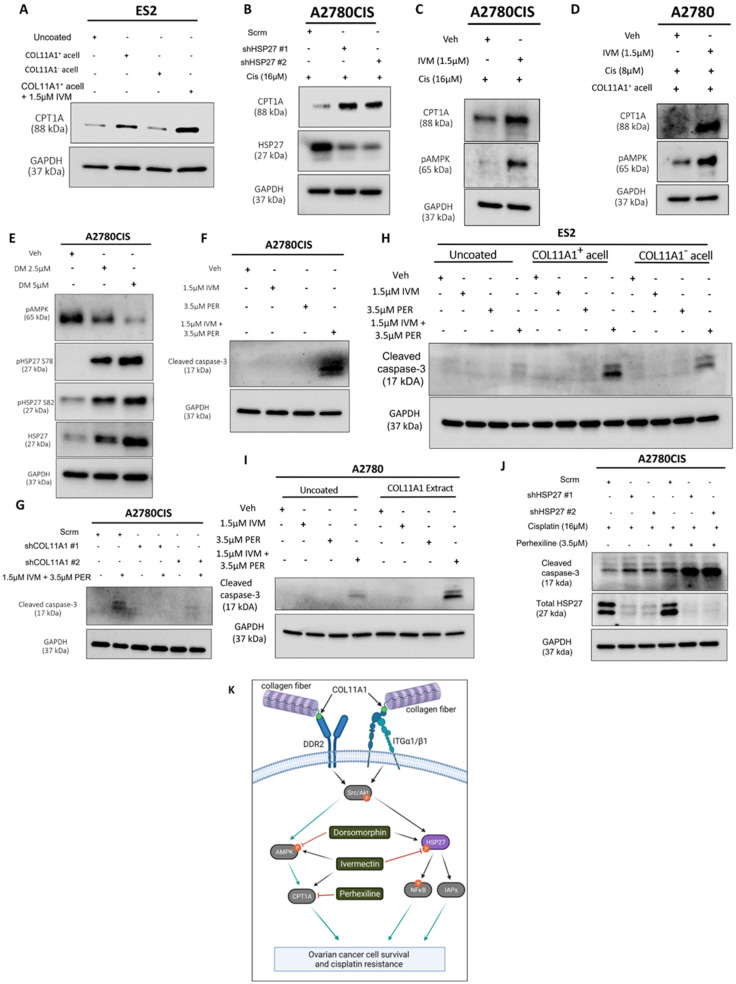
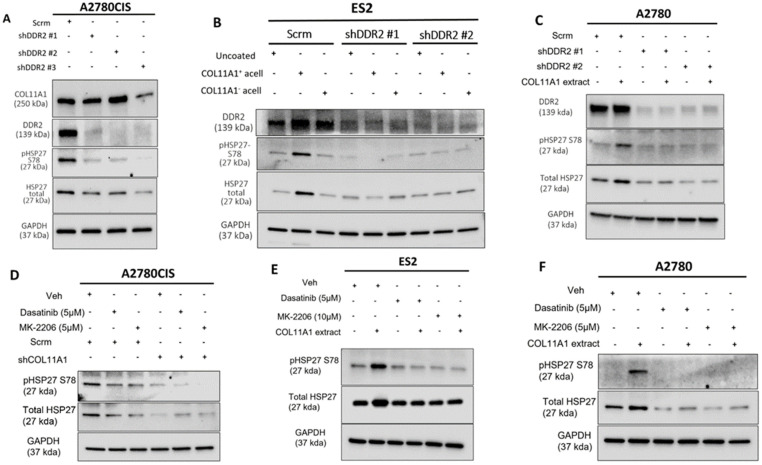
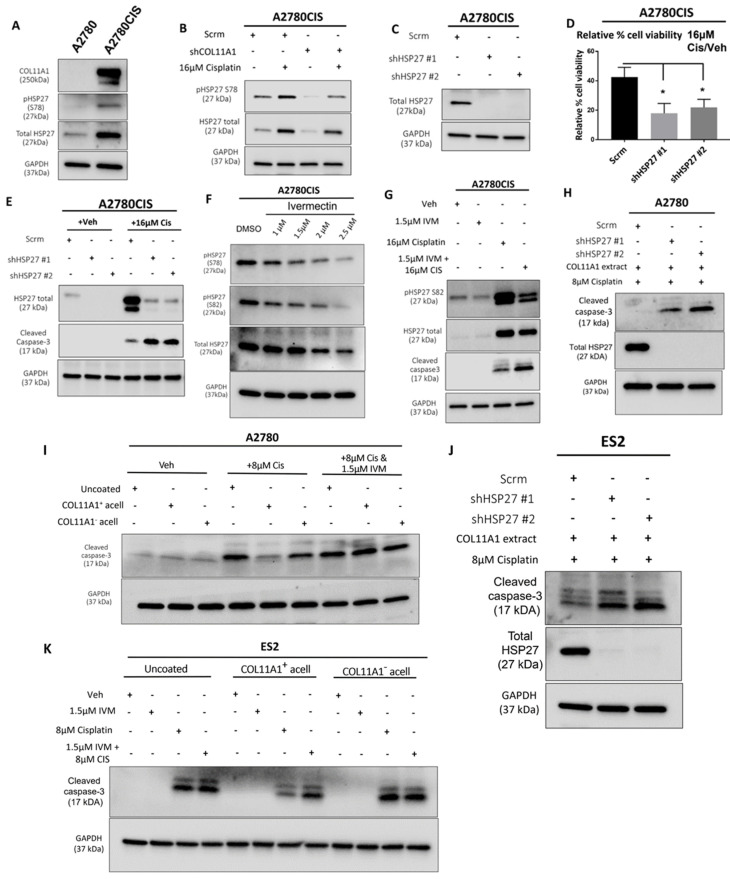
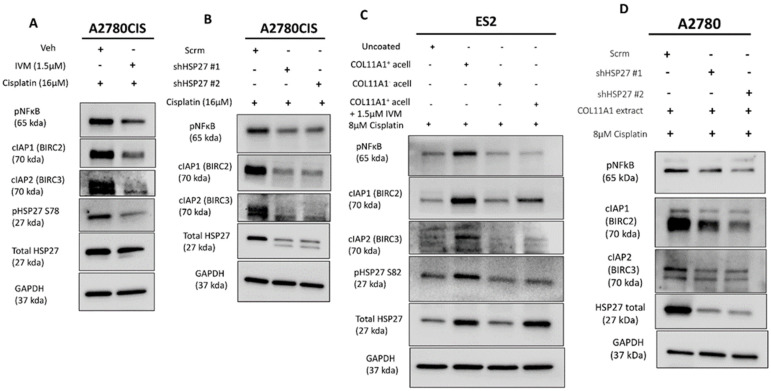
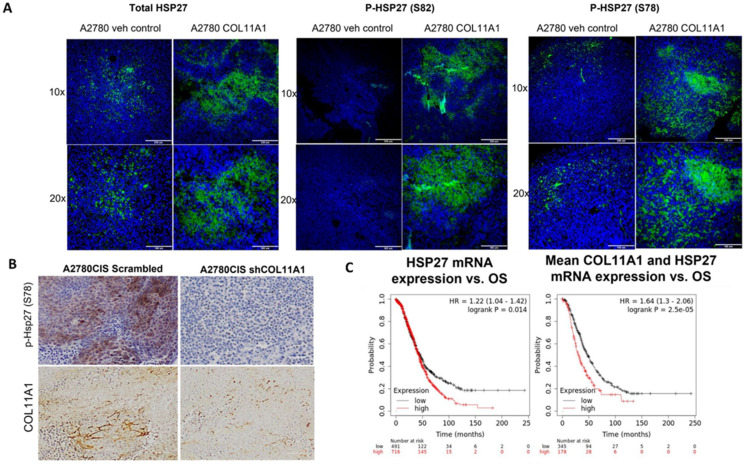
Collagen type XI alpha 1 (COL11A1) is a novel biomarker associated with cisplatin resistance in ovarian cancer. We have previously reported that COL11A1 activates Src-Akt signaling through the collagen receptors discoidin domain receptor 2 (DDR2) and integrin α1β1 to confer cisplatin resistance to ovarian cancer cells. To identify the potential signaling molecules downstream of COL11A1 signaling, we performed protein kinase arrays and identified heat shock protein 27 (HSP27) as a potential mediator of COL11A1-induced cisplatin resistance. Through receptor knockdown and inhibitor experiments, we demonstrated that COL11A1 significantly upregulates HSP27 phosphorylation and expression via DDR2/integrin α1β1 and Src/Akt signaling in ovarian cancer cells. Furthermore, genetic knockdown and pharmacological inhibition of HSP27, via ivermectin treatment, significantly sensitizes ovarian cancer cells cultured on COL11A1 to cisplatin treatment. HSP27 knockdown or inhibition also decreases NFκB activity as well as the expression of inhibitors of apoptosis proteins (IAPs), which are known downstream effector molecules of COL11A1 that promote cisplatin resistance. Interestingly, HSP27 knockdown or inhibition stimulates ovarian cancer cells to upregulate fatty acid oxidation (FAO) for survival and cisplatin resistance, and dual inhibition of HSP27 and FAO synergistically kills ovarian cancer cells that are cultured on COL11A1. Collectively, this study identifies HSP27 as a novel and druggable COL11A1 downstream effector molecule that may be targeted to overcome cisplatin resistance in recurrent ovarian cancer, which often overexpress COL11A1.
XI型胶原蛋白α1(COL11A1)是一种与卵巢癌顺铂耐药相关的新型生物标志物。我们之前曾报道,COL11A1通过胶原蛋白受体盘状结构域受体2(DDR2)和整合素α1β1激活Src-Akt信号通路,赋予卵巢癌细胞顺铂耐药性。为了鉴定COL11A1信号通路下游的潜在信号分子,我们进行了蛋白激酶阵列分析,并确定热休克蛋白27(HSP27)是COL11A1诱导的顺铂耐药的潜在介质。通过受体敲低和抑制剂实验,我们证明COL11A1在卵巢癌细胞中通过DDR2/整合素α1β1和Src/Akt信号通路显著上调HSP27的磷酸化和表达。此外,通过伊维菌素处理对HSP27进行基因敲低和药理抑制,可显著使在COL11A1上培养的卵巢癌细胞对顺铂治疗敏感。HSP27敲低或抑制还会降低NFκB活性以及凋亡抑制蛋白(IAPs)的表达,IAPs是已知的促进顺铂耐药的COL11A1下游效应分子。有趣的是,HSP27敲低或抑制会刺激卵巢癌细胞上调脂肪酸氧化(FAO)以维持生存和顺铂耐药性,而对HSP27和FAO的双重抑制可协同杀死在COL11A1上培养的卵巢癌细胞。总的来说,这项研究确定HSP27是一种新型的、可药物靶向的COL11A1下游效应分子,可能成为克服复发性卵巢癌顺铂耐药的靶点,复发性卵巢癌通常过度表达COL11A1。