Department of Food Biotechnology, Institute of Chemistry and Food Technology (IATA-CSIC), Avenida Dr. Catedrático Agustín Escardino 7, 46980 Paterna, Valencia, Spain.
Int J Mol Sci. 2021 Sep 23;22(19):10242. doi: 10.3390/ijms221910242.
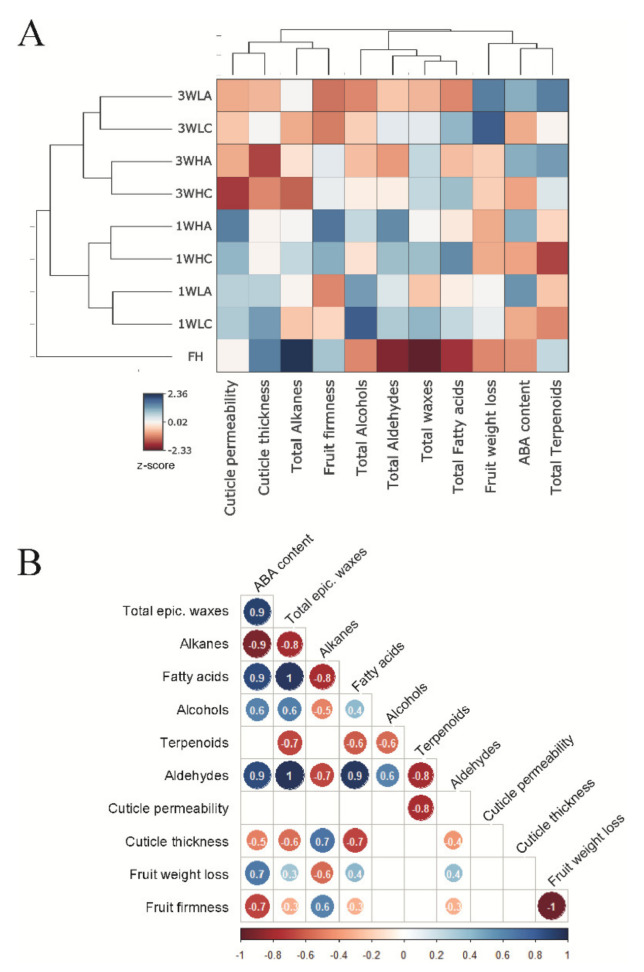
The phytohormone abscisic acid (ABA) is a major regulator of fruit response to water stress, and may influence cuticle properties and wax layer composition during fruit ripening. This study investigates the effects of ABA on epicuticular wax metabolism regulation in a citrus fruit cultivar with low ABA levels, called Pinalate ( L. Osbeck), and how this relationship is influenced by water stress after detachment. Harvested ABA-treated fruit were exposed to water stress by storing them at low (30-35%) relative humidity. The total epicuticular wax load rose after fruit detachment, which ABA application decreased earlier and more markedly during fruit-dehydrating storage. ABA treatment changed the abundance of the separated wax fractions and the contents of most individual components, which reveals dependence on the exposure to postharvest water stress and different trends depending on storage duration. A correlation analysis supported these responses, which mostly fitted the expression patterns of the key genes involved in wax biosynthesis and transport. A cluster analysis indicated that storage duration is an important factor for the exogenous ABA influence and the postharvest environment on epicuticular wax composition, cuticle properties and fruit physiology. Dynamic ABA-mediated reconfiguration of wax metabolism is influenced by fruit exposure to water stress conditions.
植物激素脱落酸(ABA)是调控果实响应水分胁迫的主要因子,可能会影响果实成熟过程中的角质层特性和蜡层组成。本研究调查了 ABA 对低 ABA 水平柑橘品种 Pinalate(L. Osbeck)表皮蜡代谢调控的影响,以及果实脱离后水分胁迫对这种关系的影响。收获的经 ABA 处理的果实通过在低(30-35%)相对湿度下储存来暴露于水分胁迫。在果实脱水贮藏过程中,总表皮蜡负载增加,ABA 处理更早且更明显地降低了这一负载。ABA 处理改变了分离的蜡级分的丰度和大多数单个成分的含量,这表明 ABA 处理依赖于采后水分胁迫和不同的储存时间的趋势。相关性分析支持了这些反应,这些反应大多与蜡生物合成和转运关键基因的表达模式相吻合。聚类分析表明,储存时间是外源 ABA 影响和采后环境对表皮蜡组成、角质层特性和果实生理影响的重要因素。ABA 介导的蜡代谢的动态重新配置受果实暴露于水分胁迫条件的影响。