Vera Belén Del Valle, Carmona-Márquez José, Lozano-Rojas Óscar Martín, Parrado-González Alberto, Vidal-Giné Claudio, Pautassi Ricardo Marcos, Fernández-Calderón Fermín
Faculty of Psychology, National University of Córdoba, Córdoba X5000HUA, Argentina.
Institute of Psychological Research, IIPsi-CONICET-UNC, Córdoba X5000HUA, Argentina.
J Clin Med. 2021 Sep 28;10(19):4468. doi: 10.3390/jcm10194468.
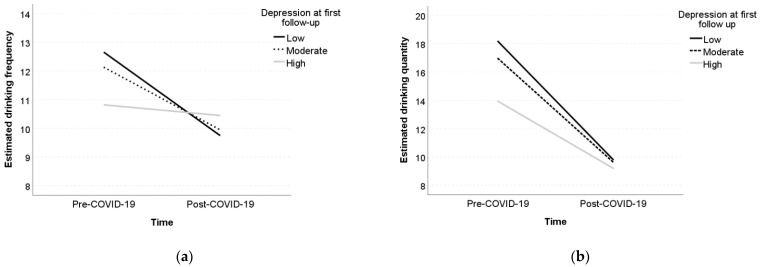
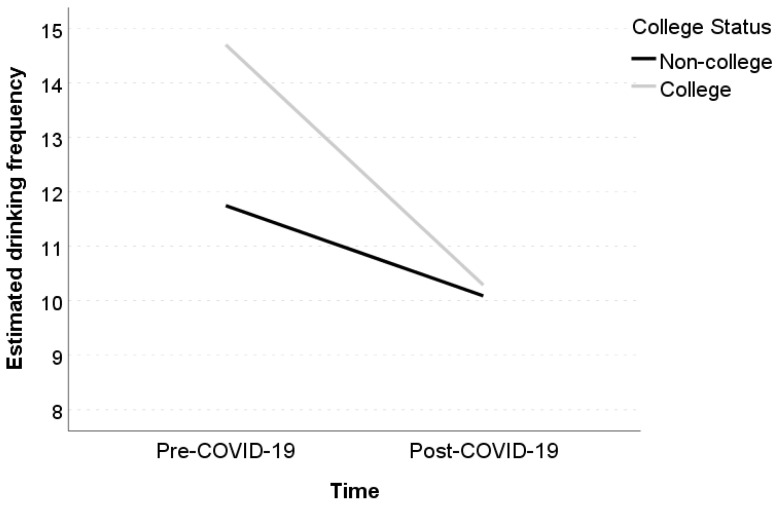
Health measures instantiated to reduce the spread of COVID-19 have imposed significant constraints for the population and impacted on drinking habits and mental health. This study longitudinally compared changes in alcohol consumption before and after the COVID-19 outbreak and the impact of sociodemographic and mental health variables on such changes among a community sample of young adults. Data were collected in the context of a larger, ongoing longitudinal study. The sample consisted of 305 young adults from Spain aged between 18 and 26 years (mean age = 21.27, ( = 2.21), female = 53.4%; college students = 61.6%) who completed first (November-2019 and February-2020; i.e., before the outbreak of COVID-19) and second follow-up questionnaires (March 2021, a year after the COVID-19 outbreak). Alcohol use (quantity and drinking frequency), depression and anxiety symptoms were measured. Quantity and frequency of alcohol use decreased from the pre- to post-COVID-19 period. A decrease in drinking frequency was observed among college students, but not in noncollege peers. Although we found no effect of pre-COVID-19 anxiety on alcohol use changes, those with more depressive symptoms at the pre-COVID assessment were more resistant to decreasing their drinking quantity and frequency after the COVID-19 outbreak. This information will be of value when designing interventions aimed at reducing harmful alcohol use and highlights the role of mental health status when identifying high risk populations of young-adults during this, and future, public health crises.
为减少新冠病毒传播而实施的健康措施给民众带来了重大限制,并对饮酒习惯和心理健康产生了影响。本研究纵向比较了新冠疫情爆发前后酒精消费量的变化,以及社会人口统计学和心理健康变量对社区年轻成年人样本中此类变化的影响。数据是在一项正在进行的大型纵向研究背景下收集的。样本包括305名年龄在18至26岁之间的西班牙年轻人(平均年龄 = 21.27,标准差 = 2.21),其中女性占53.4%;大学生占61.6%,他们分别完成了第一次(2019年11月至2020年2月;即新冠疫情爆发前)和第二次随访问卷调查(2021年3月,新冠疫情爆发一年后)。对酒精使用情况(数量和饮酒频率)、抑郁和焦虑症状进行了测量。从新冠疫情前到疫情后,酒精使用的数量和频率均有所下降。大学生的饮酒频率有所下降,但非大学生同龄人没有。虽然我们发现新冠疫情前的焦虑对酒精使用变化没有影响,但在新冠疫情前评估中抑郁症状较多的人在疫情爆发后更难减少饮酒量和频率。这些信息在设计旨在减少有害酒精使用的干预措施时将具有价值,并凸显了在此次及未来公共卫生危机期间识别年轻成年人高风险人群时心理健康状况的作用。