Department of Electrical and Computer Engineering, Iowa State University, Ames, IA 50011, USA.
School of Electrical Engineering & Computer Science, University of North Dakota, Grand Forks, ND 58202, USA.
Sensors (Basel). 2021 Oct 3;21(19):6608. doi: 10.3390/s21196608.
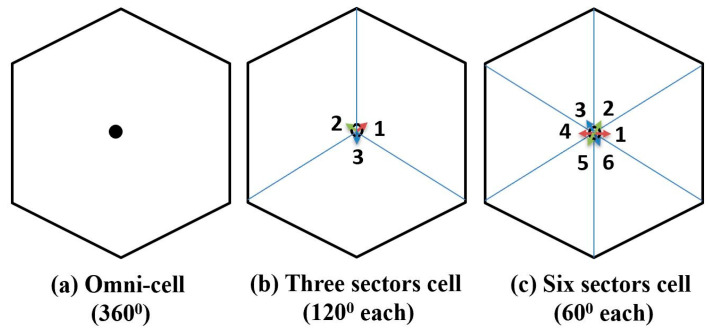
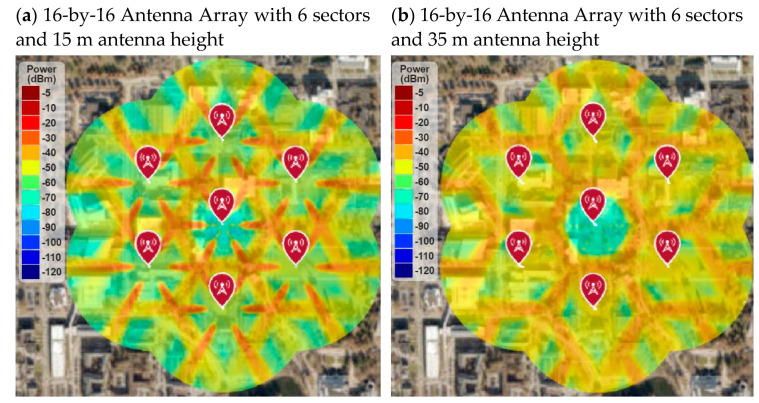
The 5G cellular network is no longer hype. Mobile network operators (MNO) around the world (e.g., Verizon and AT&T in the USA) started deploying 5G networks in mid-frequency bands (i.e., 3-6 GHz) with existing 4G cellular networks. The mid-frequency band can significantly boost the existing network performance additional spectrum (i.e., 50 MHz-100 MHz). However, the high-frequency bands (i.e., 24 GHz-100 GHz) can offer a wider spectrum (i.e., 400800 MHz), which is needed to meet the ever-growing capacity demands, highest bitrates (20 Gb/s), and lowest latencies. As we move to the higher frequency bands, the free space propagation loss increases significantly, which will limit the individual cell site radius to 100 m for the high-frequency band compared to several kilometers in 4G. Therefore, the MNOs will need to deploy hundreds of new small cells (e.g., 100 m cell radius) compared to one large cell site (e.g., Macrocell with several km in radius) to ensure 100% network coverage for the same area. It will be a big challenge for the MNOs to accurately plan and acquire these massive numbers of new cell site locations to provide uniform 5G coverage. This paper first describes the 5G coverage planning with a traditional three-sector cell. It then proposes an updated cell architecture with six sectors and an advanced antenna system that provides better 5G coverage. Finally, it describes the potential challenges of 5G network deployment with future research directions.
5G 蜂窝网络不再是炒作。世界各地的移动网络运营商(MNO)(例如美国的 Verizon 和 AT&T)已开始在中频频段(即 3-6GHz)部署 5G 网络,并与现有的 4G 蜂窝网络共存。中频频段可以显著提高现有网络性能,增加额外的频谱(即 50MHz-100MHz)。然而,高频段(即 24GHz-100GHz)可以提供更宽的频谱(即 400-800MHz),这是满足不断增长的容量需求、最高比特率(约 20Gb/s)和最低延迟所必需的。随着我们向更高的频段移动,自由空间传播损耗会显著增加,这将使高频段的单个小区站点半径限制在 100m,而 4G 的半径则可达数公里。因此,MNO 相比部署一个大型基站(例如半径数公里的宏基站),需要部署数百个新的小基站(例如半径 100m 的小基站),以确保相同区域的网络覆盖率达到 100%。MNO 要准确规划和获取这些大量的新基站位置,以提供均匀的 5G 覆盖,这将是一个巨大的挑战。本文首先描述了具有传统三扇区小区的 5G 覆盖规划,然后提出了一种具有六个扇区和先进天线系统的更新的小区架构,以提供更好的 5G 覆盖。最后,描述了未来研究方向的 5G 网络部署的潜在挑战。