Verma Anurag, Tsao Noah, Thomann Lauren, Ho Yuk-Lam, Iyengar Sudha, Luoh Shiuh-Wen, Carr Rotonya, Crawford Dana, Efird Jimmy T, Huffman Jennifer, Hung Adriana, Ivey Kerry, Levin Michael, Lynch Julie, Natarajan Pradeep, Pyarajan Saiju, Bick Alexander, Costa Lauren, Genovese Giulio, Hauger Richard, Madduri Ravi, Pathak Gita, Polimanti Renato, Voight Benjamin, Vujkovic Marijana, Zekavat Maryam, Zhao Hongyu, Ritchie Marylyn D, Chang Kyong-Mi, Cho Kelly, Casas Juan P, Tsao Philip S, Gaziano J Michael, O'Donnell Christopher, Damrauer Scott, Liao Katherine
Corporal Michael Crescenz VA Medical Center, Philadelphia, Philadelphia, USA.
Department of Genetics, Perelman School of Medicine, University of Pennsylvania, Philadelphia, Pennsylvania, USA.
medRxiv. 2021 Oct 15:2021.05.18.21257396. doi: 10.1101/2021.05.18.21257396.
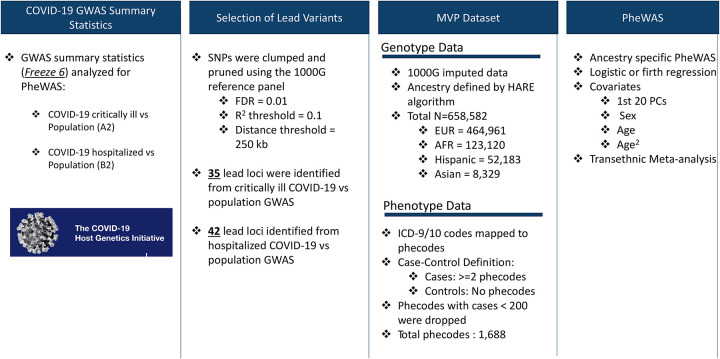
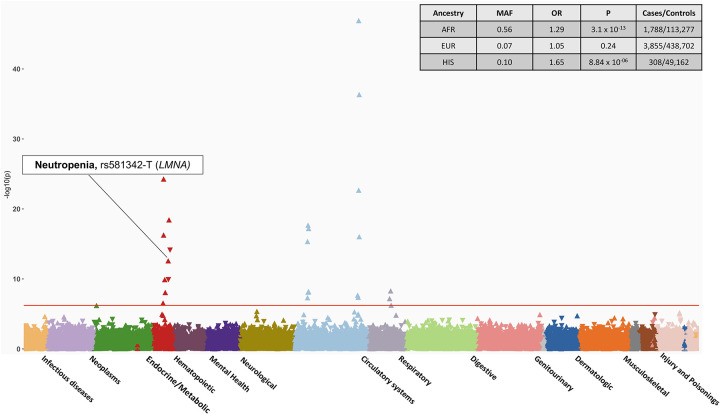
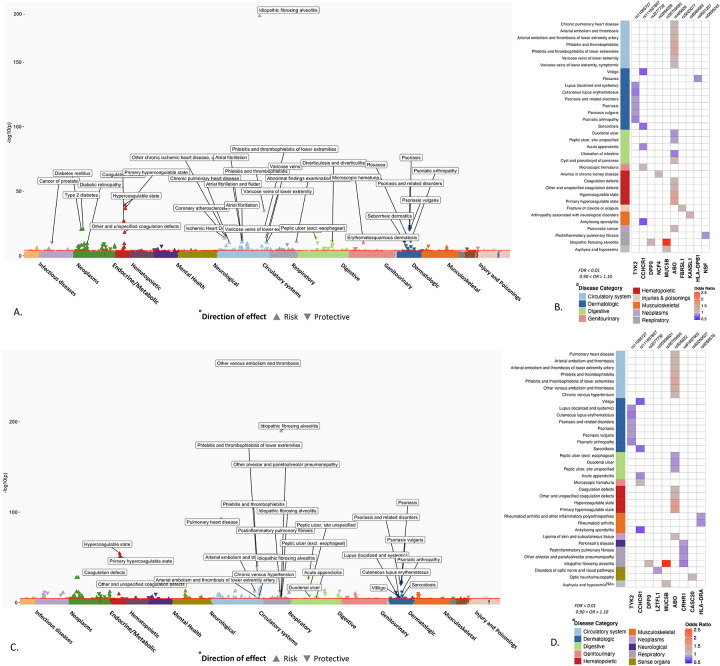
The study aims to determine the shared genetic architecture between COVID-19 severity with existing medical conditions using electronic health record (EHR) data. We conducted a Phenome-Wide Association Study (PheWAS) of genetic variants associated with critical illness (n=35) or hospitalization (n=42) due to severe COVID-19 using genome-wide association summary from the Host Genetics Initiative. PheWAS analysis was performed using genotype-phenotype data from the Veterans Affairs Million Veteran Program (MVP). Phenotypes were defined by International Classification of Diseases (ICD) codes mapped to clinically relevant groups using published PheWAS methods. Among 658,582 Veterans, variants associated with severe COVID-19 were tested for association across 1,559 phenotypes. Variants at the locus (rs495828, rs505922) associated with the largest number of phenotypes (n=53 and n=59); strongest association with venous embolism, odds ratio (ORrs495828 1.33 (p=1.32 × 10), and thrombosis OR 1.33, p=2.2 × 10. Among 67 respiratory conditions tested, 11 had significant associations including locus (rs35705950) with increased risk of idiopathic fibrosing alveolitis OR 2.83, p=4.12 × 10; rs61667602) associated with reduced risk of pulmonary fibrosis, OR 0.84, p=2.26 × 10. The locus (rs11085727) associated with reduced risk for autoimmune conditions, e.g., psoriasis OR 0.88, p=6.48 × 10, lupus OR 0.84, p=3.97 × 10. PheWAS stratified by genetic ancestry demonstrated differences in genotype-phenotype associations across ancestry. (rs581342) associated with neutropenia OR 1.29 p=4.1 × 10 among Veterans of African ancestry but not European. Overall, we observed shared genetic architecture between COVID-19 severity and conditions related to underlying risk factors for severe and poor COVID-19 outcomes. Differing associations between genotype-phenotype across ancestries may inform heterogenous outcomes observed with COVID-19. Divergent associations between risk for severe COVID-19 with autoimmune inflammatory conditions both respiratory and non-respiratory highlights the shared pathways and fine balance of immune host response and autoimmunity and caution required when considering treatment targets.
该研究旨在利用电子健康记录(EHR)数据确定新冠病毒疾病严重程度与现有医疗状况之间的共同遗传结构。我们使用宿主遗传学倡议的全基因组关联总结,对与重症新冠病毒疾病(n = 35)或因严重新冠病毒疾病住院(n = 42)相关的基因变异进行了全表型组关联研究(PheWAS)。PheWAS分析使用了退伍军人事务部百万退伍军人计划(MVP)的基因型-表型数据。表型由国际疾病分类(ICD)代码定义,这些代码使用已发表的PheWAS方法映射到临床相关组。在658,582名退伍军人中,对与严重新冠病毒疾病相关的变异进行了1,559种表型的关联测试。位于 位点(rs495828,rs505922)的变异与最多的表型相关(n = 53和n = 59);与静脉栓塞的关联最强,比值比(ORrs495828 1.33(p = 1.32 × 10),与血栓形成的OR为1.33,p = 2.2 × 10。在测试的67种呼吸道疾病中,11种有显著关联,包括 位点(rs35705950)与特发性肺纤维化风险增加相关,OR 2.83,p = 4.12 × 10;rs61667602)与肺纤维化风险降低相关,OR 0.84,p = 2.26 × 10。 位点(rs11085727)与自身免疫性疾病风险降低相关,例如银屑病OR 0.88,p = 6.48 × 10,狼疮OR 0.84,p = 3.97 × 10。按遗传血统分层的PheWAS显示不同血统的基因型-表型关联存在差异。 (rs581342)与非洲裔退伍军人的中性粒细胞减少症相关,OR 1.29,p = 4.1 × 10,而欧洲裔退伍军人则无此关联。总体而言,我们观察到新冠病毒疾病严重程度与严重和不良新冠病毒疾病结局的潜在风险因素相关状况之间存在共同的遗传结构。不同血统之间基因型-表型的不同关联可能为新冠病毒疾病观察到的异质性结局提供信息。严重新冠病毒疾病风险与呼吸道和非呼吸道自身免疫性炎症疾病之间的不同关联突出了免疫宿主反应和自身免疫的共同途径和精细平衡,以及在考虑治疗靶点时所需的谨慎。