Department of Integrative Biology and Physiology (X.S.R., P.P., F.B., G.F., H.W., D.Y., J.H.v.B.), University of Minnesota, Minneapolis, MN, 55455.
Center for Immunology (X.S.R.), University of Minnesota, Minneapolis, MN, 55455.
Circ Res. 2021 Dec 3;129(12):1086-1101. doi: 10.1161/CIRCRESAHA.121.319737. Epub 2021 Oct 14.
The initial hypertrophy response to cardiac pressure overload is considered compensatory, but with sustained stress, it eventually leads to heart failure. Recently, a role for recruited macrophages in determining the transition from compensated to decompensated hypertrophy has been established. However, whether cardiac resident immune cells influence the early phase of hypertrophy development has not been established.
To assess the role of cardiac immune cells in the early hypertrophy response to cardiac pressure overload induced by transverse aortic constriction (TAC).
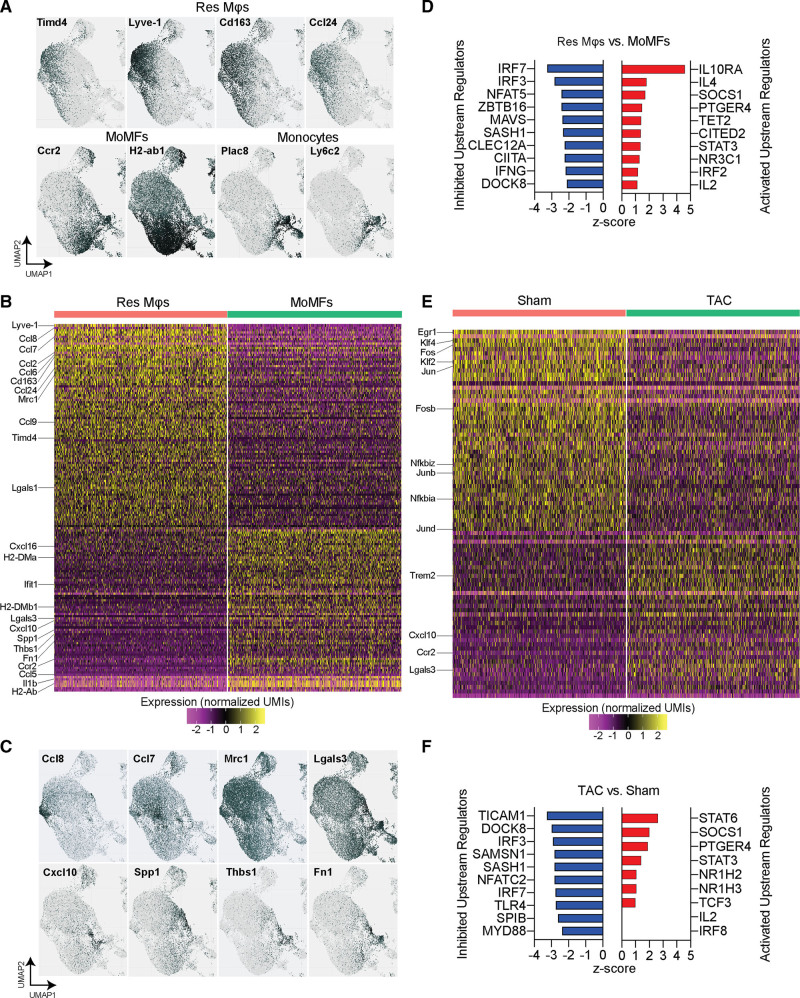
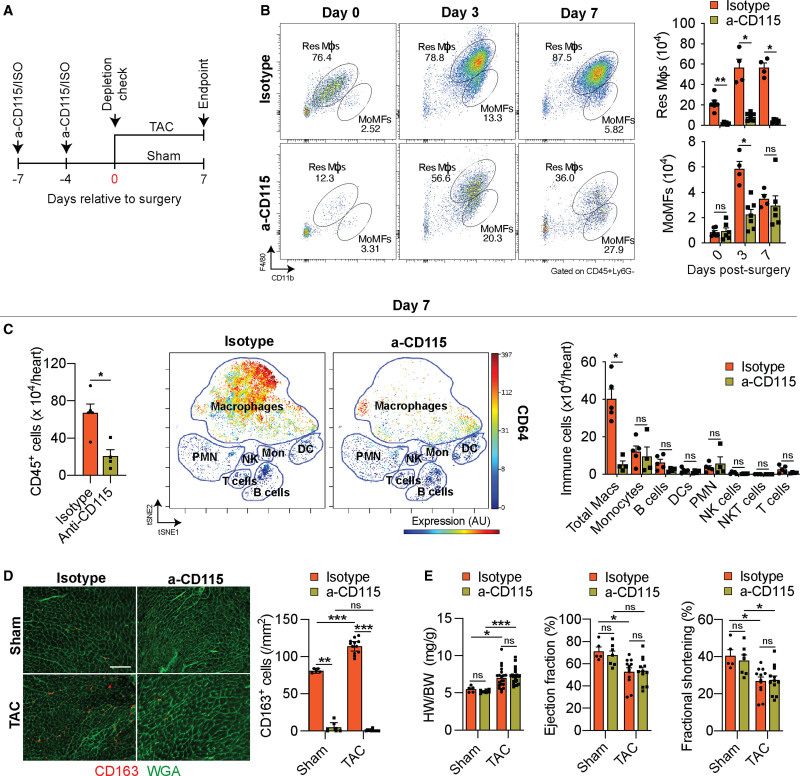
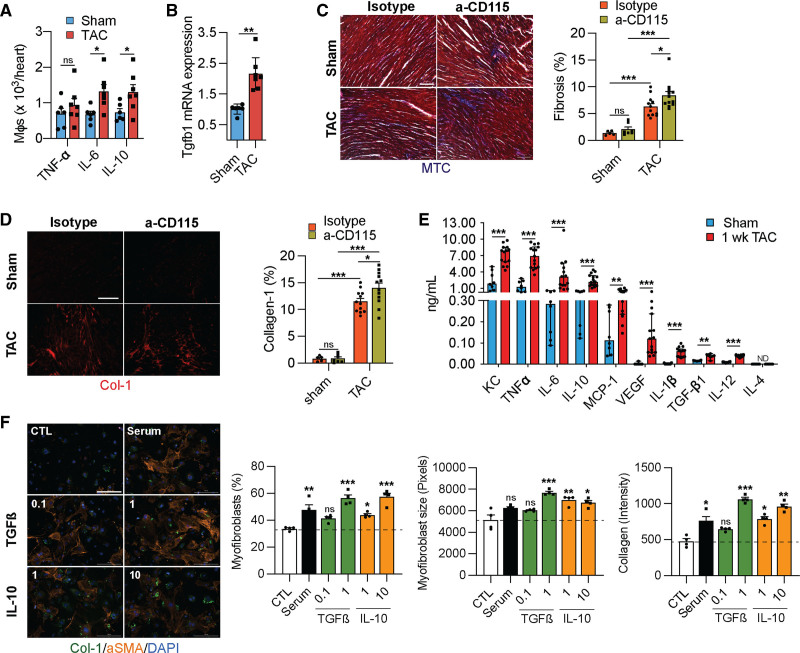
We performed cytometry by time-of-flight to determine the identity and abundance of immune cells in the heart at 1 and 4 weeks after TAC. We observed a substantial increase in cardiac macrophages 1 week after TAC. We then conducted Cite-Seq single-cell RNA sequencing of cardiac immune cells isolated from 4 sham and 6 TAC hearts. We identified 12 clusters of monocytes and macrophages, categorized as either resident or recruited macrophages, that showed remarkable changes in their abundance between sham and TAC conditions. To determine the role of cardiac resident macrophages early in the response to a hypertrophic stimulus, we used a blocking antibody against macrophage colony-stimulating factor 1 receptor (CD115). As blocking CD115 initially depletes all macrophages, we allowed the replenishment of recruited macrophages by monocytes before performing TAC. This preferential depletion of resident macrophages resulted in enhanced fibrosis and a blunted angiogenesis response to TAC. Macrophage depletion in CCR2 (C-C chemokine receptor type 2) knockout mice showed that aggravated fibrosis was primarily caused by the recruitment of monocyte-derived macrophages. Finally, 6 weeks after TAC these early events lead to depressed cardiac function and enhanced fibrosis, despite complete restoration of cardiac immune cells.
Cardiac resident macrophages are a heterogeneous population of immune cells with key roles in stimulating angiogenesis and inhibiting fibrosis in response to cardiac pressure overload.
心脏压力超负荷引起的初始心肌肥厚反应被认为是代偿性的,但随着持续的压力,它最终会导致心力衰竭。最近,募集的巨噬细胞在确定从代偿性肥厚向失代偿性肥厚的转变中起作用已得到确立。然而,心脏固有免疫细胞是否影响肥厚发展的早期阶段尚未确定。
评估心脏固有免疫细胞在心脏压力超负荷引起的心肌肥厚早期反应中的作用,这种压力超负荷是由横主动脉缩窄(TAC)引起的。
我们通过飞行时间细胞术确定 TAC 后 1 周和 4 周心脏中免疫细胞的身份和丰度。我们观察到 TAC 后 1 周心脏巨噬细胞大量增加。然后,我们对从 4 个假手术和 6 个 TAC 心脏中分离的心脏免疫细胞进行 Cite-Seq 单细胞 RNA 测序。我们鉴定了 12 个单核细胞和巨噬细胞簇,可分为固有或募集的巨噬细胞,它们在假手术和 TAC 条件之间的丰度有明显变化。为了确定心脏固有巨噬细胞在对肥大刺激的早期反应中的作用,我们使用了针对巨噬细胞集落刺激因子 1 受体(CD115)的阻断抗体。由于阻断 CD115 最初会耗尽所有巨噬细胞,因此在进行 TAC 之前,我们允许单核细胞补充募集的巨噬细胞。这种固有巨噬细胞的优先耗竭导致 TAC 时纤维化增强和血管生成反应减弱。CCR2(C-C 趋化因子受体 2)基因敲除小鼠中的巨噬细胞耗竭表明,加重的纤维化主要是由单核细胞衍生的巨噬细胞募集引起的。最后,TAC 后 6 周,尽管心脏免疫细胞完全恢复,但这些早期事件导致心脏功能下降和纤维化增强。
心脏固有巨噬细胞是一群具有异质性的免疫细胞,在心脏压力超负荷引起的刺激血管生成和抑制纤维化反应中具有关键作用。