Department of Medicine, Swiss Tropical and Public Health Institute, Socinstrasse 57, 4002, Basel, Switzerland.
University of Basel, P.O. Box, 4003, Basel, Switzerland.
Malar J. 2021 Oct 13;20(1):401. doi: 10.1186/s12936-021-03942-5.
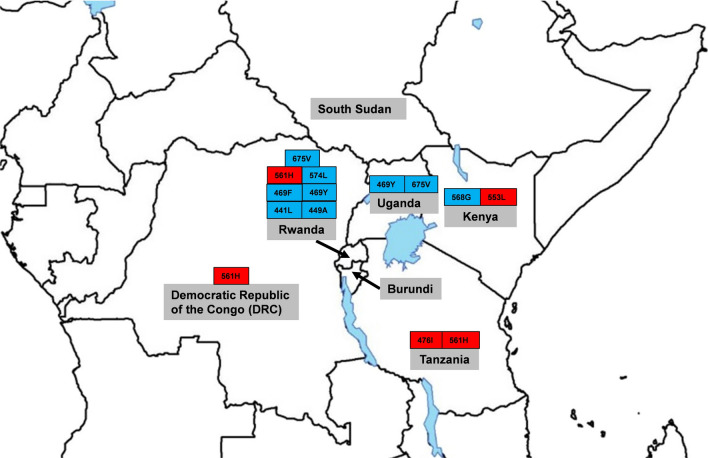
Artemisinin resistance has emerged and spread in the Greater Mekong Sub-region (GMS), followed by artemisinin-based combination therapy failure, due to both artemisinin and partner drug resistance. More worrying, artemisinin resistance has been recently reported and confirmed in Rwanda. Therefore, there is an urgent need to strengthen surveillance systems beyond the GMS to track the emergence or spread of artemisinin and partner drug resistance in other endemic settings. Currently, anti-malarial drug efficacy is monitored primarily through therapeutic efficacy studies (TES). Even though essential for anti-malarial drug policy change, these studies are difficult to conduct, expensive, and may not detect the early emergence of resistance. Additionally, results from TES may take years to be available to the stakeholders, jeopardizing their usefulness. Molecular markers are additional and useful tools to monitor anti-malarial drug resistance, as samples collected on dried blood spots are sufficient to monitor known and validated molecular markers of resistance, and could help detecting and monitoring the early emergence of resistance. However, molecular markers are not monitored systematically by national malaria control programmes, and are often assessed in research studies, but not in routine surveillance. The implementation of molecular markers as a routine tool for anti-malarial drug resistance surveillance could greatly improve surveillance of anti-malarial drug efficacy, making it possible to detect resistance before it translates to treatment failures. When possible, ex vivo assays should be included as their data could be useful complementary, especially when no molecular markers are validated.
在大湄公河次区域(GMS),由于青蒿素和联合用药的耐药性,青蒿素耐药性已经出现并传播,随后出现了基于青蒿素的联合疗法失败。更令人担忧的是,青蒿素耐药性最近在卢旺达得到了报告和证实。因此,迫切需要加强 GMS 以外的监测系统,以跟踪青蒿素和联合用药在其他流行地区耐药性的出现或传播。目前,抗疟药物疗效主要通过治疗效果研究(TES)进行监测。尽管这些研究对于抗疟药物政策的改变至关重要,但这些研究很难进行,费用高昂,并且可能无法检测到耐药性的早期出现。此外,TES 的结果可能需要数年时间才能提供给利益相关者,从而降低了它们的有用性。分子标志物是监测抗疟药物耐药性的额外且有用的工具,因为从干血斑中收集的样本足以监测已知和经过验证的耐药性分子标志物,并有助于检测和监测耐药性的早期出现。然而,国家疟疾控制规划并没有系统地监测分子标志物,而且通常在研究中进行评估,而不是在常规监测中。将分子标志物作为抗疟药物耐药性监测的常规工具实施,可以大大改善抗疟药物疗效监测,使其有可能在耐药性转化为治疗失败之前检测到耐药性。只要有可能,应包括体外检测,因为其数据可能是有用的补充,尤其是在没有经过验证的分子标志物的情况下。