Global Health and Tropical Medicine (GHTM), Department of Medical Parasitology, Instituto de Higiene e Medicina Tropical, Universidade Nova de Lisboa, Rua da Junqueira Nº100, 1349-008, Lisbon, Portugal.
Instituto Nacional de Saúde (INS), Av. Eduardo Mondlane Nº 1008, Caixa Postal 264, Maputo, Mozambique.
Malar J. 2023 May 19;22(1):160. doi: 10.1186/s12936-023-04589-0.
Malaria remains one of the most serious public health problems in sub-Saharan Africa and Mozambique is the world's fourth largest contributor, with 4.7% of disease cases and 3.6% of total deaths due to malaria. Its control relies on the fight against the vector and treatment of confirmed cases with anti-malarial drugs. Molecular surveillance is an important tool for monitoring the spread of anti-malarial drug resistance.
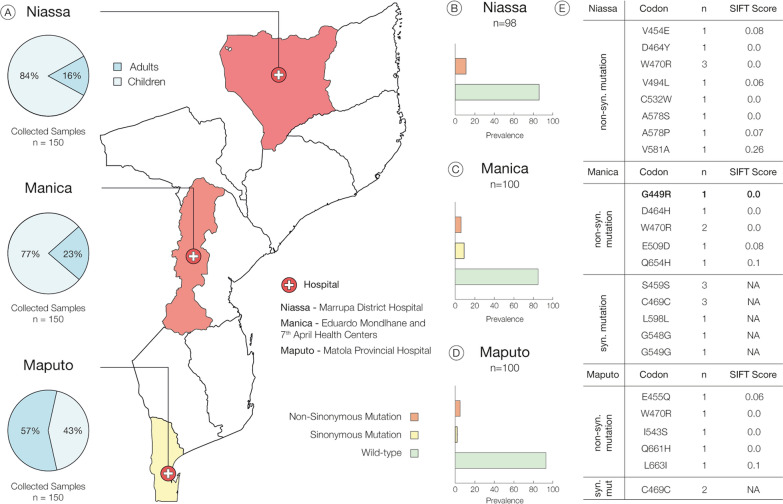
A cross-sectional study recruited 450 participants with malaria infection detected by Rapid Diagnostic Tests, from three different study sites (Niassa, Manica and Maputo) between April and August 2021. Correspondent blood samples were collected on filter paper (Whatman® FTA® cards), parasite DNA extracted and pfk13 gene sequenced using Sanger method. SIFT software (Sorting Intolerant From Tolerant) was used, predict whether an amino acid substitution affects protein function.
No pfkelch13-mediated artemisinin resistance gene mutation was detected in this study settings. However, non-synonymous mutations were detected at prevalence of 10.2%, 6% and 5% in Niassa, Manica and Maputo, respectively. Most (56.3%) of the reported non-synonymous mutations were due to substitution at the first base of the codon, 25% at the second base and 18.8% at the third base. Additionally, 50% of non-synonymous mutations showed a SIFTscore bellow cut off value of 0.05, therefore, they were predicted to be deleterious.
These results do not show an emergence of artemisinin resistance cases in Mozambique. However, the increased number of novel non-synonymous mutations highlights the relevance of increasing the number of studies focused on the molecular surveillance of artemisinin resistance markers, for its early detection.
疟疾仍然是撒哈拉以南非洲和莫桑比克最严重的公共卫生问题之一,莫桑比克是世界上第四大疟疾病例贡献国,疟疾病例占 4.7%,总死亡人数占 3.6%。其控制依赖于对抗疟媒和用抗疟药物治疗确诊病例。分子监测是监测抗疟药物耐药性传播的重要工具。
一项横断面研究于 2021 年 4 月至 8 月在三个不同的研究地点(尼亚萨、马尼卡和马普托)招募了 450 名通过快速诊断检测发现疟疾感染的参与者。采集相应的血样在滤纸上(Whatman® FTA®卡),寄生虫 DNA 用 Sanger 法提取,pfk13 基因测序。使用 SIFT 软件(Sorting Intolerant From Tolerant)预测氨基酸取代是否影响蛋白质功能。
本研究未发现 pfkelch13 介导的青蒿素耐药基因突变。然而,在尼亚萨、马尼卡和马普托分别检测到非同义突变的流行率为 10.2%、6%和 5%。报告的非同义突变中,大多数(56.3%)是由于密码子的第一个碱基发生取代,25%是第二个碱基,18.8%是第三个碱基。此外,50%的非同义突变的 SIFT 评分低于 0.05 的截止值,因此预测为有害。
这些结果表明莫桑比克没有出现青蒿素耐药病例。然而,新出现的非同义突变数量增加,突出了增加关注青蒿素耐药标志物分子监测研究数量的重要性,以便及早发现。