Key Laboratory of Molecular Biology of Infectious Diseases (Chinese Ministry of Education), Institute for Viral Hepatitis, Department of Infectious Diseases, The Second Affiliated Hospital, Chongqing Medical University, Chongqing, China.
Institute for Virology, University Hospital Essen, University of Duisburg-Essen, Essen, 45122, Germany.
Cell Mol Immunol. 2022 Feb;19(2):150-157. doi: 10.1038/s41423-021-00774-w. Epub 2021 Oct 13.
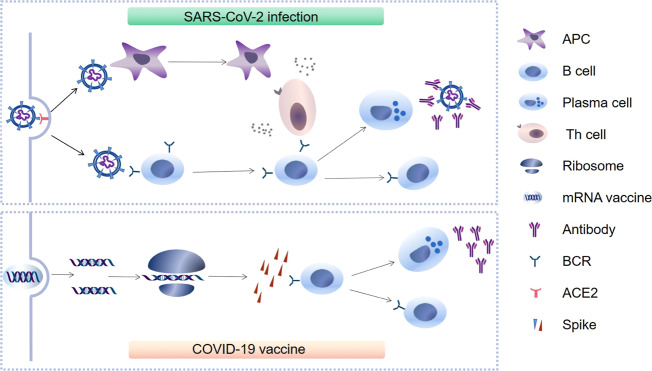
Coronavirus disease 2019 (COVID-19), caused by severe acute respiratory syndrome coronavirus 2 (SARS-CoV-2), is an ongoing pandemic that poses a great threat to human health worldwide. As the humoral immune response plays essential roles in disease occurrence and development, understanding the dynamics and characteristics of virus-specific humoral immunity in SARS-CoV-2-infected patients is of great importance for controlling this disease. In this review, we summarize the characteristics of the humoral immune response after SARS-CoV-2 infection and further emphasize the potential applications and therapeutic prospects of SARS-CoV-2-specific humoral immunity and the critical role of this immunity in vaccine development. Notably, serological antibody testing based on the humoral immune response can guide public health measures and control strategies; however, it is not recommended for population surveys in areas with very low prevalence. Existing evidence suggests that asymptomatic individuals have a weaker immune response to SARS-CoV-2 infection, whereas SARS-CoV-2-infected children have a more effective humoral immune response than adults. The correlations between antibody (especially neutralizing antibody) titers and protection against SARS-CoV-2 reinfection should be further examined. In addition, the emergence of cross-reactions among different coronavirus antigens in the development of screening technology and the risk of antibody-dependent enhancement related to SARS-CoV-2 vaccination should be given further attention.
新型冠状病毒病(COVID-19),由严重急性呼吸综合征冠状病毒 2(SARS-CoV-2)引起,是一场正在进行的大流行,对全球人类健康构成了巨大威胁。由于体液免疫反应在疾病的发生和发展中起着至关重要的作用,因此了解 SARS-CoV-2 感染患者中病毒特异性体液免疫的动态和特征对于控制这种疾病非常重要。在这篇综述中,我们总结了 SARS-CoV-2 感染后体液免疫反应的特征,并进一步强调了 SARS-CoV-2 特异性体液免疫的潜在应用和治疗前景及其在疫苗开发中的关键作用。值得注意的是,基于体液免疫反应的血清学抗体检测可以指导公共卫生措施和控制策略;然而,在流行率非常低的地区,不建议进行人群调查。现有证据表明,无症状个体对 SARS-CoV-2 感染的免疫反应较弱,而 SARS-CoV-2 感染的儿童比成年人具有更有效的体液免疫反应。抗体(尤其是中和抗体)滴度与预防 SARS-CoV-2 再感染之间的相关性还需要进一步研究。此外,在筛查技术的开发中不同冠状病毒抗原之间的交叉反应以及与 SARS-CoV-2 疫苗接种相关的抗体依赖性增强的风险应给予进一步关注。