Immunology Department, Theodor Bilharz Research Institute, Giza, Egypt.
Clinical Chemistry Department, Theodor Bilharz Research Institute, Giza, Egypt.
Virol J. 2024 Nov 5;21(1):277. doi: 10.1186/s12985-024-02546-0.
Defining the protective thresholds against the severe-acute-respiratory-syndrome-related corona virus-2 pandemic is a crucial challenge. To reduce the risks of severe disease, hospitalization, and death, various COVID-19 vaccines have been rapidly developed.
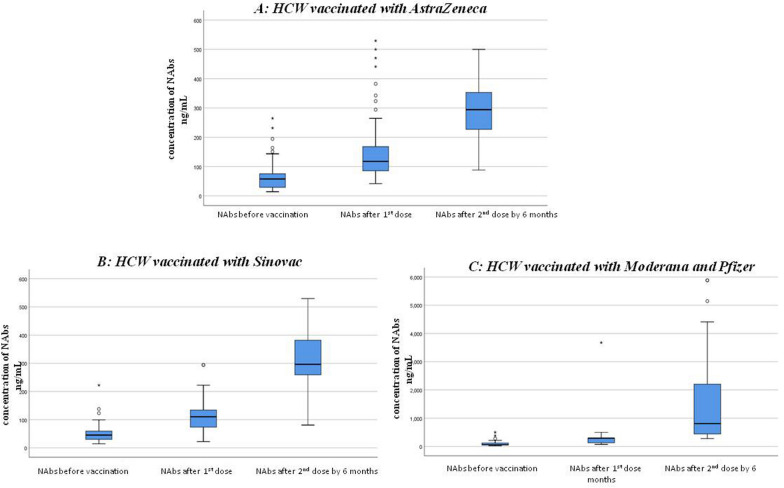
This study aimed to assess the impact of three common COVID-19 vaccine types; two mRNA COVID-19 vaccines: (Pfizer/BioNTech's BNT162b2 and Moderna's mRNA-1273), one adenoviral vector vaccine: Oxford/AstraZeneca's ChAdOx1, and one inactivated vaccine (Sinovac Biotech/China's Sinovac) on the level of neutralizing antibodies, considering factors such as vaccine type, demographic characteristics, and hybrid immunity. We conducted a direct comparative analysis involving 300 healthcare workers, both with and without prior SARS-CoV-2 infection (B.1, C.36.3, and AY.32 (Delta) variants). Neutralizing antibodies levels were measured at baseline (before vaccination), before the second dose, and six months after the second dose.
The results showed a significant increase in neutralizing antibodies levels after complete vaccination with all vaccine types. Among healthcare workers, those vaccinated with mRNA vaccines (Moderna or Pfizer) exhibited the highest neutralizing antibodies titers, followed by AstraZeneca, and finally Sinovac with the lowest titer. On studying the effect of previous COVID-19 infection after vaccination, no significant difference in neutralizing antibodies levels was observed between healthcare workers vaccinated with mRNA or AstraZeneca vaccines, both with prior COVID-19 infection, following the first and six months after the second dose.
These findings suggest that individuals with prior COVID-19 may only require a single dose of mRNA or AstraZeneca vaccines to achieve a similar level of immunization as those without prior COVID-19 who completed the vaccination program.
There is a significant increase in neutralizing antibodies levels after complete vaccination against COVID-19 Vaccination with mRNA vaccines exhibits the highest neutralizing antibodies titers. Vaccination with Sinovac exhibits the lowest neutralizing antibodies titers.
定义针对严重急性呼吸综合征相关冠状病毒 2 大流行的保护阈值是一项至关重要的挑战。为了降低患重病、住院和死亡的风险,已迅速开发出各种 COVID-19 疫苗。
本研究旨在评估三种常见的 COVID-19 疫苗类型的影响:两种 mRNA COVID-19 疫苗:辉瑞/生物科技公司的 BNT162b2 和 Moderna 的 mRNA-1273,一种腺病毒载体疫苗:牛津/阿斯利康的 ChAdOx1,以及一种灭活疫苗(科兴生物/中国的科兴)对中和抗体水平的影响,同时考虑疫苗类型、人口统计学特征和混合免疫等因素。我们进行了一项直接比较分析,涉及 300 名医护人员,包括有和没有先前 SARS-CoV-2 感染(B.1、C.36.3 和 AY.32(Delta)变体)的人员。在基线(接种疫苗前)、第二剂疫苗前和第二剂疫苗后六个月测量中和抗体水平。
结果表明,所有疫苗类型完全接种后,中和抗体水平均显著升高。在医护人员中,接种 mRNA 疫苗(Moderna 或辉瑞)的人表现出最高的中和抗体滴度,其次是阿斯利康,最后是科兴,滴度最低。在研究接种疫苗后先前 COVID-19 感染的影响时,mRNA 或阿斯利康疫苗接种的医护人员在第一剂和第二剂后六个月,在中和抗体水平方面没有观察到先前 COVID-19 感染的差异。
这些发现表明,先前患有 COVID-19 的个体可能只需要接种一剂 mRNA 或阿斯利康疫苗,就可以达到与未患 COVID-19 但已完成疫苗接种计划的个体相似的免疫水平。
COVID-19 完全接种后中和抗体水平显著升高。接种 mRNA 疫苗可产生最高的中和抗体滴度。接种科兴可产生最低的中和抗体滴度。