Manoukian Paul, Bijlsma Maarten, van Laarhoven Hanneke
Laboratory for Experimental Oncology and Radiobiology, Center for Experimental and Molecular Medicine, Cancer Center Amsterdam, Amsterdam UMC, University of Amsterdam, Amsterdam, Netherlands.
Department of Medical Oncology, Cancer Center Amsterdam, Amsterdam UMC, University of Amsterdam, Amsterdam, Netherlands.
Front Cell Dev Biol. 2021 Sep 27;9:743907. doi: 10.3389/fcell.2021.743907. eCollection 2021.
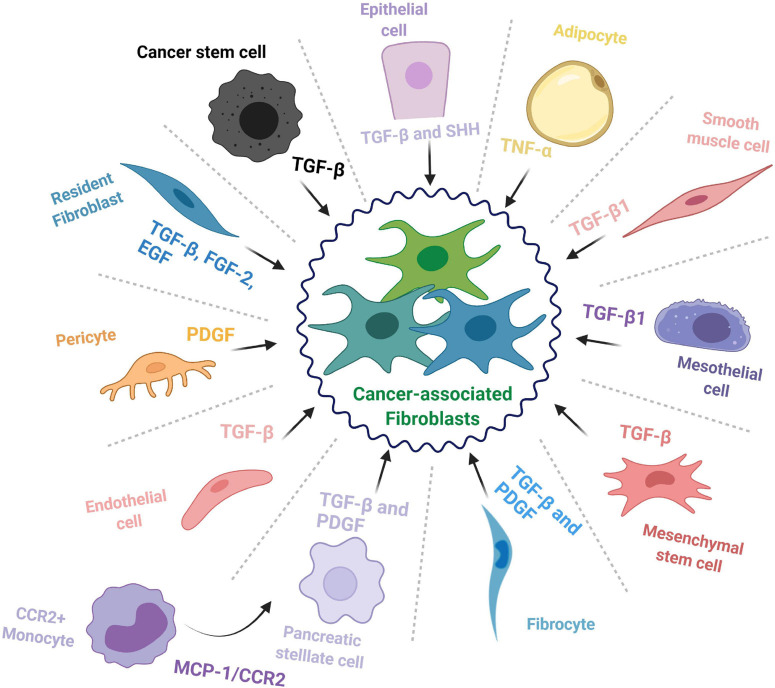
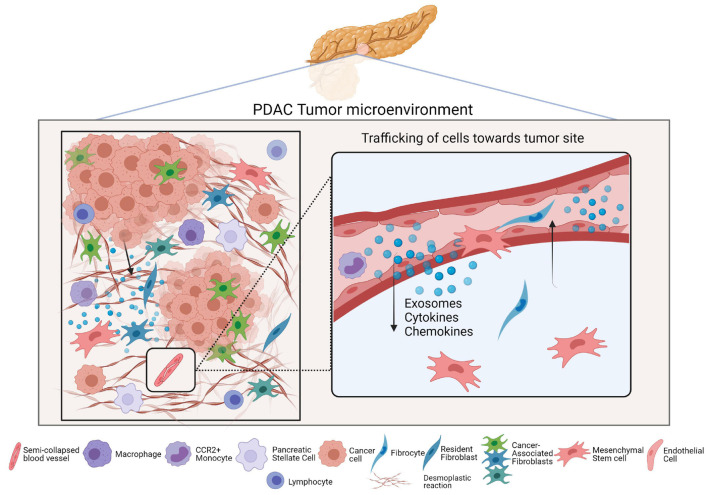
Pancreatic tumors are known to harbor an abundant and highly desmoplastic stroma. Among the various cell types that reside within tumor stroma, cancer-associated fibroblasts (CAFs) have gained a lot of attention in the cancer field due to their contributions to carcinogenesis and tumor architecture. These cells are not a homogeneous population, but have been shown to have different origins, phenotypes, and contributions. In pancreatic tumors, CAFs generally emerge through the activation and/or recruitment of various cell types, most notably resident fibroblasts, pancreatic stellate cells (PSCs), and tumor-infiltrating mesenchymal stem cells (MSCs). In recent years, single cell transcriptomic studies allowed the identification of distinct CAF populations in pancreatic tumors. Nonetheless, the exact sources and functions of those different CAF phenotypes remain to be fully understood. Considering the importance of stromal cells in pancreatic cancer, many novel approaches have aimed at targeting the stroma but current stroma-targeting therapies have yielded subpar results, which may be attributed to heterogeneity in the fibroblast population. Thus, fully understanding the roles of different subsets of CAFs within the stroma, and the cellular dynamics at play that contribute to heterogeneity in CAF subsets may be essential for the design of novel therapies and improving clinical outcomes. Fortunately, recent advances in technologies such as microfluidics and bio-printing have made it possible to establish more advanced models that will likely prove useful. In this review, we will present the different roles of stromal cells in pancreatic cancer, focusing on CAF origin as a source of heterogeneity, and the role this may play in therapy failure. We will discuss preclinical models that could be of benefit to the field and that may contribute to further clinical development.
已知胰腺肿瘤含有丰富且高度促结缔组织增生的基质。在肿瘤基质中存在的各种细胞类型中,癌症相关成纤维细胞(CAFs)因其对肿瘤发生和肿瘤结构的贡献而在癌症领域备受关注。这些细胞并非同质群体,而是已被证明具有不同的起源、表型和作用。在胰腺肿瘤中,CAFs通常通过多种细胞类型的激活和/或募集而出现,最显著的是驻留成纤维细胞、胰腺星状细胞(PSCs)和肿瘤浸润间充质干细胞(MSCs)。近年来,单细胞转录组学研究使得在胰腺肿瘤中鉴定出不同的CAF群体成为可能。尽管如此,这些不同CAF表型的确切来源和功能仍有待充分了解。考虑到基质细胞在胰腺癌中的重要性,许多新方法旨在靶向基质,但目前的基质靶向治疗效果欠佳,这可能归因于成纤维细胞群体的异质性。因此,充分了解基质中不同CAF亚群的作用以及导致CAF亚群异质性的细胞动力学,对于设计新疗法和改善临床结果可能至关重要。幸运的是,微流体和生物打印等技术的最新进展使得建立更先进的模型成为可能,这些模型可能会被证明是有用的。在这篇综述中,我们将阐述基质细胞在胰腺癌中的不同作用,重点关注作为异质性来源的CAF起源以及这可能在治疗失败中所起的作用。我们将讨论可能对该领域有益且可能有助于进一步临床开发的临床前模型。