Velasco Vanessa, Shariati S Ali, Esfandyarpour Rahim
Biochemistry Department, Stanford University, Palo Alto, CA USA.
Department of Biomolecular Engineering, Institute for the Biology of Stem Cells, University of California, Santa Cruz, CA USA.
Microsyst Nanoeng. 2020 Oct 5;6:76. doi: 10.1038/s41378-020-00185-3. eCollection 2020.
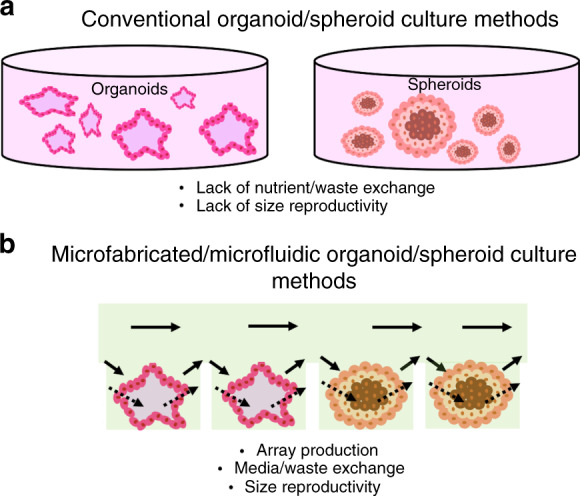
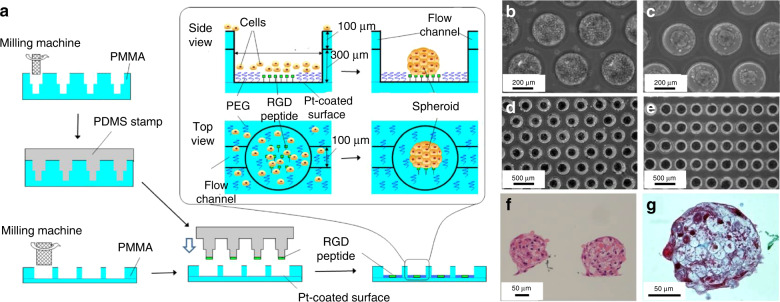
Innovations in biomaterials and stem cell technology have allowed for the emergence of novel three-dimensional (3D) tissue-like structures known as organoids and spheroids. As a result, compared to conventional 2D cell culture and animal models, these complex 3D structures have improved the accuracy and facilitated in vitro investigations of human diseases, human development, and personalized medical treatment. Due to the rapid progress of this field, numerous spheroid and organoid production methodologies have been published. However, many of the current spheroid and organoid production techniques are limited by complexity, throughput, and reproducibility. Microfabricated and microscale platforms (e.g., microfluidics and microprinting) have shown promise to address some of the current limitations in both organoid and spheroid generation. Microfabricated and microfluidic devices have been shown to improve nutrient delivery and exchange and have allowed for the arrayed production of size-controlled culture areas that yield more uniform organoids and spheroids for a higher throughput at a lower cost. In this review, we discuss the most recent production methods, challenges currently faced in organoid and spheroid production, and microfabricated and microfluidic applications for improving spheroid and organoid generation. Specifically, we focus on how microfabrication methods and devices such as lithography, microcontact printing, and microfluidic delivery systems can advance organoid and spheroid applications in medicine.
生物材料和干细胞技术的创新使得被称为类器官和球体的新型三维(3D)组织样结构得以出现。因此,与传统的二维细胞培养和动物模型相比,这些复杂的三维结构提高了准确性,并促进了对人类疾病、人类发育和个性化医疗的体外研究。由于该领域的快速发展,已经发表了许多球体和类器官的生产方法。然而,当前许多球体和类器官的生产技术受到复杂性、通量和可重复性的限制。微制造和微尺度平台(如微流体和微打印)已显示出有望解决当前类器官和球体生成中的一些限制。微制造和微流体装置已被证明可以改善营养物质的输送和交换,并允许阵列式生产尺寸可控的培养区域,从而以更低的成本产生更均匀的类器官和球体,实现更高的通量。在这篇综述中,我们讨论了类器官和球体生产的最新方法、目前在类器官和球体生产中面临的挑战,以及用于改善球体和类器官生成的微制造和微流体应用。具体而言,我们关注光刻、微接触印刷和微流体输送系统等微制造方法和装置如何推动类器官和球体在医学中的应用。