Department of Clinical Laboratory, Sun Yat-Sen Memorial Hospital, Sun Yat-Sen University, Guangzhou, Guangdong, China.
Guangdong Provincial Key Laboratory of Malignant Tumor Epigenetics and Gene Regulation, Sun Yat-Sen Memorial Hospital, Sun Yat-Sen University, Guangzhou, Guangdong, China.
Immun Inflamm Dis. 2021 Dec;9(4):1428-1438. doi: 10.1002/iid3.492. Epub 2021 Oct 14.
Diabetic foot ulcer infection (DFI) is an infectious disease of the skin and soft tissue in diabetics notorious for making rapid progress and being hard to cure. Staphylococcus aureus (S. aureus), most frequently detected in DFI, recently was suggested as an intracellular pathogen that can invade and survive within mammalian host cells. Autophagy in macrophages plays a vital immune role in combating intracellular pathogens through bacterial destruction, but there is a lack of empirical research about the infection characteristics and autophagy in diabetic skin infection.
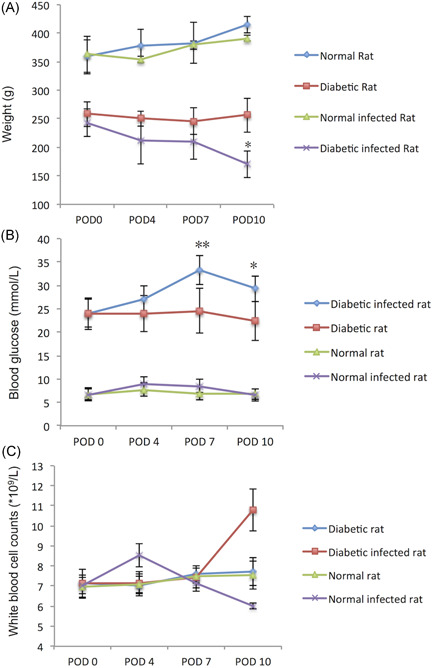
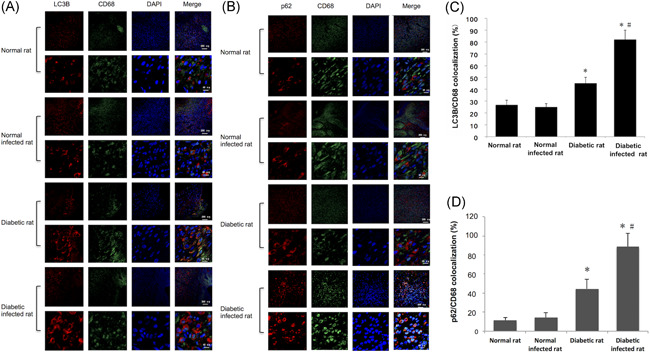
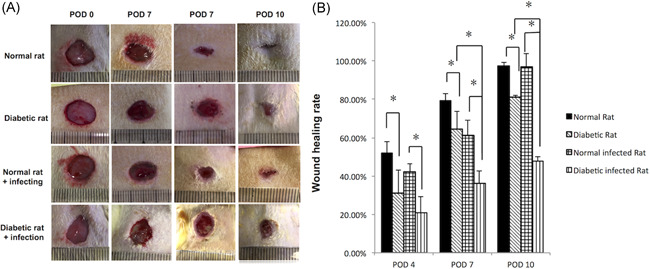
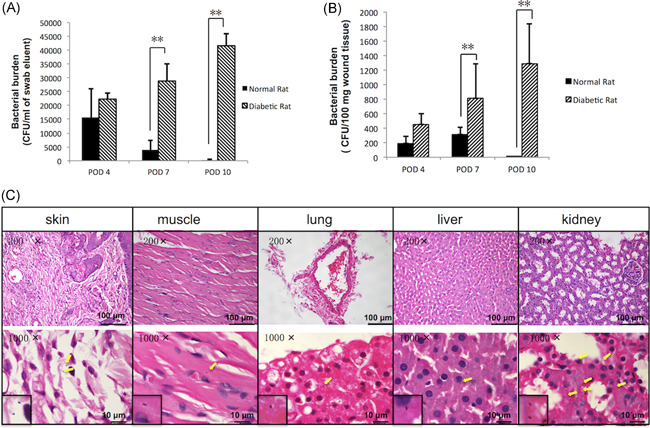
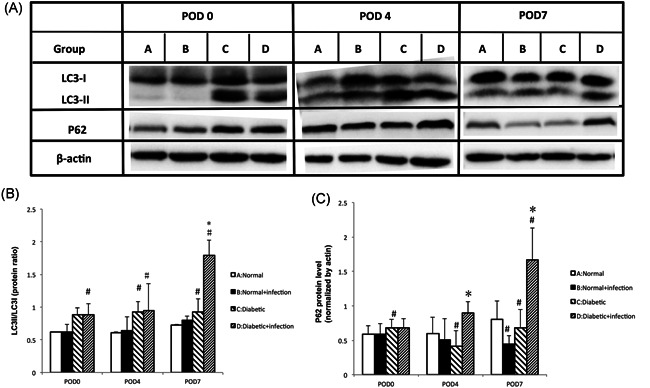
Here, we used streptozotocin-induced Sprague Dawley rats as a diabetic skin wound model to examine the S. aureus clearance ability and wound healing in vitro. Western blot and immunofluorescence staining were used to evaluate the autophagic flux of the macrophages in diabetic rats dermis, even with S. aureus infection.
We demonstrated that infections in diabetic rats appeared more severe and more invasive with weakened pathogen clearance ability of the host immune system, which coincided with the suppressed autophagic flux in dermal macrophages, featured by a significant increase in endogenous LC3II/I and in p62.
Our results first provided convincing evidence that autophagy of macrophages was dysfunctional in diabetes, especially after being infected by S. aureus, which weakens the intracellular killing of S. aureus, potentially worsens the infections, and accelerates the infection spread in the diabetic rat model. Further understanding of the special immune crosstalk between diabetes host and S. aureus infection through autophagic factors will help to explain the complex clinical phenomenon and guarantee the development of effective therapies for diabetic foot infections.
糖尿病足溃疡感染(DFI)是一种糖尿病患者皮肤和软组织的传染病,以迅速进展和难以治愈而闻名。金黄色葡萄球菌(S. aureus)是 DFI 中最常检测到的病原体,最近被认为是一种可以入侵和在哺乳动物宿主细胞内生存的细胞内病原体。巨噬细胞中的自噬在通过细菌破坏来抵抗细胞内病原体方面发挥着至关重要的免疫作用,但对于糖尿病皮肤感染中的感染特征和自噬,缺乏经验性研究。
在这里,我们使用链脲佐菌素诱导的 Sprague Dawley 大鼠作为糖尿病皮肤伤口模型,以检查金黄色葡萄球菌在体外的清除能力和伤口愈合能力。Western blot 和免疫荧光染色用于评估糖尿病大鼠真皮中巨噬细胞的自噬通量,即使金黄色葡萄球菌感染也是如此。
我们证明,糖尿病大鼠的感染更加严重和侵袭性更强,宿主免疫系统的病原体清除能力减弱,这与真皮巨噬细胞自噬通量的抑制相一致,特征是内源性 LC3II/I 和 p62 的显著增加。
我们的结果首次提供了令人信服的证据,表明巨噬细胞的自噬在糖尿病中是功能失调的,尤其是在金黄色葡萄球菌感染后,这削弱了金黄色葡萄球菌的细胞内杀伤能力,可能使感染恶化,并加速糖尿病大鼠模型中的感染扩散。通过自噬因子进一步了解糖尿病宿主与金黄色葡萄球菌感染之间的特殊免疫相互作用,将有助于解释复杂的临床现象,并保证为糖尿病足感染开发有效的治疗方法。