Institute for Integrative Biology of the Cell (I2BC), CEA, CNRS, Univ Paris-Sud, Université Paris-Saclay, 91198 Gif-sur-Yvette Cedex, France.
Viruses. 2017 Dec 4;9(12):372. doi: 10.3390/v9120372.
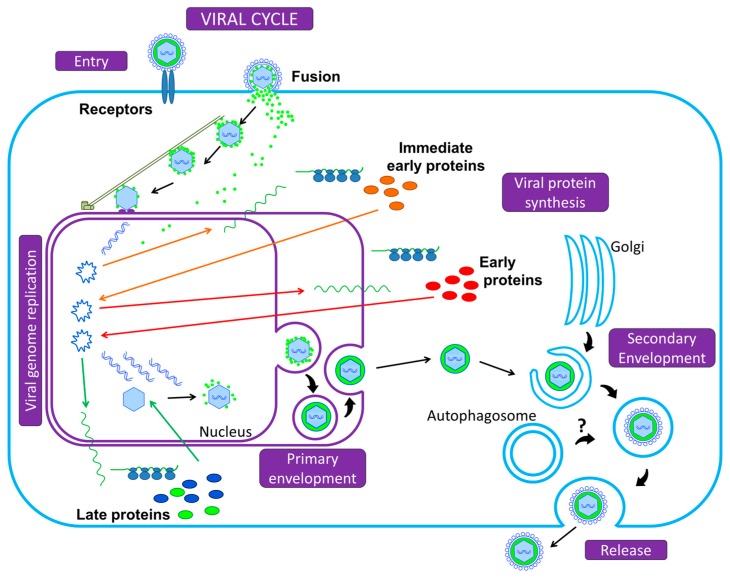
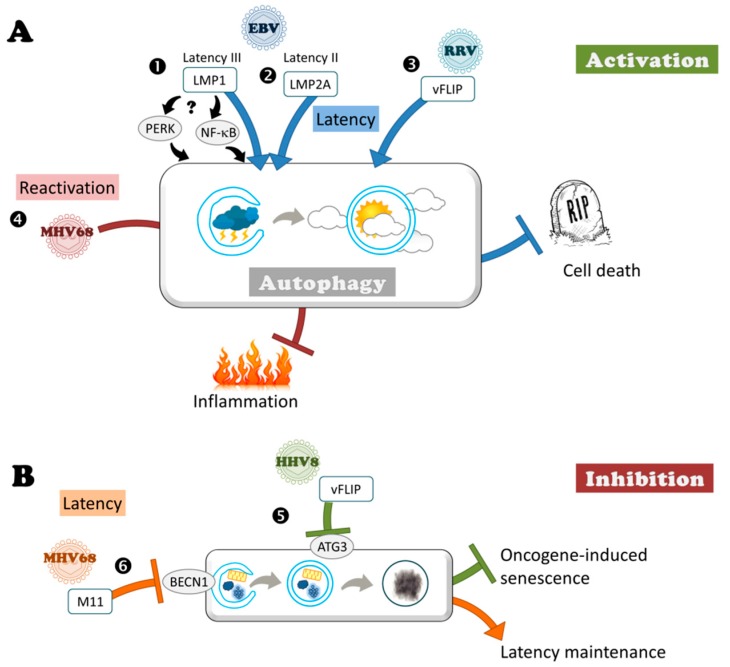
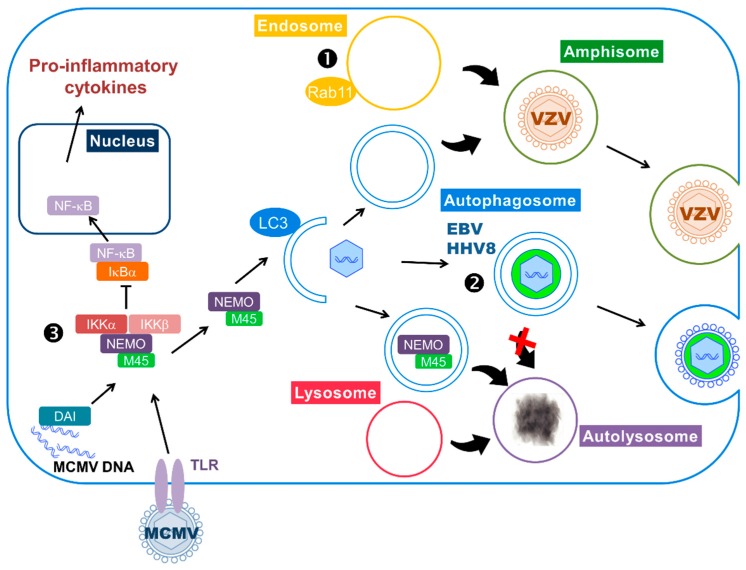
Autophagy is an essential vacuolar process of the cell, leading to lysosomal degradation and recycling of proteins and organelles, which is extremely important in maintaining homeostasis. Multiple roles have been now associated with autophagy, in particular a pro-survival role in nutrient starvation or in stressful environments, a role in life span extension, in development, or in innate and adaptive immunity. This cellular process can also take over microorganisms or viral proteins inside autophagosomes and degrade them directly in autolysosomes and is then called xenophagy and virophagy, respectively. Several Herpesviruses have developed strategies to escape this degradation, by expression of specific anti-autophagic proteins. However, we are increasingly discovering that Herpesviruses hijack autophagy, rather than just fight it. This beneficial effect is obvious since inhibition of autophagy will lead to decreased viral titers for human cytomegalovirus (HCMV), Epstein-Barr virus (EBV) or Varicella-Zoster virus (VZV), for example. Conversely, autophagy stimulation will improve viral multiplication. The autophagic machinery can be used in whole or in part, and can optimize viral propagation or persistence. Some viruses block maturation of autophagosomes to avoid the degradation step, then autophagosomal membranes are used to contribute to the envelopment and/or the egress of viral particles. On the other hand, VZV stimulates the whole process of autophagy to subvert it in order to use vesicles containing ATG (autophagy-related) proteins and resembling amphisomes for their transport in the cytoplasm. During latency, autophagy can also be activated by latent proteins encoded by different oncogenic Herpesviruses to promote cell survival and achieve long term viral persistence in vivo. Finally, reactivation of gammaherpesvirus Murid Herpesvirus 68 (MHV68) in mice appears to be positively modulated by autophagy, in order to control the level of inflammation. Therefore, Herpesviruses appear to behave more like thieves than fugitives.
自噬是细胞的一种重要的液泡过程,导致溶酶体降解和蛋白质及细胞器的再循环,这在维持内稳态方面非常重要。自噬现在与多种角色相关联,特别是在营养饥饿或应激环境中具有促进生存的作用,在寿命延长、发育或先天和适应性免疫中具有作用。这个细胞过程也可以吞噬自噬体中的微生物或病毒蛋白,并直接在自溶酶体中降解它们,然后分别称为异噬作用和病毒噬作用。几种疱疹病毒已经开发出逃避这种降解的策略,通过表达特定的抗自噬蛋白。然而,我们越来越发现疱疹病毒劫持自噬,而不仅仅是与之对抗。这种有益的效果是显而易见的,因为抑制自噬会导致人类巨细胞病毒(HCMV)、EB 病毒(EBV)或水痘带状疱疹病毒(VZV)等病毒滴度降低。相反,自噬的刺激会改善病毒的复制。自噬机制可以全部或部分被利用,并且可以优化病毒的繁殖或持久性。一些病毒阻止自噬体的成熟以避免降解步骤,然后自噬体膜被用于促进病毒粒子的包膜和/或出芽。另一方面,VZV 刺激自噬的整个过程来颠覆它,以便利用含有 ATG(自噬相关)蛋白的囊泡,并将其类似阿米巴虫用于在细胞质中的运输。在潜伏期,不同致癌疱疹病毒编码的潜伏蛋白也可以激活自噬,以促进细胞存活并实现体内病毒的长期持续存在。最后,小鼠中的γ疱疹病毒鼠疱疹病毒 68(MHV68)的再激活似乎被自噬积极调节,以控制炎症水平。因此,疱疹病毒的行为更像是小偷而不是逃犯。