San Francisco Veterans Affairs Medical Center, San Francisco, California, USA.
Department of Radiology and Biomedical Imaging, University of California San Francisco, San Francisco, California, USA.
Alzheimers Dement. 2022 Jul;18(7):1370-1382. doi: 10.1002/alz.12480. Epub 2021 Oct 14.
Amyloid beta (Aβ), tau, and neurodegeneration jointly with the Alzheimer's disease (AD) risk factors affect the severity of clinical symptoms and disease progression.
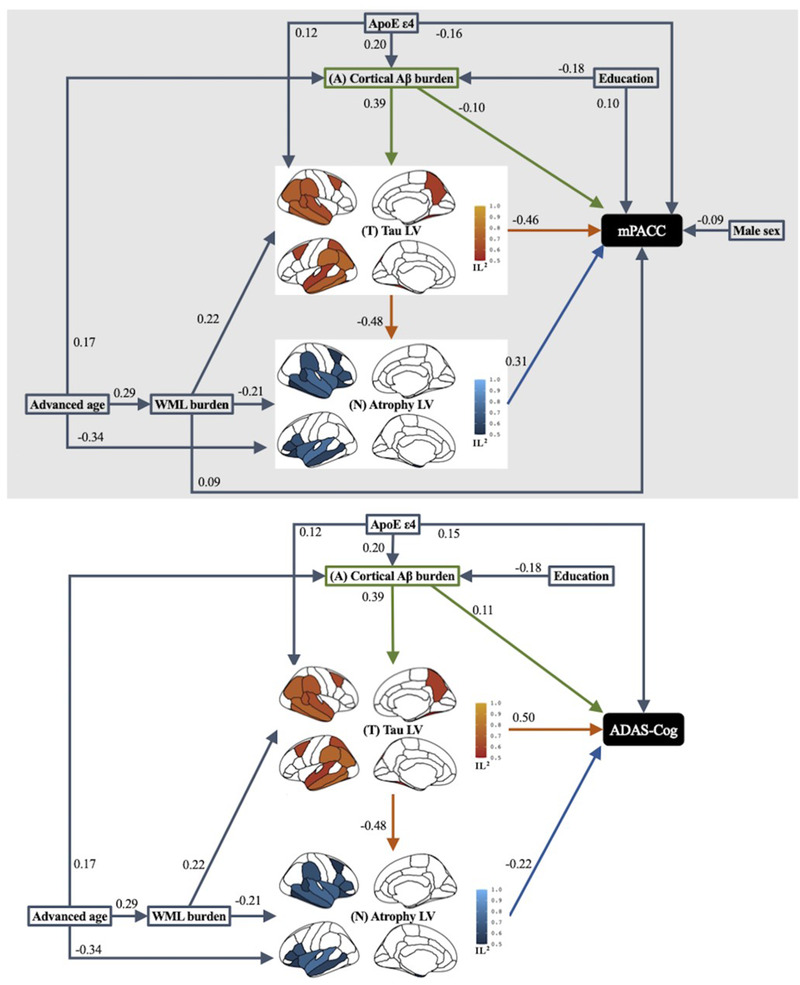
Within 248 Aβ-positive elderly with and without cognitive impairment and dementia, partial least squares structural equation pathway modeling was used to assess the direct and indirect effects of imaging biomarkers (global Aβ-positron emission tomography [PET] uptake, regional tau-PET uptake, and regional magnetic resonance imaging-based atrophy) and risk-factors (age, sex, education, apolipoprotein E [APOE], and white-matter lesions) on cross-sectional cognitive impairment and longitudinal cognitive decline.
Sixteen percent of variance in cross-sectional cognitive impairment was accounted for by Aβ, 46% to 47% by tau, and 25% to 29% by atrophy, although 53% to 58% of total variance in cognitive impairment was explained by incorporating mediated and direct effects of AD risk factors. The Aβ-tau-atrophy pathway accounted for 50% to 56% of variance in longitudinal cognitive decline while Aβ, tau, and atrophy independently explained 16%, 46% to 47%, and 25% to 29% of the variance, respectively.
These findings emphasize that treatments that remove Aβ and completely stop downstream effects on tau and neurodegeneration would only be partially effective in slowing of cognitive decline or reversing cognitive impairment.
β淀粉样蛋白(Aβ)、tau 蛋白和神经退行性变与阿尔茨海默病(AD)的危险因素共同影响临床症状的严重程度和疾病进展。
在 248 名 Aβ 阳性的老年认知障碍和痴呆患者中,使用偏最小二乘结构方程路径模型评估了影像学生物标志物(全脑 Aβ 正电子发射断层扫描 [PET] 摄取、tau-PET 摄取的区域和基于区域磁共振成像的萎缩)和危险因素(年龄、性别、教育、载脂蛋白 E [APOE]和白质病变)对横断面认知障碍和纵向认知下降的直接和间接影响。
横断面认知障碍的 16%可以由 Aβ解释,46%至 47%可以由 tau 解释,25%至 29%可以由萎缩解释,尽管纳入 AD 危险因素的中介和直接效应可以解释认知障碍总方差的 53%至 58%。Aβ-tau-萎缩途径解释了纵向认知下降的 50%至 56%,而 Aβ、tau 和萎缩独立解释了 16%、46%至 47%和 25%至 29%的方差。
这些发现强调,去除 Aβ 并完全阻止其对 tau 和神经退行性变的下游影响的治疗方法,只能在减缓认知下降或逆转认知障碍方面起到部分作用。