Children's Hospital Los Angeles, and the Department of Pediatrics, University of Southern California, Los Angeles, California, United States of America.
Department of Population and Public Health Sciences, University of Southern California, Los Angeles, California, United States of America.
PLoS One. 2021 Oct 14;16(10):e0258469. doi: 10.1371/journal.pone.0258469. eCollection 2021.
Lead, a toxic metal, affects cognitive development at the lowest measurable concentrations found in children, but little is known about its direct impact on brain development. Recently, we reported widespread decreases in cortical surface area and volume with increased risks of lead exposure, primarily in children of low-income families.
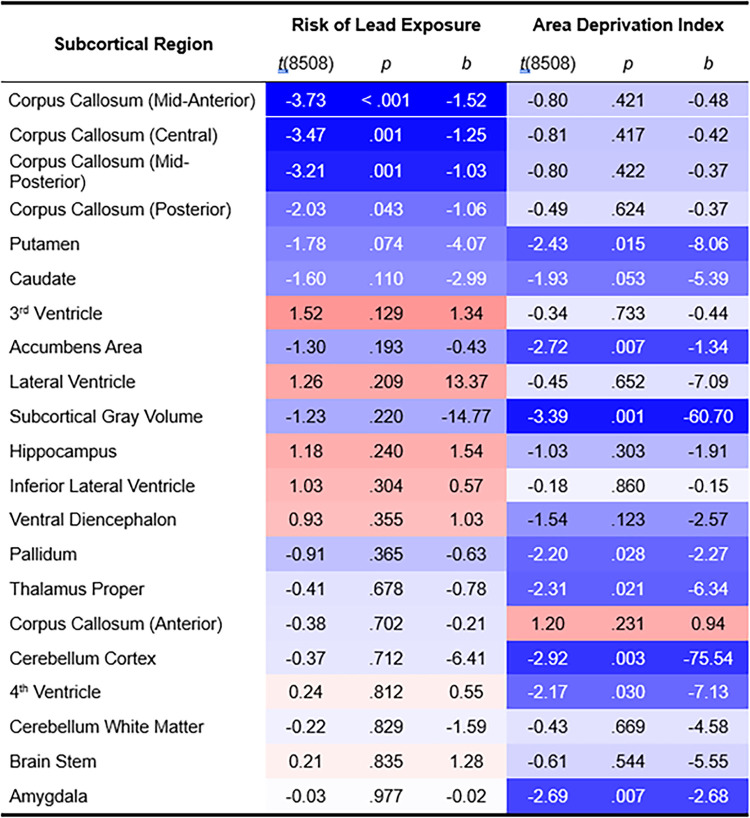
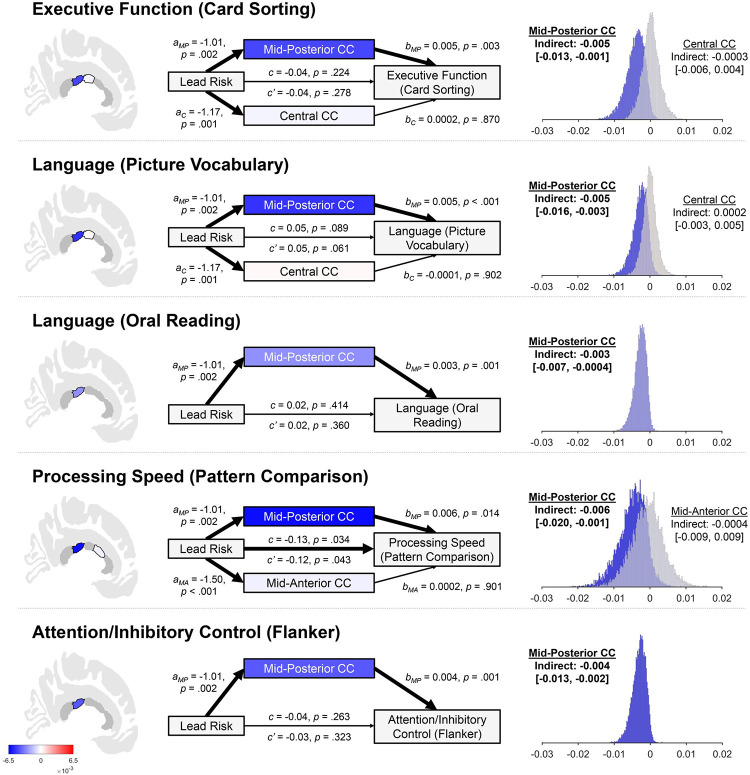
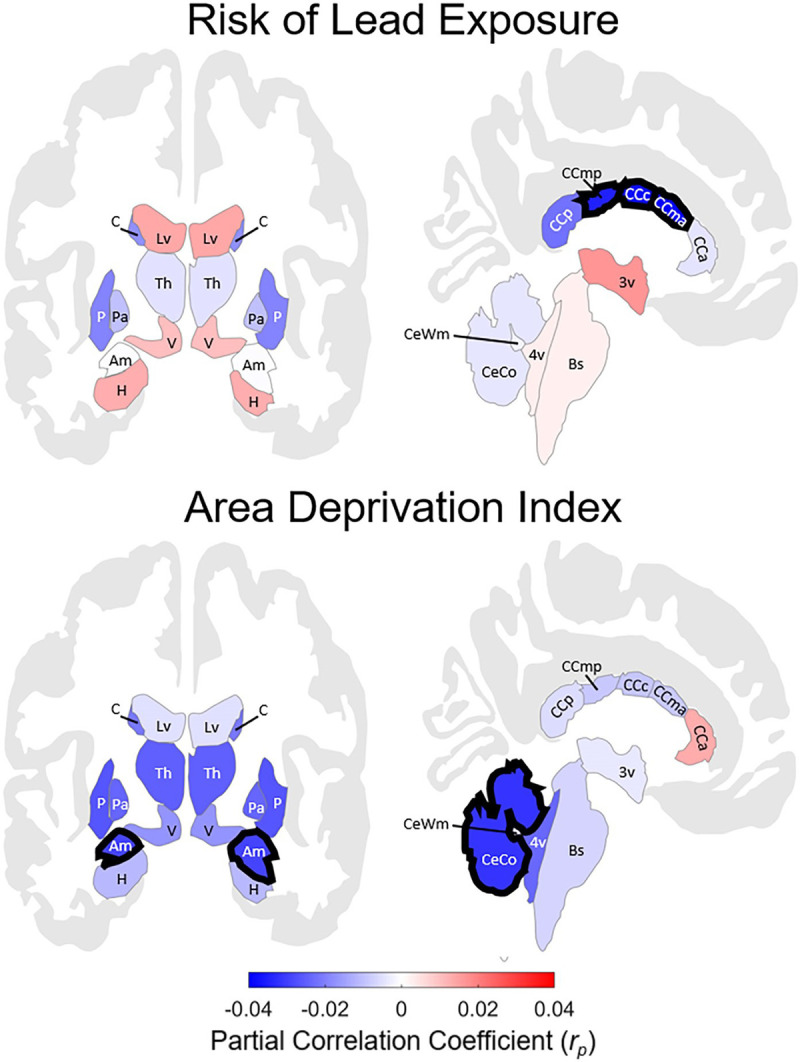
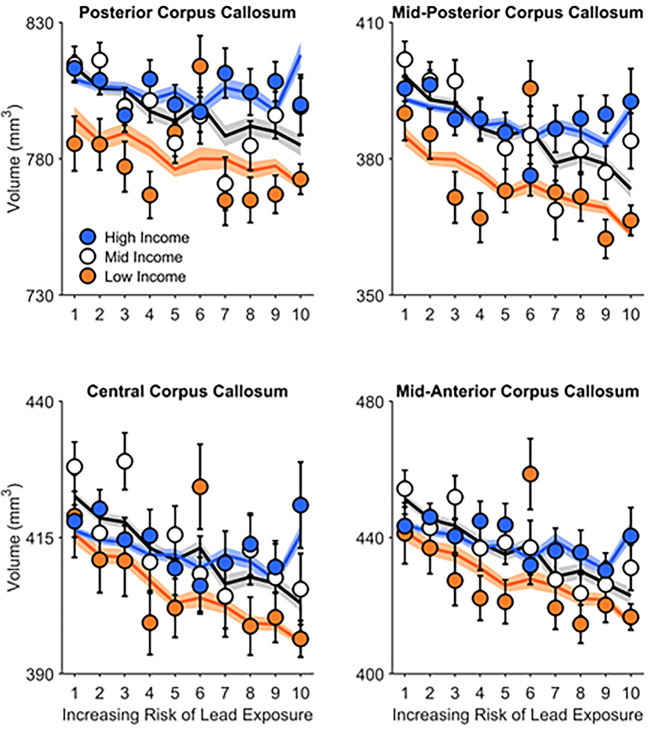
We examined associations of neighborhood-level risk of lead exposure with cognitive test performance and subcortical brain volumes. We also examined whether subcortical structure mediated associations between lead risk and cognitive performance. Our analyses employed a cross-sectional analysis of baseline data from the observational Adolescent Brain Cognitive Development (ABCD) Study. The multi-center ABCD Study used school-based enrollment to recruit a demographically diverse cohort of almost 11,900 9- and 10-year-old children from an initial 22 study sites. The analyzed sample included data from 8,524 typically developing child participants and their parents or caregivers. The primary outcomes and measures were subcortical brain structure, cognitive performance using the National Institutes of Health Toolbox, and geocoded risk of lead exposure. Children who lived in neighborhoods with greater risks of environmental lead exposure exhibited smaller volumes of the mid-anterior (partial correlation coefficient [rp] = -0.040), central (rp = -0.038), and mid-posterior corpus callosum (rp = -0.035). Smaller volumes of these three callosal regions were associated with poorer performance on cognitive tests measuring language and processing speed. The association of lead exposure risk with cognitive performance was partially mediated through callosal volume, particularly the mid-posterior corpus callosum. In contrast, neighborhood-level indicators of disadvantage were not associated with smaller volumes of these brain structures.
Environmental factors related to the risk of lead exposure may be associated with certain aspects of cognitive functioning via diminished subcortical brain structure, including the anterior splenium (i.e., mid-posterior corpus callosum).
铅是一种有毒金属,在儿童体内可检测到的最低浓度下就会影响认知发育,但人们对其对大脑发育的直接影响知之甚少。最近,我们报告了在暴露于铅的风险增加的情况下,皮质表面积和体积普遍减少,主要发生在低收入家庭的儿童中。
我们研究了邻里层面铅暴露风险与认知测试表现和皮质下脑容量之间的关联。我们还研究了皮质下结构是否介导了铅风险与认知表现之间的关联。我们的分析采用了观察性青少年大脑认知发育(ABCD)研究的基线数据的横断面分析。多中心的 ABCD 研究使用基于学校的入学方式从最初的 22 个研究点招募了近 11900 名 9 至 10 岁的具有不同人口统计学特征的儿童。分析样本包括来自 8524 名发育正常的儿童及其父母或照顾者的数据。主要结果和措施是皮质下脑结构、使用国家卫生研究院工具包进行的认知表现以及地理编码的铅暴露风险。生活在环境铅暴露风险较高的社区的儿童表现出较小的中前(部分相关系数[rp] = -0.040)、中央(rp = -0.038)和中后胼胝体(rp = -0.035)体积。这三个胼胝体区域的体积较小与语言和处理速度认知测试表现较差有关。铅暴露风险与认知表现之间的关联部分通过胼胝体体积介导,尤其是后中胼胝体。相比之下,邻里层面的不利指标与这些脑结构的体积减小无关。
与铅暴露风险相关的环境因素可能通过减少皮质下脑结构(包括前连合的后段(即后中胼胝体))与某些认知功能有关。