Bridge Holly, Morjaria Rupal, Peirson Stuart N, Coullon Gaelle S L, Warnaby Catherine E, Pothecary Carina A, Leatherbarrow Brian, Foster Russell G, Downes Susan M
Wellcome Centre for Integrative Neuroimaging, Nuffield Department of Clinical Neurosciences, University of Oxford, John Radcliffe Hospital, Oxford, United Kingdom.
Oxford Eye Hospital, John Radcliffe Hospital, Oxford, United Kingdom.
Front Neurosci. 2021 Sep 28;15:744543. doi: 10.3389/fnins.2021.744543. eCollection 2021.
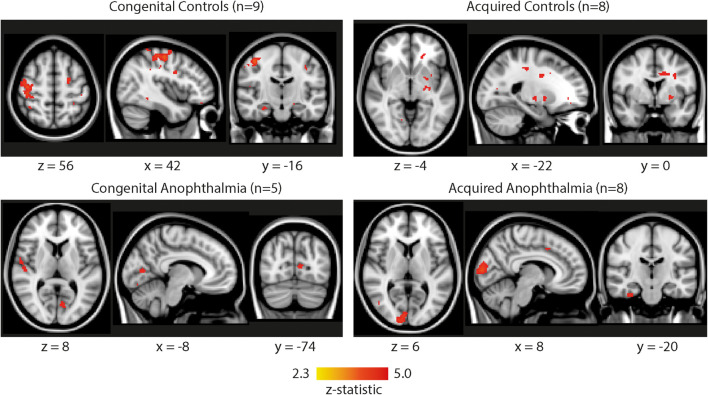
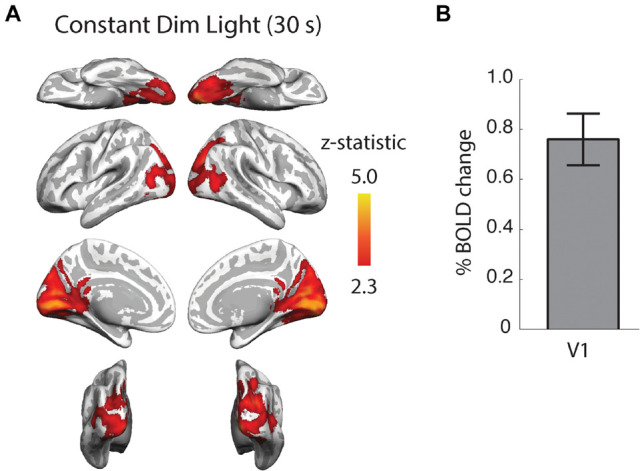
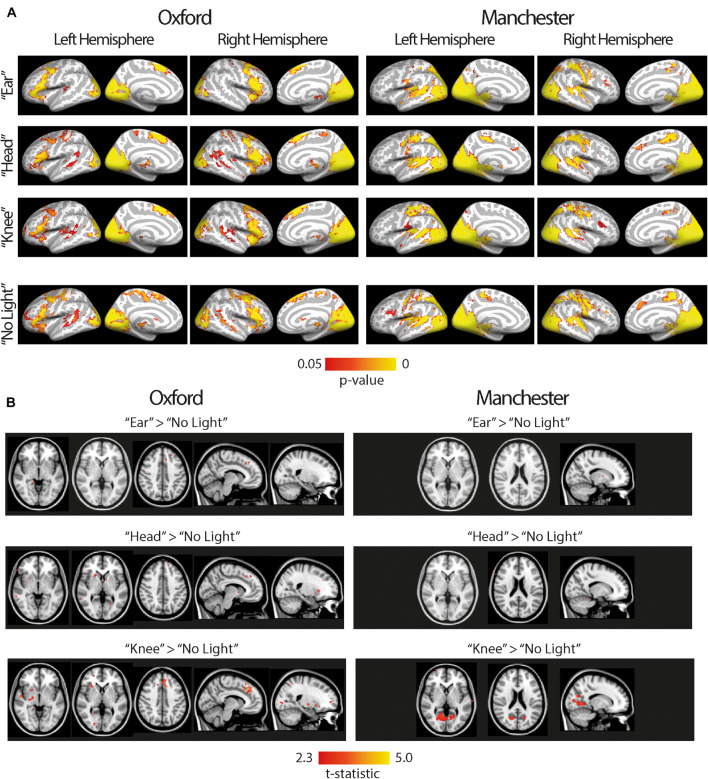
Light plays a critical role in regulating physiology and behavior, including both visual and non-visual responses. In mammals, loss of both eyes abolishes all of these responses, demonstrating that the photoreceptors involved are exclusively ocular. By contrast, many non-mammalian species possess extra-ocular photoreceptors located in the pineal complex and deep brain. Whilst there have been suggestions of extra-ocular photoreception in mammals, including man, evidence for these photoreceptors is limited. One approach to objectively determine the presence of such receptors is to measure brain responses to light using functional magnetic resonance imaging (fMRI). Moreover, by using participants who are clinically anophthalmic (congenital and acquired), it is possible to investigate potential light detection in the absence of the retina. Here we scanned participants with anophthalmia and sighted participants in 4 different conditions; the first 3 conditions had a bright light source applied to the following locations: behind the right ear ("ear"), just below the nasal bridge and between the eyes ("head"), and at the right popliteal fossa ("knee"). In the fourth and final scan, the light source was switched off so that there was no light stimulus. All participants were scanned in a completely dark room. No consistent brain activity was detected during any of the light conditions in either sighted controls or anophthalmic participants. Thus, we do not provide any evidence for the presence of extraocular photoreceptors modulating human brain activity, despite recent evidence for gene transcription that may occur as a result of these photoreceptors.
光在调节生理和行为方面起着关键作用,包括视觉和非视觉反应。在哺乳动物中,双眼失明会消除所有这些反应,这表明所涉及的光感受器仅存在于眼睛中。相比之下,许多非哺乳动物物种在松果体复合体和深部大脑中拥有眼外光感受器。虽然有人提出在包括人类在内的哺乳动物中存在眼外光感受,但这些光感受器的证据有限。一种客观确定此类感受器存在的方法是使用功能磁共振成像(fMRI)测量大脑对光的反应。此外,通过使用临床上无眼症(先天性和后天性)的参与者,有可能在没有视网膜的情况下研究潜在的光检测。在这里,我们在4种不同条件下对无眼症参与者和有视力的参与者进行了扫描;前3种条件下,将明亮光源照射到以下位置:右耳后方(“耳部”)、鼻梁下方两眼之间(“头部”)以及右腘窝(“膝盖”)。在第四次也是最后一次扫描中,关闭光源,以便没有光刺激。所有参与者都在完全黑暗的房间里进行扫描。在有视力的对照组或无眼症参与者的任何光照条件下,均未检测到一致的大脑活动。因此,尽管最近有证据表明这些光感受器可能导致基因转录,但我们没有提供任何证据证明存在调节人类大脑活动的眼外光感受器。