Cell Therapy Center, The University of Jordan, Amman, Jordan.
Department of Clinical Laboratory Science, The University of Jordan, School of Science, Amman, Jordan.
Front Immunol. 2021 Sep 28;12:732549. doi: 10.3389/fimmu.2021.732549. eCollection 2021.
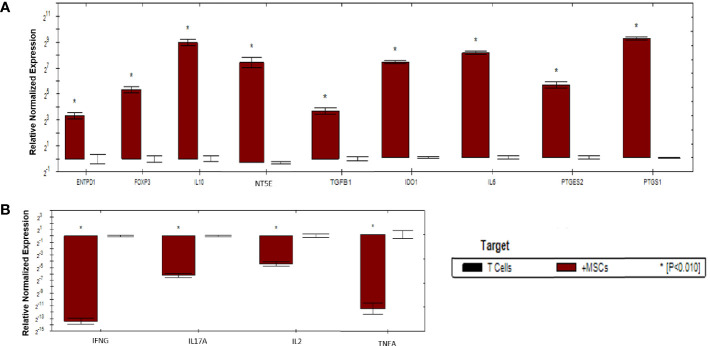
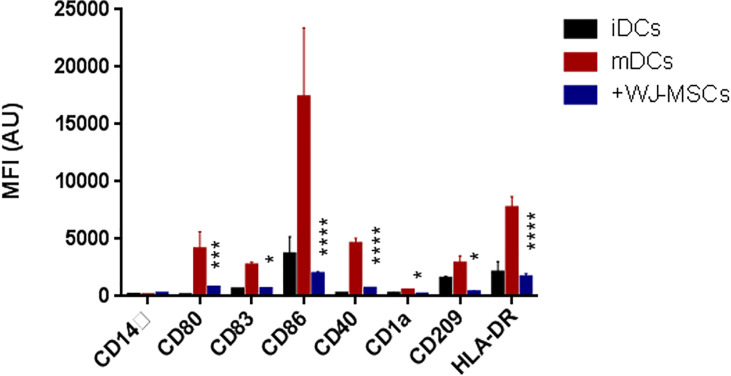
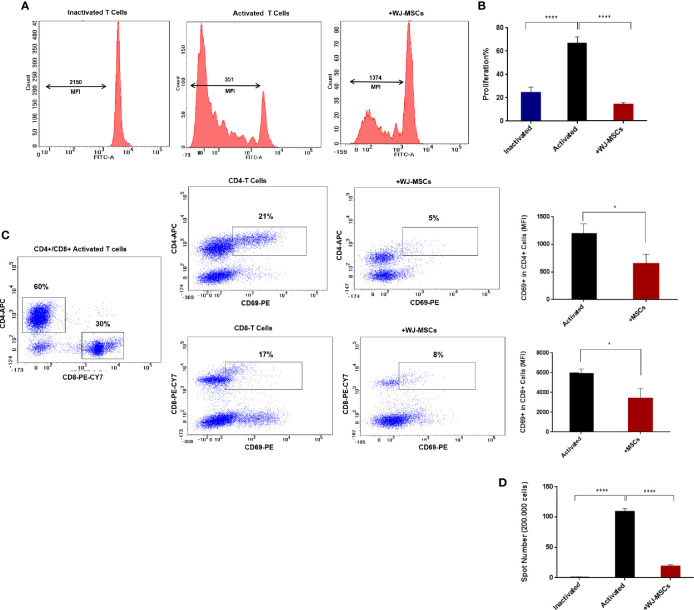
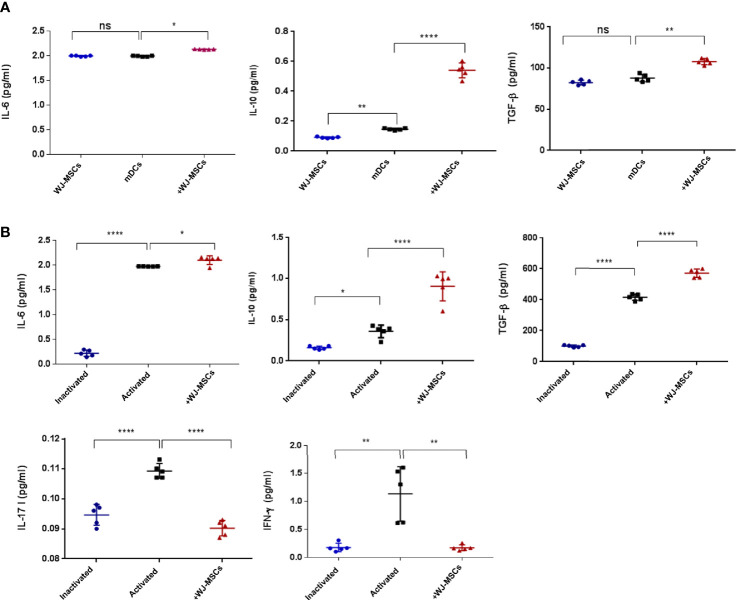
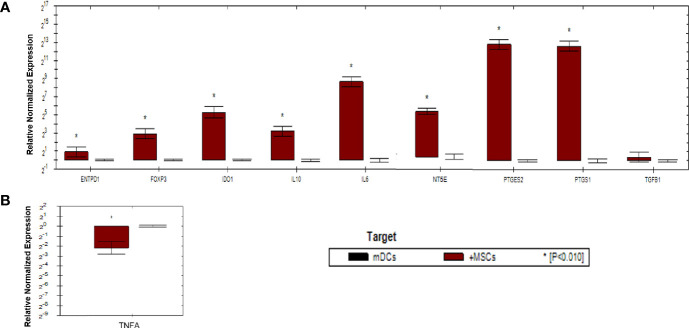
The unique immunomodulation and immunosuppressive potential of Wharton's jelly-derived mesenchymal stromal cells (WJ-MSCs) make them a promising therapeutic approach for autoimmune diseases including type 1 diabetes (T1D). The immunomodulatory effect of MSCs is exerted either by cell-cell contact or by secretome secretion. Cell-cell contact is a critical mechanism by which MSCs regulate immune-responses and generate immune regulatory cells such as tolerogenic dendritic cells (tolDCs) and regulatory T cell (Tregs). In this study, we primed WJ-MSCs with TNF-α and IFN-γ and investigated the immunomodulatory properties of primed WJ-MSCs on mature dendritic cells (mDCs) and activated T cells differentiated from mononuclear cells (MNCs) of T1D patient's. Our findings revealed that primed WJ-MSCs impaired the antigen-mediated immunity, upregulated immune-tolerance genes and downregulated immune-response genes. We also found an increase in the production of anti-inflammatory cytokines and suppression of the production of pro-inflammatory cytokines. Significant upregulation of and augmented an immunosuppressive effect on adaptive T cell immunity which represented a strong evidence in support of the formation of Tregs. Furthermore, upregulation of many critical genes involved in the immune-tolerance mechanism ( and was detected. Interestingly, upregulation of genes express a strong evidence to switch immunostimulatory response toward immunoregulatory response. We conclude that WJ-MSCs primed by TNF-α and IFN-γ may represent a promising tool to treat the autoimmune disorders and can provide a new evidence to consider MSCs- based therapeutic approach for the treatment of TID.
牙髓基质干细胞(WJ-MSCs)具有独特的免疫调节和免疫抑制潜能,使其成为治疗包括 1 型糖尿病(T1D)在内的自身免疫性疾病的有前途的治疗方法。MSC 的免疫调节作用是通过细胞-细胞接触或分泌组分泌来发挥的。细胞-细胞接触是 MSC 调节免疫反应并产生免疫调节细胞(如耐受树突状细胞(tolDCs)和调节性 T 细胞(Tregs))的关键机制。在这项研究中,我们用 TNF-α和 IFN-γ 预刺激 WJ-MSCs,并研究了预刺激的 WJ-MSCs 对来自 T1D 患者单核细胞(MNCs)分化的成熟树突状细胞(mDCs)和活化 T 细胞的免疫调节特性。我们的研究结果表明,预刺激的 WJ-MSCs 损害了抗原介导的免疫反应,上调了免疫耐受基因,下调了免疫反应基因。我们还发现抗炎细胞因子的产生增加,促炎细胞因子的产生受到抑制。和 的显著上调增强了对适应性 T 细胞免疫的抑制作用,这为 Tregs 的形成提供了强有力的证据。此外,还检测到许多参与免疫耐受机制的关键基因(和 上调。有趣的是,上调 基因表达强烈证据表明免疫刺激反应向免疫调节反应转变。我们得出结论,用 TNF-α和 IFN-γ 预刺激的 WJ-MSCs 可能代表治疗自身免疫性疾病的有前途的工具,并为考虑基于 MSC 的治疗方法治疗 TID 提供新的证据。